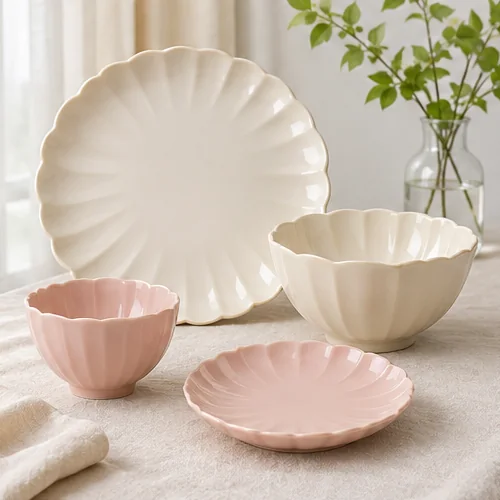
A catalogue 16-piece set is someone else’s idea of a table. If your customers eat from a 27 cm plate, use bowls for pasta rather than cereal, or never drink from a mug at dinner, you can build the set around them instead: choose each piece, the count per person, the glaze and the box. Most of the cost and freight of a set is decided by that piece list, so it is worth writing carefully.
Here is how we build a custom set, step by step, with the sizes and weights of the pieces it can be made from, three worked examples, and what to check before you sign off.
Step 1: start from pieces that already exist
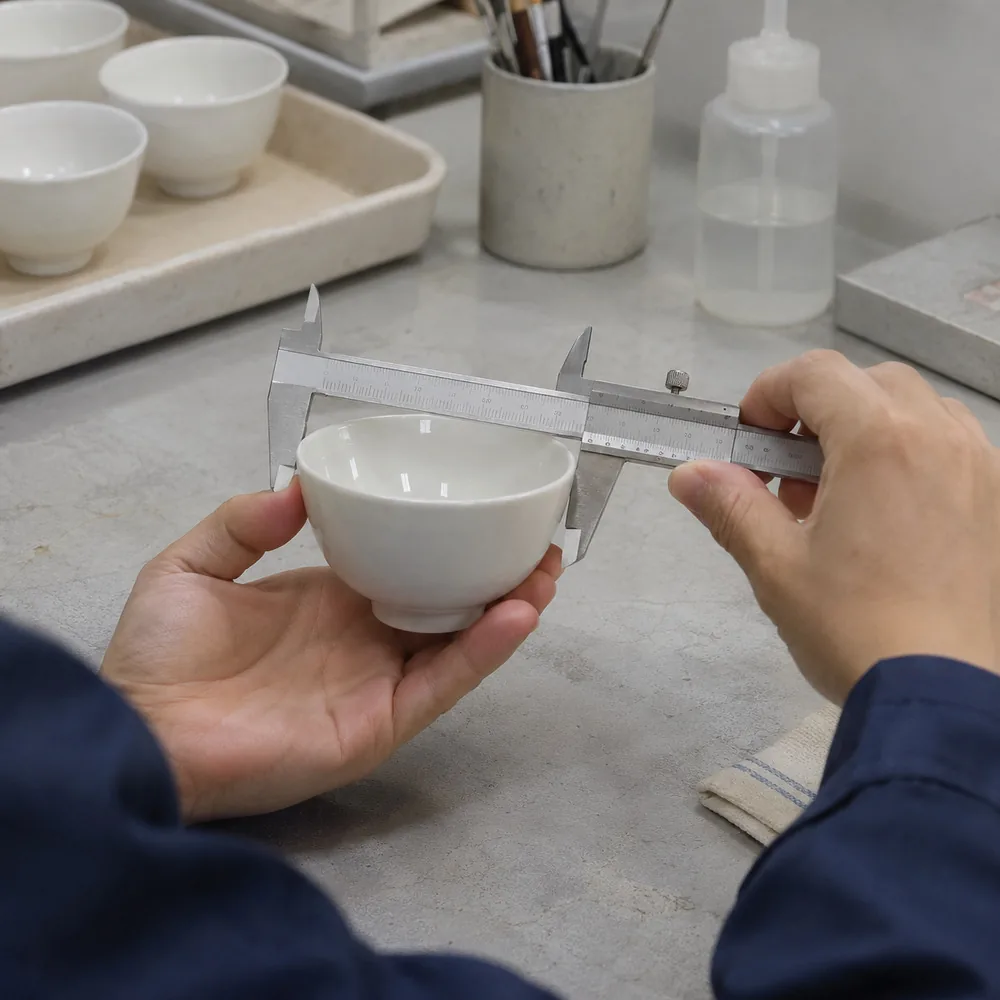
Every piece that comes from an existing shape keeps its mold, so it adds no tooling and no mold lead time. We hold 3,800 molds across 12 shape families; these are the plates and bowls our sets are usually built from.
Plates
| Piece | Size | Weight | Typical role in a set |
|---|---|---|---|
| PL-18 | Ø18 cm | 340 g | Bread or side plate |
| PL-21 | Ø21 cm | 460 g | Salad, dessert or side plate |
| PL-23 | Ø23 cm | 550 g | Main plate in European and Asian sets |
| PL-27 | Ø27 cm | 760 g | US dinner plate, or a serving plate |
| PL-30 | Ø30 cm | 920 g | Charger or platter |
Bowls
| Piece | Size | Weight | Typical role in a set |
|---|---|---|---|
| BW-11 | 11.5 cm, 350 ml | 210 g | Rice, dessert, small portions |
| BW-13 | 13 cm, 500 ml | 280 g | Cereal or soup |
| BW-15 | 15 cm, 750 ml | 380 g | Soup, salad, larger cereal bowl |
| BW-18 | 18 cm, 1,100 ml | 520 g | Pasta, noodles, serving |
Mugs and cups
Mugs come from our BM range, 250 to 500 ml, and cups and saucers from our CF range, 180 to 300 ml. If one piece needs to be new, for example a pasta plate with a deep well, only that shape needs a mold. The rest of the set stays on stock shapes.
Step 2: build the list around how your customers eat
Decide the main plate first, because it sets the size of everything else, the size of the box and the number of sets in a container. Our guide to dinnerware set sizes explains why US buyers usually expect a 27 cm dinner plate where many European ranges use 23 cm. Then add pieces in the order people use them: side plate, bowl, mug or cup, serving pieces.
Example 1: a US retail set for four
| Per person | Piece | Weight |
|---|---|---|
| Dinner plate | PL-27 | 760 g |
| Side plate | PL-21 | 460 g |
| Bowl | BW-15, 750 ml | 380 g |
| Mug | BM-350, 350 ml | 320 g |
| Per person | 4 pieces | 1,920 g |
| Set of 4 | 16 pieces | 7,680 g |
That is heavier than our standard DS-16 at 6,850 g, which uses 20 and 23 cm plates and 300 ml mugs. Bigger plates and bowls add weight and carton volume quickly, and a set that is nearly a kilogram heavier costs more to ship and is harder for a shopper to carry home.
Example 2: a European set for six, without mugs
| Per person | Piece | Weight |
|---|---|---|
| Main plate | PL-23 | 550 g |
| Side plate | PL-18 | 340 g |
| Bowl | BW-13, 500 ml | 280 g |
| Per person | 3 pieces | 1,170 g |
| Set of 6 | 18 pieces | 7,020 g |
Six place settings weigh less than the four-person US set above, because there are no mugs and the plates are smaller. For comparison, our standard DS-24, a six-person set with mugs, weighs 9,200 g.
Example 3: a bowl-led set for four
| Per person | Piece | Weight |
|---|---|---|
| Dinner plate | PL-27 | 760 g |
| Pasta or noodle bowl | BW-18, 1,100 ml | 520 g |
| Small bowl | BW-11, 350 ml | 210 g |
| Per person | 3 pieces | 1,490 g |
| Set of 4 | 12 pieces | 5,960 g |
This suits ranges built around pasta, noodles or rice, where a side plate is rarely used.
Step 3: decide whether the mug belongs in the box
Mugs take a lot of space in a set carton, because they do not nest with plates and bowls. In our standard sets, leaving them out lets 81% more place settings into a 40HQ. If your customers buy mugs separately anyway, a set without them may sell at a better price per place setting, and the mug can become its own SKU. The container loading guide has the per-model figures.
When to keep the mug
Keep it when the set is a gift, a starter set for a first home, or a price-point set where the shopper expects “everything in one box”. In those cases, the box is the product.
When to drop it
Drop it when the range is sold open-stock as well, when the mugs come in several colours, or when freight per set matters more than the headline piece count.
Step 4: one glaze across every piece
A set is judged on the table, side by side, so colour has to match across plates, bowls and mugs made on different forming lines and fired in different kiln positions.
How we hold it
We hold ΔE 1.5 within a batch and 2.0 between batches, measured on an X-Rite Ci7800 under D65 light. Glaze goes on 0.25–0.35 mm thick by robot, and each tunnel kiln logs its temperature curve through nine thermocouples. Our guide to glaze colour matching explains why each piece type needs its own fired sample.
Decoration across the set
Decoration follows the same rule as any tableware: underglaze or in-glaze on surfaces that touch food, decals on outer walls only. If the pattern sits on the plate rim and the outside of the bowl, approve it on both shapes, because a pattern that fits a 27 cm rim may need resizing for a 21 cm one.
Step 5: pack it as a set, not as loose pieces
A set carton holds different shapes that must not touch each other.
The shipping carton
Ours are five-ply corrugated with corrugated dividers between pieces, and each new set carton is drop-tested from 1.2 m to ISTA 1A and 3A before the set is approved. Our 2025 transit breakage was 0.21%.
The retail box
For retail, the set can go into a printed colour box, on FSC-certified board if needed, or into a gift box with a magnetic lid and an EVA insert. Cartons and boxes carry only your brand, and barcodes and country-of-origin marks follow the rules of the destination market.
Check the box like a shopper
Open the sample box the way a customer will. Each piece should have its own place, plates should not touch directly, and the lid should close again without force.
How a retail set programme runs over a year
A set is rarely a single order. For a retailer it is a programme, delivered in batches, and the set has to look the same in the last delivery as in the first.
A German discount retailer’s sets
One of our longest set programmes is for a German discount supermarket’s own label: 16-piece and 20-piece sets, about 3.4 million pieces a year, delivered in 12 batches across the year. The glaze recipe is locked to that customer, so every batch is made from the same formula, and colour is measured against the approved standard each time.
What that means for your set
Plan the set as a programme from the start. Agree the delivery schedule with the first order, lock the glaze recipe if you will reorder, and keep a signed reference set at both ends. Our guide to private label ceramics covers how a retail programme is run from audit to delivery plan.
Market details that change the set
| Market | What usually changes |
|---|---|
| United States | A 27 cm dinner plate is expected; food-contact reports to FDA guidance (ASTM C738), and Prop 65 for California |
| European Union | 23 cm main plates are common; a Declaration of Conformity under Regulation (EC) No 1935/2004 travels with each shipment |
| Canada | Lead and cadmium reports under SOR/2016-175 |
| Japan | Smaller bowls and plates are common; every SKU tested under the Food Sanitation Act |
Barcodes, country-of-origin marks and any language on the box follow the rules of the destination market, and the box carries only your brand.
When the set is for a hotel or restaurant
A hotel does not buy sets in boxes. It buys a piece list per cover and replaces pieces one by one for years, so the questions change.
Order by shape, not by set
Hotel and restaurant projects start at 200 pieces per shape, in 30–40 working days, and each shape is reordered on its own as pieces break. Build the list per cover, then multiply by covers and add a breakage reserve for the first months of service.
Choose for the dishwasher and the stack
Commercial service needs strengthened porcelain, which we make to 120 MPa or more in bending strength, a glaze of 6 Mohs or harder, and shapes that stack level: we hold plate warp to 1.2 mm or less and rims to ±1.5 mm. Nine of our hotel shapes are tested for 1,000 commercial dishwasher cycles under EN 12875. Our guide to hotel and restaurant dinnerware covers the full specification.
Keep the decoration where the machine cannot reach it
A logo or rim band for service ware should be underglaze, in-glaze or laser-marked. Decals and gold lines wear in a commercial machine; keep them for front-of-house pieces that are washed by hand.
Step 6: approve it in the right order
Approving in the wrong order is the usual cause of delays on a custom set.
- Piece list and sizes, with the set weight and container count we calculate from them.
- Glaze and decoration, on fired samples of each piece type.
- The set as a whole, side by side under daylight.
- The box and the carton, including the drop test.
- Test reports for your market, covering the glaze and every decoration. Our guide to food-contact testing by country lists what each market needs.
Minimums and timing for a custom set
| What you order | Minimum | Lead time |
|---|---|---|
| Set from stock shapes, our glaze, in a gift box | 1,000 sets | Quoted per project |
| Stock shapes in your glaze or with your decal | 1,000 pcs per piece type | 30–40 working days |
| A set that includes a new shape | 3,000 pcs of the new shape | 45–55 working days |
| Full private-label programme | 5,000 pcs per SKU | 50–65 working days, first order |
Lead times run from deposit and signed artwork. July to October adds 7–10 days. Our guide to dinnerware MOQs explains why each change moves the minimum, and the guide to private label ceramics covers what a full retail programme involves.
Send us your piece list
Send the pieces, the count per person, the market and the quantity through the custom dinnerware page. We will return the set weight, the carton size and the container count before you approve a sample, so the freight is known before the price is fixed.