
Suppliers · MOQ · Testing · Inspection
Sourcing Ceramic Dinnerware from China: Suppliers, MOQ and Quality Control
These guides cover the part of an order that happens before production: deciding who actually makes your dinnerware, what the minimum really is for what you want, which test reports your market needs, and how the goods are checked before they leave.
1 core guide4 articles4 product ranges
Start from where your order is
Find the line that matches where your order is now.
| Where you are | What to settle | Read |
|---|---|---|
| You have three quotes and they look alike | Whether all three quote the same body, glaze, decoration and packing | How to source dinnerware |
| You are not sure the supplier owns its kilns | Kiln list, forming lines, audits issued in its own name | Supplier audit checklist |
| The MOQ is higher than your first order | Which change sets the minimum, and whether it can be shared | MOQ explained |
| You sell into the US, EU, Canada or Japan | A lead and cadmium report for your SKU, to your market's method | Food-contact testing |
| Goods are ready and you must approve shipment | AQL level, sample size and written defect limits | Pre-shipment inspection |
| Your retail customer asks for factory evidence | Energy, water and carbon records a factory can show | Factory |
Start with the core guide
Each core guide sets out the whole decision and links to the shorter articles that settle one detail each.
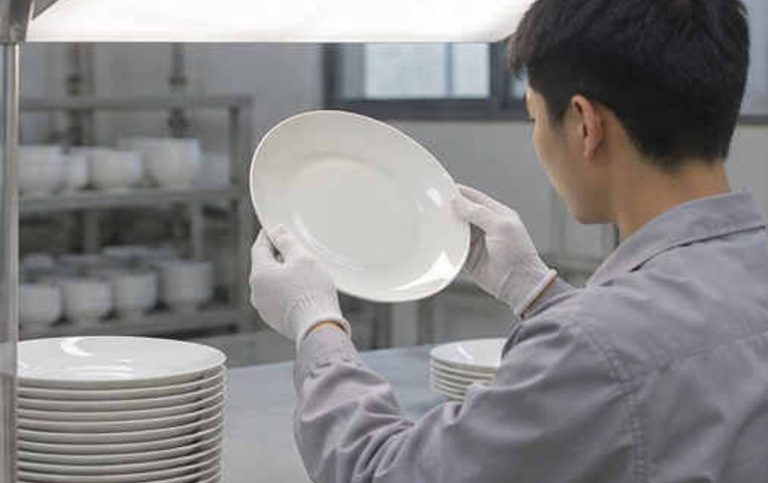
All Sourcing & Quality Control articles
Newest first. New articles in this topic are added here as they are published.
- Pre-Shipment Inspection for Ceramic Dinnerware: What AQL 2.5 Really AcceptsWhat AQL 2.5 and 4.0 accept on a dinnerware order, the sample sizes, the defect limits to write down, and a pre-shipment…
- Dinnerware MOQ Explained, From 48 Pieces to 5,000 per SKUWhy ceramic MOQs run from 48 pieces to 5,000 per SKU, what each change adds on the line, and six ways to…
- Food-Contact Testing for Ceramic Dinnerware, Market by MarketThe lead and cadmium rules for ceramic dinnerware in the US, California, Canada, the EU and Japan, and six checks for reading…
- Ceramic Supplier Audit Checklist for Dinnerware BuyersFive groups of checks to run on a ceramics supplier before the first order, with what to ask for and what a…
The order of decisions
A first import goes wrong most often at the start, not in the kiln. The buyer compares unit prices from three suppliers before checking whether all three quoted the same thing, and before asking who fires the ware. Our sourcing guide follows the order we would use ourselves: confirm the factory, fix the specification, set the minimum by what changes, get the test report for your market, approve a sample, then agree how the goods are inspected.
- Factory or trader. Ask for the kiln list, the forming lines and the audit reports in the factory's own name. The supplier audit checklist sets out five groups of checks and what a good answer looks like.
- Minimum order. There is no single MOQ. It moves from 48 pieces to 5,000 per SKU depending on what you change; see MOQ explained.
- Test reports. An ISO 9001 certificate does not show that a plate passes a lead and cadmium test in California. Ask for a report that names the SKU, the lab and the date; food-contact testing by market lists what each market tests.
- Inspection. Agree the AQL level and the defect limits in writing before production. Pre-shipment inspection explains what AQL 2.5 accepts.
What sourcing from Jingdezhen looks like from the factory side
Jingdezhen has made porcelain for more than a thousand years, and the city still holds both kinds of supplier a buyer will meet: thousands of small workshops and studios, and a smaller number of factories with their own kilns and lines. Trading companies sit between the two and are often the first to answer an enquiry. None of this is a problem in itself. It becomes one when a buyer believes the photo of a tunnel kiln means the order will be fired in it.
The audits retail buyers send us are a good map of what matters. In the last three years our factory has been through amfori BSCI, Sedex SMETA, Walmart FCCA, Target, Costco, Disney ILS and IKEA IWAY 6.0 audits. They overlap on labour and safety, but each retailer adds its own questions: one wants to see the kiln temperature log for a batch, another wants proof that a retained sample from that batch is kept for three years. A supplier that can answer those questions for a retailer can answer them for you.
The small details decide more than the big ones. Ask who signs the sample, and where the signed one is kept. Ask whether the 1,000 piece minimum for a new colour can be shared across two models (with us it can). Ask what happens to the order if inspection finds pinholes on the food-contact surface; our limit is two per piece, 0.5 mm or smaller, and none where food sits. Those three answers tell you more about a supplier than its brochure.
Minimum orders and lead times we work to
These are the figures every guide in this topic refers back to. Lead times are counted from deposit and approved artwork.
| Order type | Minimum order | Lead time |
|---|---|---|
| Mixed stock | 48 pcs | 7–10 days |
| Stock, one model | 500 pcs | 7–10 days |
| Standard model on an existing mold | 500 pcs | 25–30 days |
| New colour or glaze | 1,000 pcs | 30–35 days |
| Custom decal, one colour | 1,000 pcs | 35–40 days |
| Custom decal, several colours or gold | 1,500 pcs | 35–40 days |
| New mold | 3,000 pcs | 45–55 days |
| Private-label programme | 5,000 pcs per SKU | 50–65 days for the first order |
| Hotel and project orders | 200 pcs per shape | 30–40 days |
| Gift box sets | 1,000 sets | Box design in 5 days, then with the order |
Lead times are working days from deposit and approved artwork. July to October is our peak season and adds 7–10 days.
What we check, and the limits
A buyer's inspection is a sample. Ours runs on every batch, at three stages, and the limits below are the ones written into our order confirmations. Asking a supplier for its own table like this one is a quick test of whether it controls its own production.
| Defect | Accept only if |
|---|---|
| Pinholes | ≤0.5 mm across, no more than 2 per piece, and not on a food-contact surface |
| Kiln grit | ≤0.8 mm across, no more than 1 per piece |
| Orange peel | Not obvious at 30 cm under 500 lux |
| Colour | ΔE ≤1.5 within a batch, ≤2.0 between batches |
| Warp | Rim ovality ≤1.5%; plates warp ≤1.2 mm |
| Rim size | ±1.5 mm |
| Lead and cadmium | Internal limit at 50% of the legal limit |
| Gold line | Continuous, no gaps or burrs; 50 rubs without wearing through |
Read next: Quality control · Pre-shipment inspection
Where these orders usually go wrong
Comparing unit prices before specifications
Two plates at different prices are often two different plates: thinner body, thinner glaze, decal instead of underglaze. Fix the specification first and ask each supplier to quote it.
Accepting a certificate instead of a report
A certificate shows a system; a report shows a result for a SKU. If only a certificate arrives, assume the report does not exist yet.
Leaving defect limits to the inspector
Pinhole size, warp and colour difference should be written into the order. Otherwise the inspection argues about taste.
Approving one sample for many SKUs
Each glaze and decoration needs its own approved sample, signed and kept by both sides.
What to send with your enquiry
With these details we can answer in one reply instead of three. A first reply comes within 24 hours on working days.
Send these details- Model numbers or drawings, with capacity in ml
- Quantity per model and colour
- Destination market, for the test report
- Audit standard your customer requires (BSCI, FCCA, IWAY or other)
- AQL level, if you have one
- Who inspects: you, a third party, or our QC report
Products these guides apply to

Related pages
New in other topics
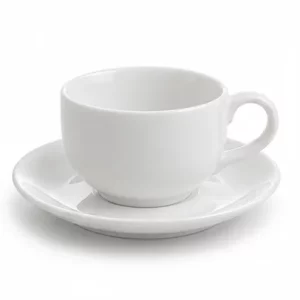 Dinnerware, Mugs & Cups · 23 Nov 2026Branded Coffee Cups for a Café: Logo, Minimums and Reorders
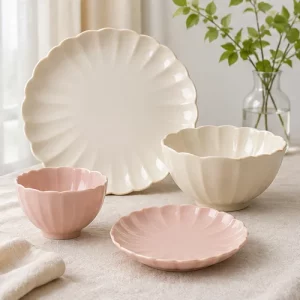 Dinnerware, Mugs & Cups · 20 Nov 2026Building a Custom Dinnerware Set From Your Own Piece List
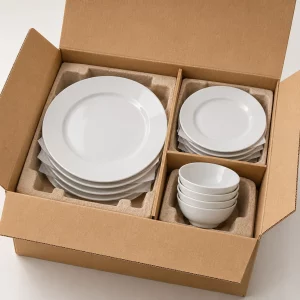 Shipping & Import · 17 Nov 2026Broken Ceramics on Arrival: How to Make a Claim That Gets Paid
 Tea Ware · 15 Nov 2026Gaiwan vs Teapot: Which to Stock, Brew With and Gift
Sourcing & Quality Control: questions buyers ask
How do I tell a ceramics factory from a trading company?
Ask for the kiln list with lengths and firing ranges, a production schedule naming the line, and audit reports issued to that company. A trader can forward photos; it cannot book your order onto a named kiln. Our kilns are listed on the factory page.
Is an ISO 9001 certificate enough to show dinnerware is safe?
No. ISO 9001 describes a management system. Food safety is shown by a lead and cadmium release test report that names the SKU, the method for your market, the lab and the date.
What AQL should I specify for dinnerware?
AQL 2.5 for major defects and 4.0 for minor is our default, with 1.5 on request. Write the defect limits, such as pinhole size and warp, into the order so both sides inspect to the same rule.
Can I order fewer than the MOQ?
Mixed stock starts at 48 pieces across models, and one stock model at 500. Once your own colour or decal is involved the minimum is 1,000 pieces, and that 1,000 can be shared across models and colours in the same order.
Other topics
Have a specific order in mind?
Send the shape, quantity and market. We reply within 24 hours on working days and send a written quotation within 48.