Underglaze decoration sits under a layer of glass. Overglaze decoration sits on top of it. That one difference decides how long a logo lasts in a dishwasher, whether it can touch food, and what colours you can have.
Underglaze is the most durable but has the narrowest palette. Overglaze, usually a fired decal, gives you any colour and photographic detail, but it is exposed to cutlery, scourers and detergent. In-glaze sits between the two. Here is how each one is made in our factory in Jingdezhen, and where we use it.
Five ways to decorate porcelain, compared
| Method | Where the colour sits | Durability | Colours and detail | Food-contact surfaces |
|---|---|---|---|---|
| Underglaze | On the raw body, sealed under clear glaze | Highest: the glaze protects it | Limited palette; cobalt blue is the classic | Yes |
| In-glaze | Sinks into the glaze during a high-temperature firing | Very high; dishwasher safe | Wider palette than underglaze, softer edges | Yes |
| Overglaze decal | Printed transfer fired onto the glaze surface | Good on outer walls; wears with abrasion | Any colour, fine detail, photographs | No, outer surfaces only |
| Gold line | Real gold fired onto the glaze | Survives our 50-rub test; wears faster than glaze | Gold lines and accents | No, and never microwave safe |
| Laser marking | Engraved into the glaze surface | Permanent, cannot wash off | One tone; fine text, serial numbers | Outer surfaces only |
On every surface that touches food or a mouth, we use underglaze or in-glaze only. That covers the inside of a mug or bowl, the eating surface of a plate and the lip of a cup.
Underglaze: the blue-and-white method
Underglaze is how Jingdezhen has made blue and white porcelain since the 14th century. The colour is painted or printed onto the unglazed body, the piece is dipped or sprayed with clear glaze, and the whole thing is fired at full porcelain temperature, 1,260–1,320 °C in our tunnel kilns. The colour ends up under a layer of glass.
That is why a 600-year-old blue and white bowl still looks fresh, and why an underglaze logo on a hotel plate survives commercial washing. Nothing in the dishwasher reaches it without first wearing through the glaze.
The limit is colour. Only pigments that survive full firing temperature can go under the glaze. Cobalt blue does this best, and a range of other oxides work, but bright reds, fine gradients and photographic detail generally do not.
We hold a Chinese invention patent for an underglaze decoration process designed for low lead and cadmium release (ZL 2023 1 0822016.8), and we check lead and cadmium release on our own Agilent 7900 ICP-MS, held to half the legal limit.
How underglaze is applied
Underglaze colour goes onto the piece after its first, lower firing. The body is first bisque-fired at 800–900 °C, which hardens it enough to handle and drives out water and organic matter. The colour is then painted, printed or transferred onto the bisque surface, the piece is glazed over it, and the whole thing is fired at 1,260–1,320 °C. The glaze melts into glass over the colour, and from then on nothing can reach the decoration without going through the glaze.
Hand-painted or printed?
Both are underglaze. Hand painting gives the brush marks and variation that collectors value, and it is slower and more expensive per piece. A printed or transferred underglaze pattern repeats exactly from piece to piece, which is what a retail or hotel range needs. For a logo, it is almost always the printed route, with a plate made once and its fee refunded on orders from 2,000 pieces.
What underglaze cannot do well
Fine gradients, photographic images and some bright colours, especially strong reds and yellows, are hard or impossible to hold at full firing temperature. Fine lines can also soften slightly as the glaze flows over them. If your design depends on any of these, look at in-glaze or a decal instead, and keep underglaze for the parts that have to last.
In-glaze: colour that sinks into the glass
In-glaze decoration is applied on top of the fired glaze and then fired again at high temperature, hot enough that the glaze softens and the colour sinks into it. Once cool, the colour is inside the glass surface, not on it.
You get a wider palette than underglaze and very good durability, which makes in-glaze our usual choice for full-colour logos on food-contact surfaces. A new decoration needs its own lead and cadmium report; our market-by-market testing guide explains why. Edges are a little softer than a decal, because the colour moves slightly as it sinks.
Where we use in-glaze
In-glaze is our first choice for logos and coloured bands on hotel, restaurant and café ware: plates, cups and saucers that go through a commercial dishwasher several times a day. It holds up there almost as well as underglaze and offers more colours. It is also the method for colour on rims and lips, where an overglaze decal would sit exactly where the mouth touches.
Overglaze decals: any colour, on the outside
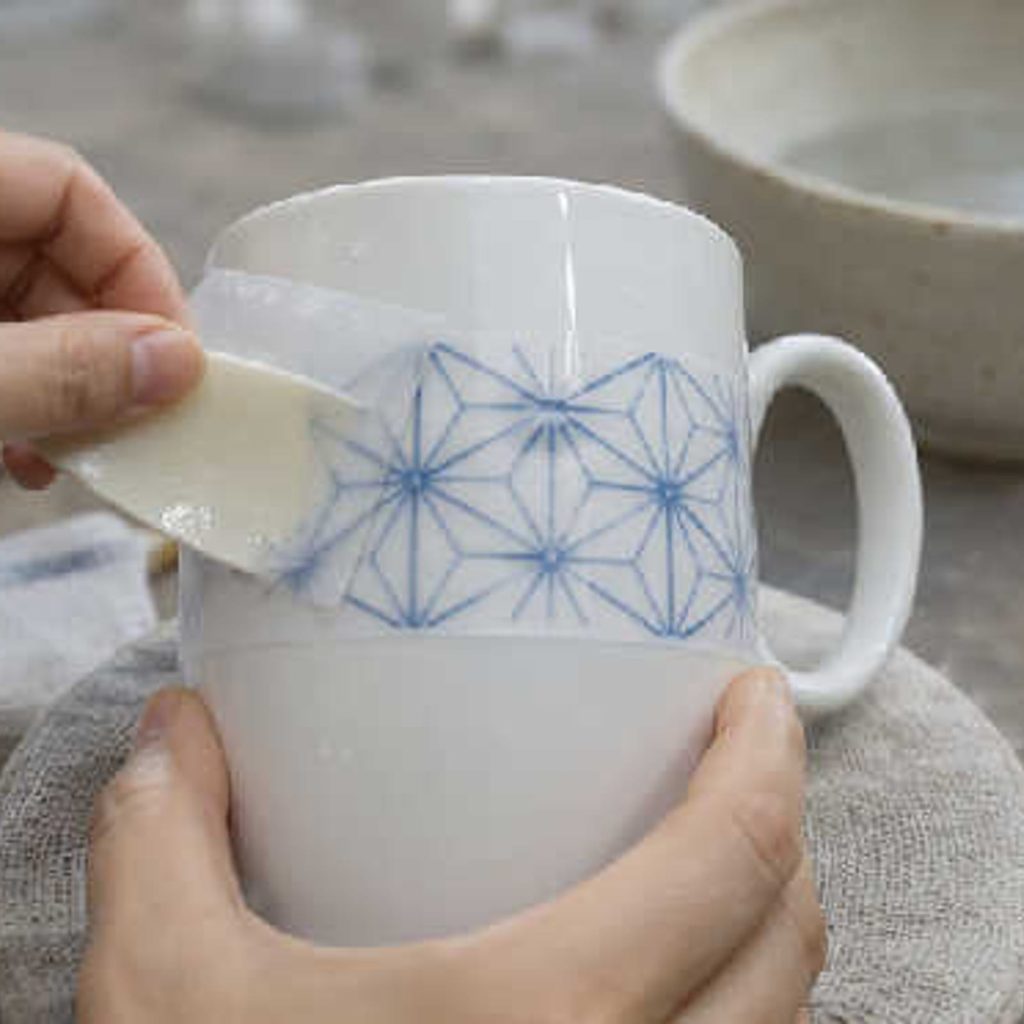
A decal is a printed transfer, rather like a water-slide sticker made of ceramic pigment. It is laid onto the glazed piece and fired at a lower temperature in a decal kiln, so the colour fuses to the surface of the glaze. We run six automatic decal machines and three decal kilns for this.
Decals can carry any Pantone colour, fine type, gradients and photographs. They are the right choice for detailed artwork on the outer wall of a mug, the rim band of a plate or the side of a bottle.
What they cannot do is resist abrasion as well as underglaze. A decal sits on the surface, so a scourer, a dishwasher tablet and years of cutlery wear on it directly. That is why we keep decals off eating surfaces and lips, and why a promotional mug printed with cheap decals often looks worn within months.
Each decal colour needs its own printing plate, which is why a one-colour decal starts at 1,000 pcs and a multi-colour or gold decal at 1,500.
How a decal is made and applied
The design is separated into colours, and each colour gets its own printing plate, made in 5–7 days, so every extra colour adds a plate. The decal is printed onto transfer paper, soaked, slid onto the glazed piece and smoothed by hand or by one of our six automatic decal machines. The piece is then fired again in one of our three roller decorating kilns at 780–850 °C, which fuses the decal onto the glaze surface.
How many colours, and what it costs
Every extra colour is another plate and another pass. That is why a one-colour decal starts at 1,000 pieces and a multi-colour or gold decal at 1,500. A full-colour photographic image can be printed as a decal, but it costs more in plates than a two-colour logo, so it is worth asking whether the design needs every colour it has.
Position on the piece
Decals are placed by hand or by machine, and placement varies slightly from piece to piece. Agree a position tolerance with the supplier before production, measured from a fixed point such as the handle or the rim, and put it in the inspection criteria.
Gold lines and laser marking
Gold is real gold fired onto the glaze, applied on our two gold-line production lines. It looks right on a fine-dining plate or a VIP lounge cup, and we test it with a 50-rub test: the line must stay continuous with no base showing. Gold has two rules that never change: it is never microwave safe, and it wears faster than the glaze around it. Our guide to hotel and restaurant dinnerware covers how to specify it for commercial use.
Laser marking engraves the mark into the glaze surface with one of our four laser markers. It is permanent and needs no extra firing, which makes it ideal for fine text, serial numbers and minimal logos. It gives one tone only.
What we check on gold
Every gold design is rubbed 50 times in our quality check, and the gold must not wear through to the glaze. Lines must be continuous, with no gaps where the glaze shows through and no rough edges. That proves the gold is properly fired. It does not make gold suitable for a microwave, which it never is, or for daily commercial dishwashing, which wears it.
What laser marking is good for
Laser marking is one colour only, the colour of the engraved glaze, and it suits marks that have to last and do not need colour: a logo on the base, a serial number, a batch code, a small mark on a hotel plate. We run four laser marking machines, and a laser mark needs no second firing: the mark is made on the finished piece.
Which method for which product
| Product | Where the mark goes | Method we recommend |
|---|---|---|
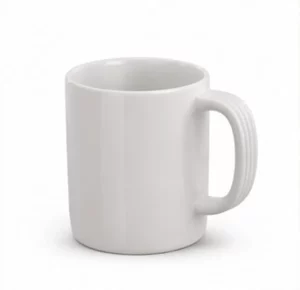
| Logo mug for daily office use | Outer wall | In-glaze, or a decal if the artwork is detailed |
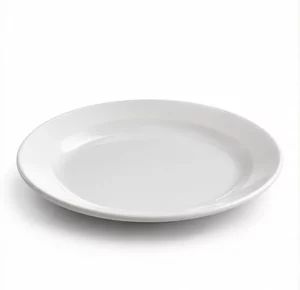
| Hotel or restaurant plate | Rim or centre | Underglaze or in-glaze |
| Branded café cup | Outer wall | In-glaze or decal; underglaze or in-glaze on the lip |
| Corporate gift in a box | Outer wall, base stamp | Decal for full colour; laser for a serial number |
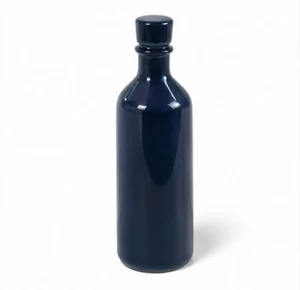
| Spirits bottle | Body and shoulder | Decal or in-glaze; gold for accents |
| Collector or art plate | Display surface | Decal or hand-painted; not for food |
If the mark must survive a commercial dishwasher every day, choose underglaze or in-glaze. If the artwork has many colours or photographic detail and sits on the outside, a decal is the honest choice. Our guide to ceramic corporate gift ideas shows how gift buyers combine them.
Colour matching across a run
Whichever method you choose, the colour has to match your brand and stay the same across the order. We match glaze and decoration colours to your Pantone reference in our 300 m² sample room and measure them on an X-Rite Ci7800: ΔE 1.5 or less within a batch, 2.0 or less between batches. The six usual causes of batch drift are in our colour consistency guide.
Ask for a fired sample before you approve. A colour on screen, a printed proof and the same colour after firing are three different things, and only the last one goes in the box.
Matching a brand colour by method
Each method reaches a brand colour in a different way. A coloured glaze is matched by developing a glaze recipe; a decal is matched by its printing ink; underglaze and in-glaze are matched within the range of pigments that survive their firing. All are measured the same way, on a spectrophotometer, and held to ΔE 1.5 within a batch and 2.0 between batches. The matching itself is done in our 300 m² sample room, against your Pantone reference or a physical sample. Our guide to glaze colour matching covers the six reasons colour drifts between batches.
Costs and lead times by method
| Method | Setup | Minimum | Lead time |
|---|---|---|---|
| Coloured glaze | Standard colours: none; exclusive colour: development fee, refunded from 5,000 pcs | 1,000 pcs | 30–35 days |
| Underglaze logo | Logo plate, fee refunded from 2,000 pcs | Ask with the quantity | Plate in 5 days |
| Overglaze decal, one colour | One printing plate | 1,000 pcs | 35–40 days |
| Overglaze decal, multi-colour or gold | One printing plate per colour | 1,500 pcs | 35–40 days |
| New pattern on an existing model | Small setup fee, refunded from 1,000 pcs | Set by the decoration method | 7–10 days to set up |
| Laser marking | Logo plate, fee refunded from 2,000 pcs | Ask with the quantity | Plate in 5 days |
Lead times are working days from the deposit and signed artwork, with 7–10 days added between July and October.
Care lines by method
The decoration decides the care instructions, so plan them with the method, not after the order.
| Method | Dishwasher | Microwave |
|---|---|---|
| Underglaze or in-glaze | Yes, once the version is tested | Yes, if non-metallic and tested |
| Coloured glaze | Yes, once the version is tested | Yes, if tested |
| Overglaze decal | Yes; hand washing keeps it bright longer | Only if non-metallic and tested |
| Gold or platinum | Hand wash recommended | Never |
| Laser marking | Yes | Yes, if the piece is tested |
Our guides to dishwasher-safe dinnerware and microwave-safe porcelain explain how to write each line.
The equipment behind each method
Which methods a factory offers, and how consistent they are, depends on what it has on the floor. This is ours.
| Process | Equipment | What it controls |
|---|---|---|
| Glazing | 12 glazing robots | Glaze 0.25–0.35 mm thick, repeatable to ±0.02 mm |
| Decal application | 6 automatic decal machines | Decal position, piece after piece |
| Decal and gold firing | 3 roller decorating kilns, 780–850 °C | Fuses decals and gold onto the glaze |
| Gold lines | 2 gold-lining lines | Line width and continuity |
| Laser marking | 4 laser markers | Fine marks, numbers and wordmarks |
| Colour checks | X-Rite Ci7800 spectrophotometer | ΔE against the approved standard, under D65 light |
| Lead and cadmium | Agilent 7900 ICP-MS | Release from decorated surfaces, before the outside lab |
Underglaze decoration also rests on our own process work: we hold an invention patent on a low lead-and-cadmium underglaze decoration process (ZL 2023 1 0822016.8).
Each decoration needs its own test report
A food-contact report covers the piece that was tested, decoration included. A report on a plain white plate does not cover the same plate with a red decal or a gold rim, because coloured decorations and metals are where lead and cadmium usually come from.
What to check on the report
- The SKU and the decoration are named, not just the shape.
- The standard matches the market: FDA guidance and ASTM C738 for the US, Prop 65 for California, LFGB and Regulation (EC) No 1935/2004 for the EU, SOR/2016-175 for Canada, the Food Sanitation Act for Japan.
- The report is current, and issued by a named lab.
When a new decoration needs new testing
Adding a decal, changing a colour or adding gold to a tested shape creates a new version that needs its own test. Plan that into the timeline, and ask the supplier which of your versions its current reports already cover. Our guide to food-contact testing by country explains each market’s rules.
Approving decoration, step by step
Decoration problems are cheapest to catch before the plates are made and most expensive after the order is fired. This is the order we approve in.
- Artwork. Vector files for logos; separated colours for decals; the Pantone references for each colour.
- Method and position. Agreed per shape, with food-contact surfaces kept to underglaze or in-glaze.
- Plates. Decal plates take 5–7 days, one per colour; underglaze and laser logo plates take 5 days.
- Fired sample. A custom sample with the real decoration, 7–15 days after approval, with test data.
- Measurement. Colour measured against the standard; gold checked with the 50-rub test; position checked against the drawing.
- Sign-off. The signed sample becomes the standard the order is inspected against.
Decoration faults, and what causes them
| Fault | What it looks like | Usual cause | How it is prevented |
|---|---|---|---|
| Colour drift | One batch a shade off another | Glaze thickness, kiln temperature or a recipe change | Robot glazing, kiln logging, locked recipes, ΔE limits |
| Pinholes in the glaze | Tiny holes in the surface | Gas escaping during firing | Process control; never accepted on food-contact surfaces |
| Gold wearing through | Base colour showing under the line | Thin gold or a weak firing | 50-rub test on every batch |
| Decal out of position | Logo off-centre or tilted | Hand application | Automatic decal machines; position checked on samples |
| Fine type closing up | Thin lines blurred under the glaze | Underglaze softens fine detail | Thicken fine type for underglaze, or use a decal |
| Decal fading in use | Colours dull after washing | Overglaze decal in a commercial dishwasher | Underglaze or in-glaze for service ware |
Every finished piece passes machine vision and a manual check before packing, and is traced to its kiln run and team, so a fault found in one carton can be followed back to its cause.
Decoration on our own ranges
Our design team uses the same methods on our own collections. Our Fendai 16-piece set, a TONFO design protected by design patent, won gold at the 2024 Jiangxi Industrial Design Competition; our Qingai celadon tea ware won a 2026 silver award for daily-use ceramic design from the China Ceramic Industry Association. We develop four themed collections and about 180 new patterns a year, and those patterns are where new decoration methods are proven before they go onto customer ranges.
What to ask a supplier
- Which method will you use, and where? “Printed logo” is not an answer.
- What touches food? Insist on underglaze or in-glaze on eating surfaces and lips.
- Which test report covers this decoration? A report on plain white ware does not cover a decal. Our guide to porcelain vs ceramic explains why food safety depends on the glaze and decoration, not the body.
- Can I see a fired sample after dishwasher testing? Run it through your own machine for a few weeks.
Send us your logo or artwork with the product and quantity, and we will tell you which method suits it and send a fired sample.