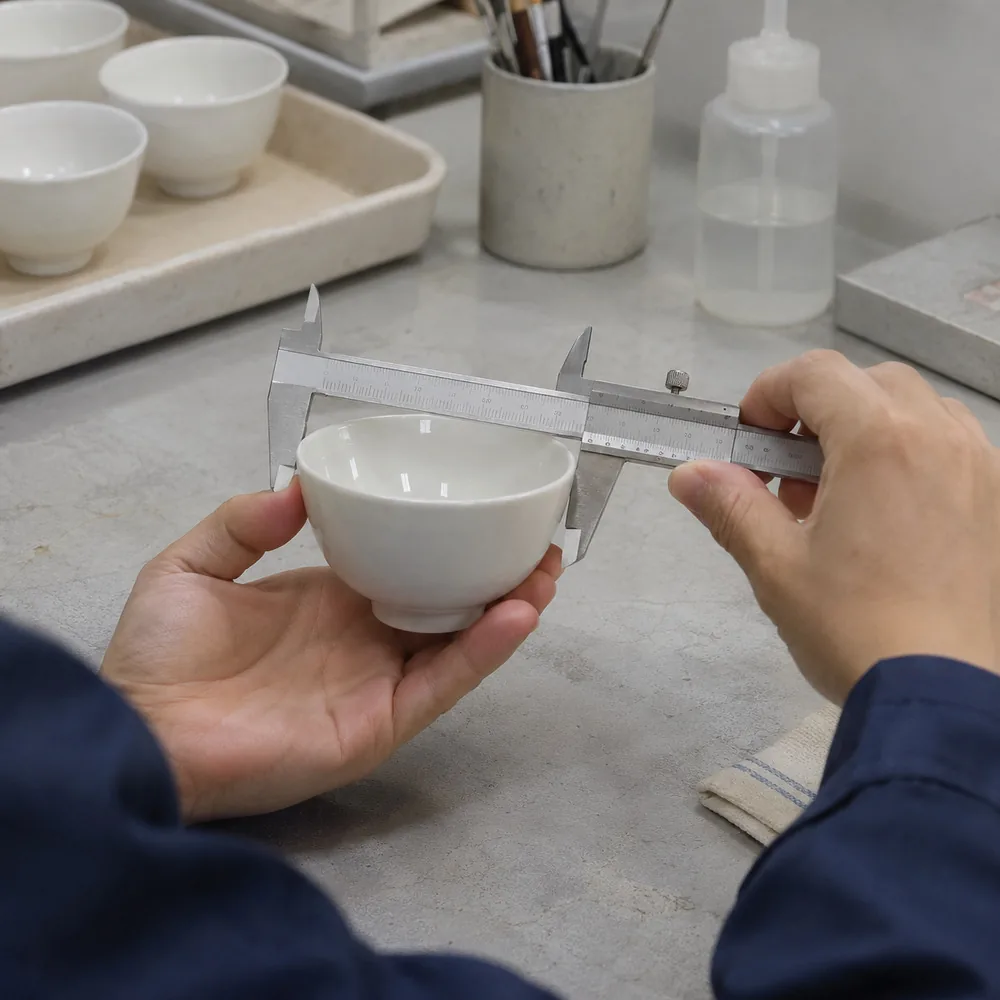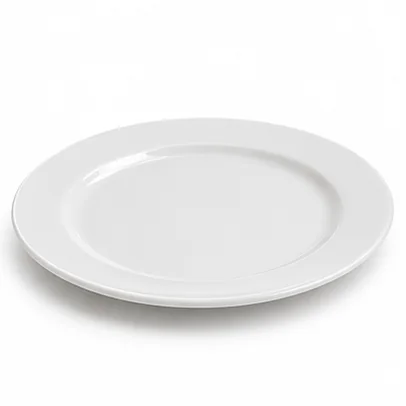
Nine of our hotel shapes are tested for 1,000 commercial dishwasher cycles. That sounds like a hotel number, but a household that runs its dishwasher once a day reaches 1,000 cycles in under three years. So the question a retail buyer should ask is the same one a hotel asks: not “is it dishwasher safe?” but “what does it look like after a thousand washes, and which version did you test?”
The short answer for porcelain: a plain or underglaze-decorated body handles the dishwasher well. Decals and gold are where the wear shows. Here is why, what the test measures, and how to put an honest label on each version of a range.
Why plain porcelain survives the dishwasher
A dishwasher attacks a plate in three ways: hot water, alkaline detergent and pieces knocking into each other in the rack. Porcelain is well placed for all three. Its body is vitrified, so it holds almost no water; ours absorbs 0.5% or less. Its glaze is hard; ours measures 6 Mohs or more. And strengthened porcelain resists the knocks, at 120 MPa or more in bending strength.
What wears first is anything sitting on top of the glaze. The glaze itself is glass fused to the body at 1,260–1,320 °C. A decal or a gold line is fired on afterwards at a much lower temperature, and that layer takes the detergent and the knocks first. Our guide to porcelain vs ceramic explains why the body makes a difference.
Hot water and sudden temperature changes
A wash cycle heats a plate, rinses it and then leaves it to cool on the rack, sometimes in a cold room. The stress is the change, not the heat itself. Porcelain that is fully vitrified and evenly formed handles this well, because there are no pockets of trapped water to expand and no thick spots that cool more slowly than the rest.
That is why we measure wall thickness during forming, to a tolerance of ±0.4 mm, and why every shape is tested for thermal shock to ASTM C554: from 180 °C straight into 20 °C water, with no cracks allowed. A plate that passes that test will not be troubled by a dishwasher’s temperature swings.
Alkaline detergent and the glaze surface
Dishwasher detergent is strongly alkaline, and over hundreds of cycles it slowly etches whatever it touches. On a hard, well-fired glaze the effect is very small. On a soft glaze, or on a decoration fired at low temperature, it shows as a loss of gloss: the surface turns from glassy to satin, and then to dull.
Our glaze goes on at 0.25–0.35 mm, applied by robot to within ±0.02 mm, and is fired with the body. An even layer matters here as much as the glaze recipe. Where the glaze is thin, the detergent reaches the body sooner and the colour looks patchy long before the plate is worn out.
Knocks in the rack
Most damage in a dishwasher is mechanical. Spray arms move pieces, cutlery shifts, and plates touch their neighbours. Two places take the hits.
The rim
The rim is the thinnest part of a plate and the first thing to touch another plate in the rack. We test impact resistance by dropping a 100 g steel ball from 1 m, and we check rim dimensions on every piece: diameter within ±1.5 mm and ovality of 1.5% or less, so that plates sit evenly in the rack instead of rocking against each other.
The foot ring
The foot ring, the unglazed ring a plate stands on, is rougher than the glaze. When plates are stacked wet, a foot ring can scratch the glaze of the plate below it. Ask your supplier whether the foot ring is polished after firing. On hotel shapes it should be.
Which decorations hold up, and which wear
The decoration method decides the dishwasher result far more than the plate underneath it.
| Decoration | Where it sits | In the dishwasher |
|---|---|---|
| Plain glaze | The glaze is the surface | Holds up; this is what the commercial test is run on |
| Underglaze | Under the glaze, sealed by it | Holds up; washing cannot reach the colour |
| In-glaze | Sunk into the glaze during firing | Holds up well |
| Decal (overglaze) | On top of the glaze | Fades and wears faster; lasts longer washed by hand |
| Gold or metal line | On top of the glaze | Wears faster than the glaze around it; hand wash, never microwave |
| Laser marking | Engraved into the glaze surface | Permanent |
This is also why surfaces that touch food or a mouth take only underglaze or in-glaze decoration at our factory, and decals go on outer walls. A mug with a decal logo on the outside can go in the dishwasher; the logo will simply age faster than the mug. Our guide to underglaze vs overglaze compares the five methods in detail.
Why decals wear first
A decal is fired onto the glaze in a separate, second firing. Ours go through three roller decorating kilns at 780–850 °C, while the body and glaze were fired at 1,260–1,320 °C. At the lower temperature the decal fuses to the surface of the glaze but does not sink into it, so it is the first thing the detergent and the rack meet.
That does not make decals a bad choice. It makes them a choice for the right surface. A decal on the outside wall of a mug is touched by detergent and water, but rarely by cutlery or another plate. A decal across the middle of a dinner plate meets knives and stacking every day, and will show wear years before the plate does.
Gold, platinum and lustre
Gold lines are applied on our two gold-line production lines and fired on in the same decorating kilns. We test every gold design by rubbing it 50 times; it must not wear through to the glaze. That proves the gold is properly fired, not that it will look new after 1,000 machine washes. For a gold rim, the honest care line is hand washing.
Laser marking and in-glaze colour
Laser marking cuts the mark into the glaze surface with one of our four laser marking machines. There is no extra layer to wear off, so the mark lasts as long as the glaze. In-glaze colour is fired at a temperature where it sinks into the glaze and is then covered by it, which is why it is the method we recommend for a logo on a hotel plate.
What a dishwasher test actually measures
The standard to ask for is EN 12875. Pieces go through repeated wash cycles, then the glaze and decoration are checked for damage such as loss of gloss, fading or wear. Our hotel shapes are tested to EN 12875-1 and -5 for 1,000 cycles, and that is the report hotel and airport buyers receive with their orders: Hainan Airport, which chose our porcelain for its VIP lounges for 2026 to 2028, and a Dubai hotel supply distributor that takes gold-rim and hotel porcelain from us, about 420,000 pieces a year.
Two things to check on any dishwasher report. First, the cycle count: a result after a handful of cycles tells you little about year three. Second, the version tested: a report on the plain white plate does not cover the same plate with a decal or a gold rim, because those are the parts that wear.
Translating 1,000 cycles into real use
A thousand cycles sounds abstract until you divide it by how often a piece is washed.
| Where the piece is used | Typical washes | Time to reach 1,000 cycles |
|---|---|---|
| Home, dishwasher run once a day | 1 a day | About 2 years 9 months |
| Home, dishwasher run every other day | 1 every 2 days | About 5 years 6 months |
| Café cup in daily service | Several a day | Months, not years |
| Hotel breakfast plate | 2 to 3 a day | Around 1 year |
The table is arithmetic, not a test result, but it explains why we run hotel shapes to 1,000 cycles rather than to a few dozen. For a café or a hotel, 1,000 cycles is the first year of service. For a home, it is most of the life of the set.
What we look at after the test
After the cycles, a tested piece is compared with an unwashed piece from the same batch. We look at four things.
- Gloss: is the glaze still glassy, or has it turned satin?
- Colour: has a coloured glaze or decoration faded or shifted? We measure colour on an X-Rite Ci7800 spectrophotometer, so the change is a number, not an opinion.
- Decoration: are lines, edges or fine type still complete?
- Surface: are there scratches, chips at the rim or crazing in the glaze?
A report that only says “pass” without saying what was checked is of limited use. Ask for the criteria as well as the result.
How to label each version of a range
Most retail ranges have more than one version of the same shape: plain, patterned, gold-rimmed. Each needs its own care line, based on what was tested.
- Plain, underglaze, in-glaze or laser: “Dishwasher safe” can be supported by a test on that version.
- Decal on the outer wall: “Dishwasher safe; hand washing keeps the decoration bright for longer” is honest and avoids returns.
- Gold or metal line: “Hand wash recommended. Not for microwave use.” Gold is never microwave safe; our guide on whether porcelain is microwave safe covers why.
Write these lines per SKU when you place the order, so the packaging, the product page and the test reports all say the same thing. The care lines on our own product pages follow the same rule.
A worked example: one mug, three versions
Here is how the rule plays out on one shape, our BM-350 mug, sold in three versions.
| Version | Decoration | Care line we would print |
|---|---|---|
| Plain glaze, any colour | Glaze only | Dishwasher safe. Microwave safe. |
| Logo on the outside wall | Overglaze decal | Dishwasher safe. Hand washing keeps the decoration bright for longer. Microwave safe if the decal is non-metallic and tested. |
| Gold rim | Gold line | Hand wash recommended. Not for microwave use. |
The body is the same in all three. Only the decoration changes, and so does the line on the box.
When a range mixes plain and decorated pieces
Sets often combine a plain dinner plate with a patterned side plate and a gold-rimmed cup. Print the care lines per piece, not one line for the set. A single “dishwasher safe” on a set box that contains a gold-rimmed cup is the kind of claim that brings returns.
Dishwasher habits that cause most of the damage
Even the right porcelain chips if it is loaded badly. The common causes are plates touching in the rack, cups knocking against cutlery, and pieces moved from a hot cycle straight into cold water. Our thermal shock test runs from 180 °C into 20 °C water with no cracks, but repeated knocks at the rim are a different stress.
For hotels and restaurants, this is where shape matters as much as body: a rolled or thickened rim and plates that stack without rocking last longer in a commercial machine. Our guide to hotel and restaurant dinnerware covers how to specify rim, warp and stacking.
What changes in a commercial kitchen
Commercial machines run hotter, faster and with stronger chemicals than home dishwashers, and the same pieces go round many times a day. Three things matter more there than in a home.
Geometry that racks and stacks
A plate that is slightly warped rocks in the rack and chips at the rim. Our limit for warp on plates is 1.2 mm, checked by machine vision and by hand on every piece, together with rim diameter and ovality. For a hotel buyer these numbers belong in the purchase order, next to the dishwasher test.
Decoration that matches the wash
In a commercial kitchen, decoration that sits on top of the glaze will wear quickly wherever cutlery and stacking reach. We put logos for hotels and airports in-glaze or underglaze, and keep decals and gold for pieces that are washed by hand or used in a VIP setting with lower volume.
Reorders that match the first order
Breakage in a hotel is a running cost, so the plates you buy in year two have to sit next to the plates from year one. We hold colour to ΔE 2.0 between batches and keep the glaze recipe and the mold for each hotel shape on file. Atour Hotels has reordered from us since 2022 across 9 shapes, about 180,000 pieces a year, on that basis.
Questions buyers ask about dishwasher-safe porcelain
Does the dishwasher cause crazing?
Crazing is a network of fine cracks in the glaze. It usually comes from a glaze that does not fit the body, so the two expand and contract by different amounts. It is most common on porous bodies that take up water. A vitrified porcelain body absorbing 0.5% water or less, with a glaze fired on at the same time, is far less prone to it. If you see crazing on a porcelain sample, treat it as a production fault, not as normal wear.
Can a gold-rimmed plate go through the dishwasher once?
Once will rarely show. Regularly will. The gold dulls and thins over repeated cycles, and it is never microwave safe. If a customer is likely to put the piece in a machine, a plain rim or an in-glaze coloured line is the better choice.
Do coloured glazes fade in the dishwasher?
A coloured glaze fired with the body is part of the glaze, so it behaves like the glaze: it holds up. What fades is colour on top of the glaze. If you are choosing between a coloured glaze and a coloured decal for the same look, the glaze is the dishwasher choice.
Is stoneware just as dishwasher safe?
Stoneware can be, but check its water absorption. A stoneware body that absorbs more water than porcelain is more vulnerable to chipping and to glaze faults over time. Our guide to porcelain vs ceramic compares the bodies by number.
Getting the right report for your range
Tell us the shapes, the decorations and where the range will be sold, and we will tell you which versions are covered by our current dishwasher testing and which would need their own test. You can start from our ceramic plates or restaurant and hotel dinnerware, or send us your list.