A German discount retailer takes 3.4 million pieces a year from us, in twelve deliveries, sold under its own label. A Nordic home retail group has bought from us since 2018: 16.8 million pieces in eight years, audited to IKEA’s IWAY 6.0. Our name is on none of those boxes.
That is private label: your brand, your packaging, our factory. Done well, it gives a retailer its own range at a factory margin. Done badly, it gives you a container of products that fail the audit (our checklist for auditing a ceramics supplier covers what retail auditors look for), miss the shelf date or don’t match last season’s stock. This guide walks through how a programme runs with us, step by step, and what to check at each stage.
What private label means in ceramics
In a private label programme the factory makes the product and the retailer owns everything the shopper sees: the brand, the packaging, the barcodes and often the design. Our name appears nowhere on the goods, the box or the outer carton.
It differs from buying a stock product with your logo on it:
| Stock product with your logo | Private label programme | |
|---|---|---|
| Design | Our shape and glaze | Our shape, or yours, with your exclusive glaze and decoration |
| Packaging | Plain or simple branded box | Your retail packaging, barcodes and labels for each market |
| Commitment | One order | A programme of repeat deliveries, often for years |
| Minimum | From 500 pcs | 5,000 pcs per SKU |
| First lead time | 25–40 days | 50–65 days |
The higher minimum pays for the work that a retailer needs and a one-off order does not: packaging development, market-specific testing, audit paperwork and a delivery plan. How each minimum is built, from 48 pieces up, is set out in why ceramic MOQs differ.
Three ways to put your brand on ceramics
| Stock product with your logo | Custom order | Private label programme | |
|---|---|---|---|
| What changes | A logo or decal on our model | Colour, decoration or shape for one order | Range, packaging, barcodes and marks, all yours |
| Minimum | 1,000 pcs for a one-colour decal | 1,000–3,000 pcs depending on the change | 5,000 pcs per SKU |
| First lead time | 35–40 days | 30–55 days | 50–65 days |
| Reorders | Order by order | Order by order | On a delivery plan agreed for the year |
| Audits | Rarely required | Sometimes | Almost always, before the first order |
The longer first lead time pays for work done once: audit, packaging development, testing for each market and a delivery plan. Reorders on a running programme are faster than a first custom order, because none of that has to be repeated.
What the retailer owns
In a programme with us, the retailer owns its brand, its artwork, its box designs and any mold or decal plate made for its range. We keep them on file and use them only for that retailer’s orders. That ownership is what lets a retailer move a range, add a second supplier or bring a design back years later.
Step 1: Pass the audit before you talk about price
Large retailers will not place an order with a factory that has not passed their social and ethical audit. Ask for the audit first, because it rules factories in or out faster than a quote.
These are ours, all current:
| Audit | Status |
|---|---|
| amfori BSCI | Grade B, valid to 18 May 2027 |
| Sedex SMETA 4-Pillar | Audited by Intertek, valid to 23 June 2028 |
| Walmart FCCA | Green, valid to 10 February 2027 |
| IKEA IWAY 6.0 | Valid to 19 January 2028 |
| Target supplier audit | Valid to 22 September 2027 |
| Costco social compliance audit | Valid to 2028 |
| Disney ILS | Valid to 2028 |
We also hold ISO 9001, ISO 14001 and ISO 45001. Every credential, with its number and expiry date, is on our certifications page. Our guide to sourcing ceramic dinnerware from China explains how to check that a certificate belongs to the factory you are actually buying from.
Match the audit to the retailer, not the other way round
Each retailer has the audit it accepts, and asking for “audited factory” in general wastes a round of emails. Start from your own compliance team’s list, then check that the factory holds that audit, at the grade required, with a date that covers your first delivery. If an audit will expire during your programme, ask when it is booked for renewal.
What the audits look at
Social audits such as amfori BSCI and Sedex SMETA look at working conditions, wages and hours, health and safety and, in SMETA’s four-pillar version, environment and business ethics. Capability audits such as Walmart FCCA look at whether the factory can produce what it promises, to the quality it promises. A programme usually needs both kinds.
Step 2: Choose the range and lock the design
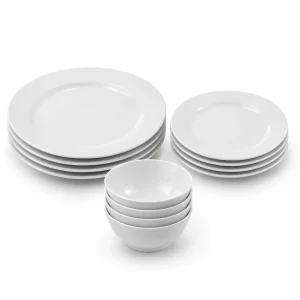

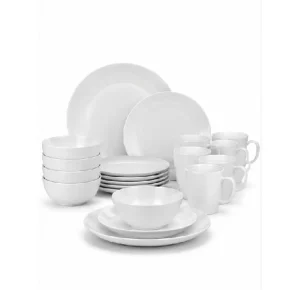
Most programmes start from existing shapes, because a mold that already runs well is the lowest risk. You can start from any of our 46 public models or our 3,800 molds, then make the range yours:
- An exclusive glaze, developed for you in about 20 days and not sold to anyone else.
- Your decoration, underglaze, in-glaze or decal. Our guide to underglaze vs overglaze explains which suits which surface.
- A shape of your own, from a 3D-printed prototype in 3 days to a production mold in 15–20 days. A mold you pay for belongs to you.
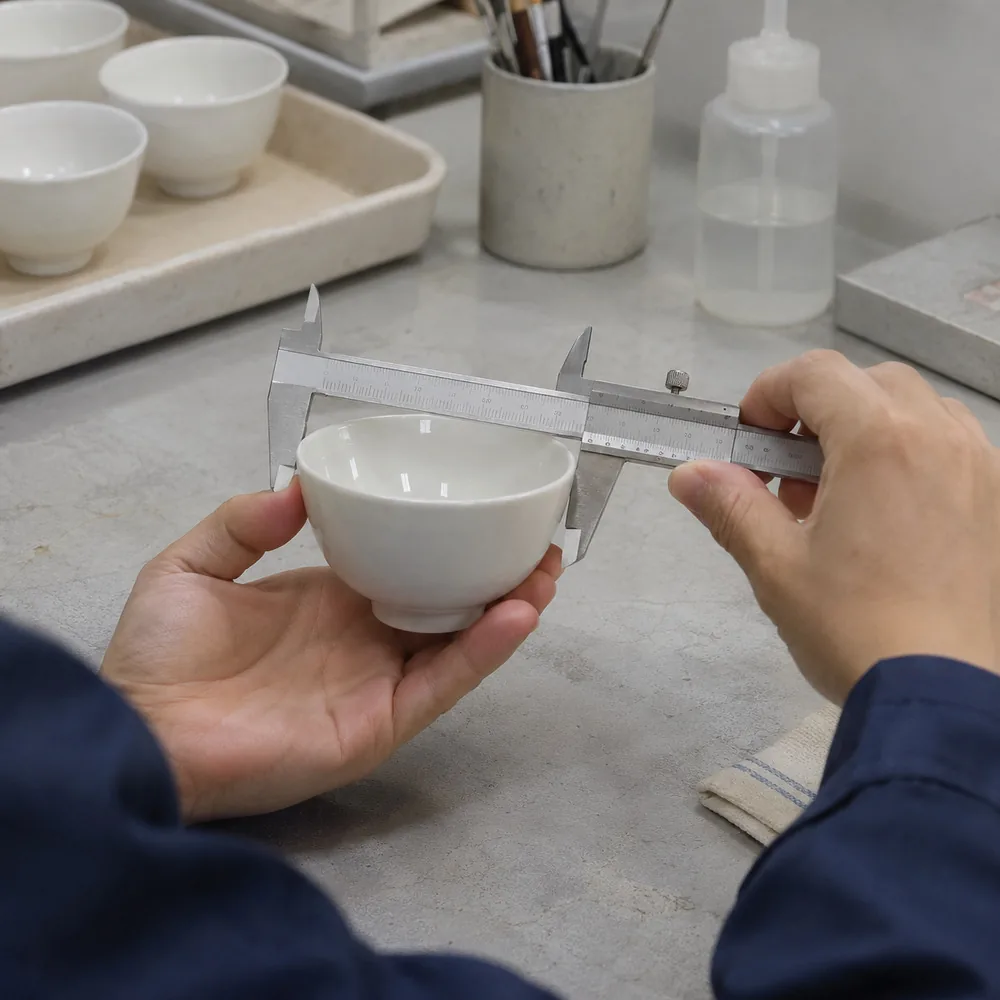
Lock colour with a fired sample, not a screen. We hold colour to ΔE 1.5 within a batch and 2.0 between batches, measured on an X-Rite Ci7800, so the reorder in year three matches the stock still on your shelf.
Building the range from existing shapes
Most of our programmes are built from shapes that already run on our lines. A Nordic home retail group has bought eight SKUs from us every quarter since 2018; a German discount retailer takes 16-piece and 20-piece dinner sets in twelve deliveries a year. Both ranges are made from production shapes with the retailer’s glaze, decoration and packaging. A shape that has already run thousands of times has known yields, known weights and known cartons, which is what a delivery plan needs.
Design support for your range
Our design and R&D team of 42 people develops four themed collections and about 180 new patterns a year; new designs made up 31% of our revenue last year. For a private label range, the team can adapt one of our patterns to your brand or develop one for you alone. Two of our recent collections won design awards: the Fendai dinnerware set took gold at the 2024 Jiangxi Industrial Design Competition, and the Endless Summer series won a China National Light Industry Council excellence award in 2025.
A pattern developed for your range is yours, along with its decal plates.
Step 3: Build the packaging around the shelf and the container
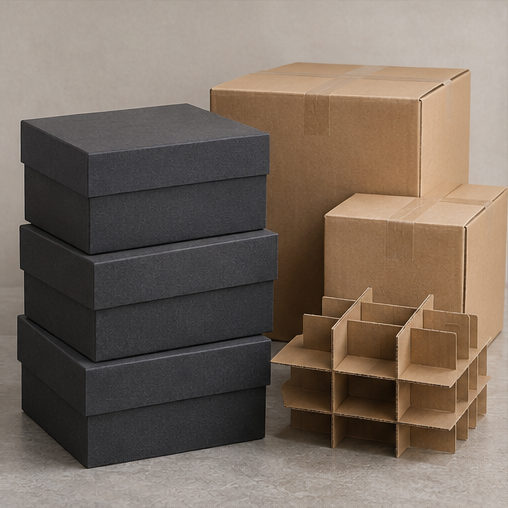
Retail packaging has two jobs: to sell on the shelf and to survive the trip. We print colour boxes in four colours with foil, UV or matt finishes, on FSC-certified board if you need it, and hold each piece in a pulp or EVA insert, with corrugated dividers in sets.
The outer carton matters as much as the box. Ours are 5-ply and drop-tested to ISTA 1A and 3A, and every new carton design gets a 1.2 m drop test. Across our 2025 shipments, transit breakage was 0.21%.
Barcodes, country-of-origin marks and warning labels follow the rules of each destination market, and only your brand goes on the carton. Give us the retailer’s packaging manual early: a carton that does not fit the distribution centre’s pallet pattern costs more than any glaze.
Packaging options for a retail range
| Item | Options |
|---|---|
| Colour box | Four-colour print, hot foil, UV spot, matte lamination; FSC-certified board available |
| Gift box | Rigid box with magnetic lid, EVA insert, fabric lining; carry bag optional |
| Inner protection | Molded pulp or EVA trays; corrugated dividers inside sets |
| Outer carton | 5-ply corrugated, drop-tested from 1.2 m to ISTA 1A and 3A |
| Pallet | 1,100 × 1,100 mm, four-way entry, stretch-wrapped with corner boards |
| Carton marks | Your brand only, with the barcode and origin mark each market requires |
Box design is part of the service
Box design is included in our design work, with three rounds of revisions and about five days per round. The finished artwork belongs to you. Design the box with the carton in mind: a box 1 cm too wide can mean one fewer box per carton layer and more freight per piece on every order.
Step 4: Test for every market you sell in
A private label range is often sold in several countries, and each has its own food-contact rules. The reports must cover the exact SKU and decoration, not a similar one.
| Market | Standard | Our report |
|---|---|---|
| United States | FDA CPG 7117.06/07, ASTM C738 | SGS-CSTC-2026-QZ-04187 |
| California | Prop 65 (lead, cadmium) | SGS-CSTC-2026-QZ-06114 |
| European Union | LFGB, EC 1935/2004, Declaration of Conformity | LFGB-20260305-118 (TÜV Rheinland) |
| Canada | SOR/2016-175 | SGS-CSTC-2026-QZ-06115 |
| Japan | Food Sanitation Act, Notice 370 | JFRL-2026-0418-TF |
We check lead and cadmium on our own Agilent 7900 ICP-MS before the outside lab sees the batch, and hold them to half the legal limit. US-01, a US warehouse club, gets an SGS report in every container.
What our testing covers by market
| Market | Standard | Coverage on our current lines |
|---|---|---|
| United States | FDA guides; ASTM C738 and C927 | 14 series, 62 SKUs |
| California | Proposition 65 (lead and cadmium) | 38 US-line SKUs |
| Canada | SOR/2016-175 | 38 Canadian-line SKUs |
| European Union | LFGB; Regulation (EC) No 1935/2004 | All food-contact shapes; declaration of conformity issued per batch |
| Japan | Food Sanitation Act, MHLW Notice No. 370 | 22 Japanese-line SKUs |
A new decoration on a tested SKU is a new version and is tested again. Plan the test into the sample stage, so the report is ready before the first container sails.
Step 5: Plan deliveries, not just an order
A programme lives on its delivery plan. The German discount retailer above takes twelve deliveries a year, so each one is smaller and its stores are never empty or overstocked.
What we commit to during production:
- Progress photos every 10 days, so you see the goods before the inspector does.
- Inspection by machine vision and a manual check on every piece, then final sampling at AQL 2.5, or 1.5 on request.
- Loading within 5 days of a passed inspection, and documents within 3 working days of sailing: invoice, packing list, bill of lading, certificate of origin (including Form E and RCEP), test reports and Declaration of Conformity.
- Peak season from July to October adds 7–10 days, so plan Christmas ranges early.
In 2025, 96.8% of our orders shipped on time.
A delivery plan, in practice
For a programme with twelve deliveries a year, we agree the forecast for the year, and book production slots month by month. Peak season, July to October, is planned at the start of the year, not in June. When a retailer’s forecast changes, the plan moves with it; when it does not, every lot ships on its date.
For programmes in North America, forward stock in Los Angeles and Toronto shortens the gap between a reorder and the shelf. A Canadian import wholesaler draws about 880,000 pieces a year this way.
What you see during each lot
Progress photos every 10 days, an inspection slot booked with 3 working days’ notice, loading within 5 days of a pass and the full document set within 3 working days of sailing. A programme runs on these being the same every time, not on any one of them being fast.
Step 6: Handle claims the same way every time
Even a good programme has the occasional claim. Agree the process before the first order, not after the first problem.
Our terms: claims within 30 days of arrival, an 8D report draft within 48 hours, liability up to the full order value, and USD 2 million of product liability insurance. Our complaint rate is 0.07%.
What an 8D report contains
The 8D report is a standard structure for solving a quality problem, and it is what we send in reply to every claim. In short, it names the team, describes the problem with evidence, contains it (for example by re-sorting stock), finds the root cause, sets a correction, checks that it works, changes the process so it does not recur, and closes the report. The first draft goes out within 48 hours; the full report follows when the cause is confirmed.
A programme with a dozen deliveries a year will see the occasional claim. What protects it is that every claim is handled the same way and leaves a change in the process behind.
Four retail programmes, and what each one needed
Every private-label programme follows the six steps above, but each retailer puts the weight somewhere different. These four are running with us now.
A Nordic home retailer: colour over eight years
A Nordic home retail group has bought from us since 2018: 8 SKUs, reordered every quarter, under its IWAY supplier code, which we passed in 2018 and hold at version 6.0 today. Its specification puts one line above the rest: colour held to ΔE 1.5. Three things hold it: a glaze recipe locked to that customer, kiln temperature logged at nine points on every run, and a sample from every batch kept for three years. Over eight years the programme has run to 16.8 million pieces with no major quality incident.
A German discount retailer: a delivery plan, not an order
A German discount supermarket has taken 16- and 20-piece dinner sets from us since 2019, about 3.4 million pieces a year, delivered in 12 batches across the year. The glaze recipe is locked, and each batch is checked against the same approved standard. For a discount chain, the delivery plan is the product: the sets have to arrive on the week the promotion runs.
A US warehouse club: reports in every container
A US warehouse club has bought 24-piece sets and mugs from us since 2021, about 1.8 million pieces a year. Every container ships with an SGS test report, so the club’s import and compliance teams can clear each shipment on its own paperwork.
A Canadian import wholesaler: stock close to the customer
A Canadian import wholesaler has taken dinner sets and mugs from us since 2019, about 880,000 pieces a year, with reorders drawn from stock we hold in Toronto rather than waiting for the next sailing. For a wholesaler selling on to many stores, the speed of the reorder matters more than the size of the first order.
What a first order usually looks like
First orders for a retail programme are larger than most importers expect, because a range is several SKUs and each has its own minimum.
| Buyer | Typical first order | What it usually includes |
|---|---|---|
| Supermarket own label | 30,000–80,000 pieces | 16- or 24-piece sets, mugs, storage jars |
| Home-furnishing chain | 20,000–50,000 pieces | Vases, ornaments, candle holders, trays, often seasonal |
| Import wholesaler | 1–3 containers | A wide range of existing models, mixed |
| E-commerce brand | 500–5,000 pieces a month | Mugs and coffee cups, packed for parcel delivery |
A private-label SKU starts at 5,000 pieces, and the first order takes 50–65 working days because molds, glaze and packaging are approved in sequence. Reorders run on standard lead times.
The largest order we have run
Our largest single order was 2.18 million pieces across 46 SKUs, shipped in 11 containers and delivered over nine months. A programme of that size is planned as a delivery schedule from the start, with production slots booked against it.
Labels, barcodes and carton marks
Retail compliance does not stop at food safety. The packaging has to carry the right marks for the destination, and only the retailer’s brand.
What goes on the product and the box
Your brand, your barcode and the origin mark the destination requires. Our name does not appear anywhere on the product, the colour box or the carton.
What goes on the carton
Carton marks follow the destination’s rules for barcodes and origin, and every carton carries our code, so a carton can be traced back to its packing line, kiln run and team if a problem appears in your warehouse or a store.
Paperwork that travels with the goods
The commercial invoice, packing list and bill of lading; the certificate of origin; food-contact test reports for the SKUs in that container; and, for the EU, a Declaration of Conformity issued with each shipment. We send the set within 3 working days of sailing. Our guide to shipping ceramics from China explains each document.
Keeping a range consistent across years
A private-label range is judged on its reorders. Three habits keep the tenth delivery looking like the first.
- Lock the recipe. For ranges that reorder for years, we reserve the glaze recipe for one customer, as we do for the Nordic and German programmes above.
- Keep the tools. Molds, decal plates and box artwork made for your range belong to you and stay on file for reorders.
- Measure, do not compare by eye. We hold colour to ΔE 1.5 within a batch and 2.0 between batches, measured on an X-Rite Ci7800 under D65 light. Our guide to glaze colour matching explains why.
How long it takes to launch a range
A first private label order typically runs 50–65 days from deposit and signed artwork, plus the time before that for audit, sampling and packaging approval. Here is a realistic launch plan for a range built on existing shapes.
| Stage | Typical time | Who leads |
|---|---|---|
| Audit review or new audit | Depends on the retailer’s schedule | Retailer’s compliance team |
| Samples of existing shapes | Stock samples in 3 days; custom samples 7–15 days | Us |
| Colour and decoration approval | One to two rounds of fired samples | Both |
| Packaging design and approval | Three revision rounds, about 5 days each | Us, approved by you |
| Market testing | Planned in the sample stage | Us, with the outside lab |
| First production lot | 50–65 days | Us |
Started together, these stages overlap. The ones that cannot be compressed are the outside lab tests and the audit, so start them first.
What it takes to start
To quote a private label programme we need five things: the products and quantities per SKU, the markets you sell in, your packaging requirements, the audits your buyers require, and your first delivery date.
See how we run private label and OEM programmes, or send us your brief. We reply within 24 working hours and can send two stock samples in 3 days while we prepare the quote.