Commercial dinnerware is not defined by how it looks on opening night. It is defined by what it looks like after the 500th trip through a dish machine, and whether the plate you reorder in year three matches the ones still in service. Buy on looks alone and you pay for it in chipped rims, grey glaze and a mismatched pass.
We make hotel and foodservice porcelain for Atour Hotels, a Dubai hotel supply distributor and the VIP lounges at Hainan Airport. This is the checklist we would use if we were buying it.
1. Ask for the strength and the hardness, as numbers
A hotel plate is washed several times a day, stacked hot, carried in piles and knocked against taps and trolleys. Two numbers predict how it survives that:
- Bending strength of the body. Our foodservice lines use reinforced porcelain of 120 MPa or more.
- Hardness of the glaze. Ours is 6 Mohs or harder, so cutlery marks and scourers do less damage to the surface.
A supplier who answers “very durable” instead of a number has probably not tested it. If you are comparing materials, our guide to porcelain vs ceramic explains why we recommend reinforced porcelain over stoneware for daily commercial use.
The numbers to put in the tender
| Property | What it tells you | Our figure |
|---|---|---|
| Bending strength | How much load a plate takes before it breaks | 120 MPa or more for strengthened porcelain |
| Glaze hardness | How well the surface resists cutlery marks | 6 Mohs or more |
| Water absorption | How vitrified the body is; affects staining and chipping | 0.5% or less; high-white porcelain 0.3% or less |
| Thermal shock | Survives hot-to-cold changes | 180 °C into 20 °C water, no cracks (ASTM C554) |
| Impact | Resists knocks at the rim and body | Falling-ball test: 100 g steel ball from 1 m |
If a supplier gives you all five as numbers with a test method, you can compare it with another supplier line by line. If it gives you adjectives, you cannot.
Strengthened porcelain or high-white porcelain?
Both are porcelain, fired in different kilns for different jobs. Our strengthened porcelain runs on tunnel kiln 3 and is the body for banquet and buffet service, where plates are stacked hot and carried in piles. High-white porcelain runs on kilns 1 and 2 and is the body for cups, saucers and fine-dining plates, where whiteness and a thinner, lighter piece matter more. Many hotels use both: strengthened plates for the banquet kitchen, high-white for the restaurant and the lounge.
2. Ask for a commercial dishwasher test, not “dishwasher safe”
“Dishwasher safe” on a retail box usually means a home machine. A commercial machine runs hotter, faster and with stronger detergent, many times a day.
The standard to ask for is EN 12875, which runs pieces through repeated commercial wash cycles and then checks them for damage to the glaze and decoration. Nine of our hotel shapes have passed 1,000 cycles under EN 12875-1 and -5, in SGS report SGS-CSTC-2026-QZ-05310. Hainan Airport chose our porcelain for its VIP lounges from 2026 to 2028 for commercial dishwasher use, and its orders ship with EN 12875 reports.
Ask which shapes the report covers. A test on one plate does not cover a decorated cup, and our guide to dishwasher-safe dinnerware shows which decorations wear first.
| Test | What it tells you | Our result |
|---|---|---|
| EN 12875-1 / -5, commercial dishwasher | Glaze and decoration survive repeated commercial washing | 1,000 cycles, 9 hotel shapes (SGS-CSTC-2026-QZ-05310) |
| ASTM C554, thermal shock | Survives going from hot to cold, such as a hot plate rinsed in cold water | 180 °C to 20 °C, no cracks (SGS-CSTC-2026-QZ-05233) |
| Microwave cycling | Safe to reheat in | 700 W × 5 min × 20 cycles, 41 SKUs |
| Food contact, FDA CPG 7117.06/07 and ASTM C738 | Lead and cadmium release within limits | Pass for the tested lines (SGS-CSTC-2026-QZ-04187) |
Which of our shapes are covered
Our commercial dishwasher testing covers 9 hotel shapes to EN 12875-1 and -5, for 1,000 cycles. A new hotel shape, or one of those shapes with a new decoration, needs its own test before the same claim can be made for it. Plan that test into the sample stage: it is far quicker to run it before the order than to argue about wear after the opening.
For what the cycle count means in years of service, and which decorations wear first, see our guide to dishwasher-safe dinnerware.
3. Specify the rim, the warp and the stack

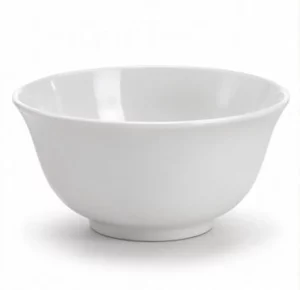
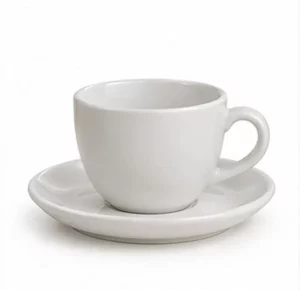
Many chips in a commercial kitchen start at the rim, when plates rock in a stack or knock in a rack. That makes geometry a durability issue, not only a looks issue. Put these in the specification:
- Rim size: ±1.5 mm.
- Ovality: 1.5% or less.
- Warp: 1.2 mm or less on plates.
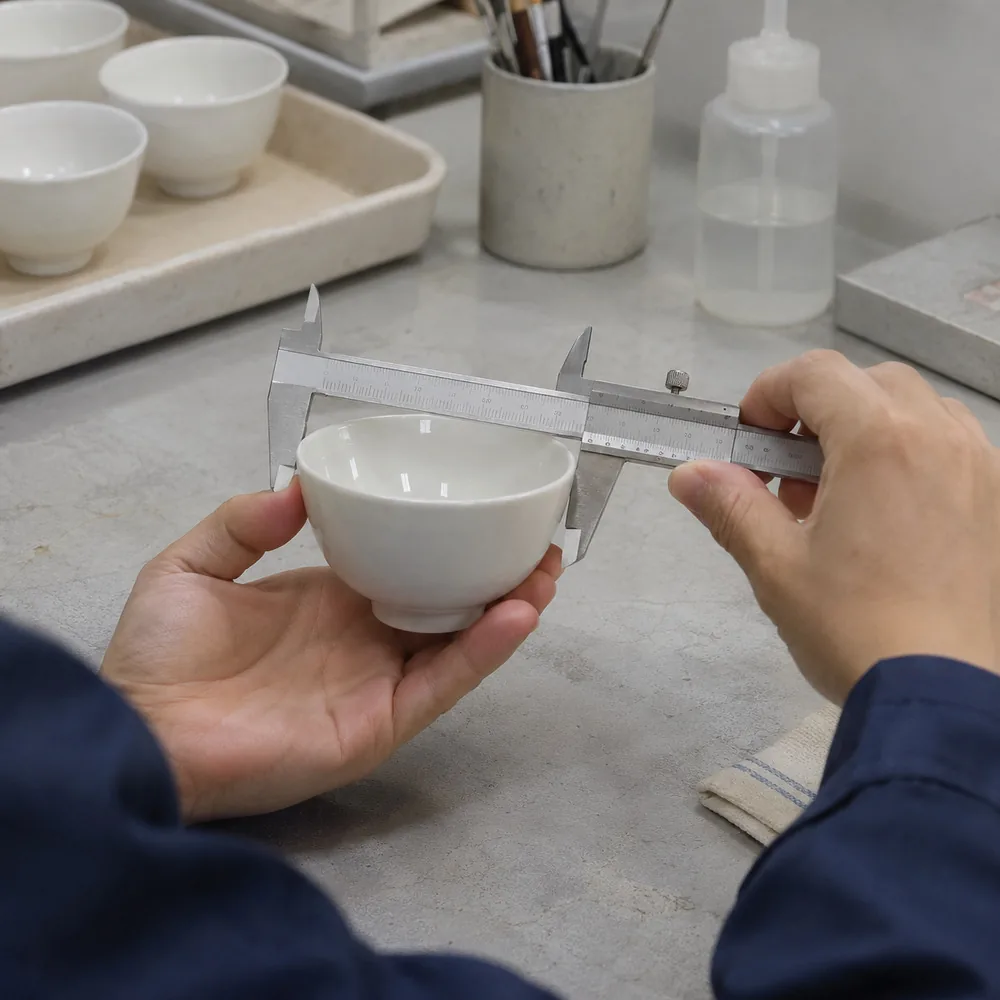
These are our production limits, checked on every piece by machine vision plus a manual check. Plates made to them stack flat on a trolley and sit flat in a plate warmer.
Rim profile and where chips start
The rim is the thinnest part of a plate and the part that meets the tap, the rack and the next plate. A rolled or thickened rim spreads a knock over more porcelain, which is why commercial plates often have a slightly heavier edge than retail ones. When you compare samples, look at the rim in profile, not only from above.
Stacks that sit flat
A stack of 20 plates that leans is a stack that will fall. Warp of 1.2 mm or less on plates, rim diameter within ±1.5 mm and ovality of 1.5% or less are what let our plates stack straight. Ask your supplier for the same three numbers, and stack 20 samples before you sign.
4. Put your logo where the dishwasher cannot reach it
A logo printed on top of the glaze fades in a commercial machine within months. For hotel ware, specify underglaze or in-glaze decoration, where the mark is sealed under or into the glaze. On any surface that touches food, that is the only decoration we use.
Gold rims look right in a fine-dining room and a VIP lounge, but they need care: gold is never microwave safe, and it wears faster than the glaze around it. Our guide to microwave-safe porcelain explains how we test for that. Our Dubai distributor customer (AE-01) takes gold-rim and hotel porcelain from us, 420,000 pieces a year since 2023, with EN 12875 reports for the hotel lines.
Logo methods for hotel ware
| Method | Durability in a commercial machine | Typical use |
|---|---|---|
| In-glaze | Very high | Logos and rim bands on everyday restaurant ware |
| Underglaze | Very high; narrow palette | Back stamps and one-colour marks; plate fee refunded from 2,000 pcs |
| Laser marking | Permanent, engraved into the glaze | Fine marks and serial codes |
| Overglaze decal | Fades over repeated washing | Outer walls of cups; front-of-house pieces washed by hand |
| Gold line | Wears; never microwave safe | VIP lounges and fine-dining service, hand washed |
Back stamp or front logo?
A logo on the underside of a plate, the back stamp, never touches food or cutlery and lasts as long as the plate. A logo on the front, or a coloured band on the rim, is what guests see. Many hotels put the brand on the back and a coloured line in-glaze on the front, which gives the look of a branded service without a decal in the way of every knife.
5. Plan replacements before you place the first order
Breakage in a hotel is not a risk, it is a running cost. What matters is whether a plate ordered in year three matches the plates already in service.
Ask the supplier three things:
- Will the mold and glaze recipe stay on file? We keep both for every hotel shape, for replacement orders.
- What colour tolerance holds between batches? We hold ΔE 2.0 between batches and 1.5 within a batch, measured on an X-Rite Ci7800, so a reorder matches the shelf.
- What is the minimum for a replacement order? Ours is 200 pcs per shape, delivered in 30–40 days.
A common rule of thumb for par stock is three of each piece per seat: one on the table, one in the dish machine and one on the shelf, with extra for banquets and breakage. Set your replacement point against that, so you reorder before service runs short.
Atour Hotels has bought from us since 2022: 9 shapes, 180,000 pieces a year, with the Atour logo on guest room and public area porcelain. That only works if every reorder matches.
A replacement plan you can put in the contract
Write three numbers into the supply agreement, so replacements do not depend on goodwill.
- Reorder minimum. For hotel and project orders, ours is 200 pieces per item.
- Reorder lead time. 30–40 days for hotel and project orders, 7–10 days for top-ups from stock.
- Match tolerance. Colour within ΔE 2.0 between batches, measured against the approved sample.
What we keep for every hotel shape
The mold, the glaze recipe and a signed sample from the first order. A replacement plate in year three is made from the same tools as the plate on opening night.
6. Check the paperwork for your market
Hotels and airports are inspected. Before you sign off samples, check that the supplier’s reports cover your market:
- US: FDA CPG 7117.06/07, ASTM C738 and, for California, Prop 65.
- EU: LFGB and EC 1935/2004 with an EU Declaration of Conformity (ours: LFGB-20260305-118, TÜV Rheinland).
- Canada and Japan: SOR/2016-175 and the Food Sanitation Act, Notice 370.
All our credentials are listed with numbers and expiry dates on our certifications page. For how to check a supplier’s factory, not just its reports, see our guide to sourcing ceramic dinnerware from China.
Which report for which market
| Market | What applies | What we can provide |
|---|---|---|
| United States | FDA guides for lead and cadmium; California Proposition 65 | Reports to ASTM C738 and C927; Proposition 65 testing for our US line |
| Canada | SOR/2016-175 | Testing for our Canadian line |
| European Union | Regulation (EC) No 1935/2004; LFGB in Germany | LFGB testing for all food-contact shapes; declaration of conformity with every batch |
| Japan | Food Sanitation Act, MHLW Notice No. 370 | Testing for our Japanese line |
| Commercial washing | EN 12875 | 1,000-cycle report for the 9 hotel shapes |
Every food-contact shape is held to an internal limit of 50% of the regulatory limit for lead and cadmium release, checked on our own ICP-MS before the outside lab sees it.
7. Build the order around service, not around a set
A hotel does not buy dinner sets. It buys shapes for each kind of service, in quantities set by how many covers it serves and how often the dishwasher cycles. Getting that list right is most of the specification.
Shapes by service
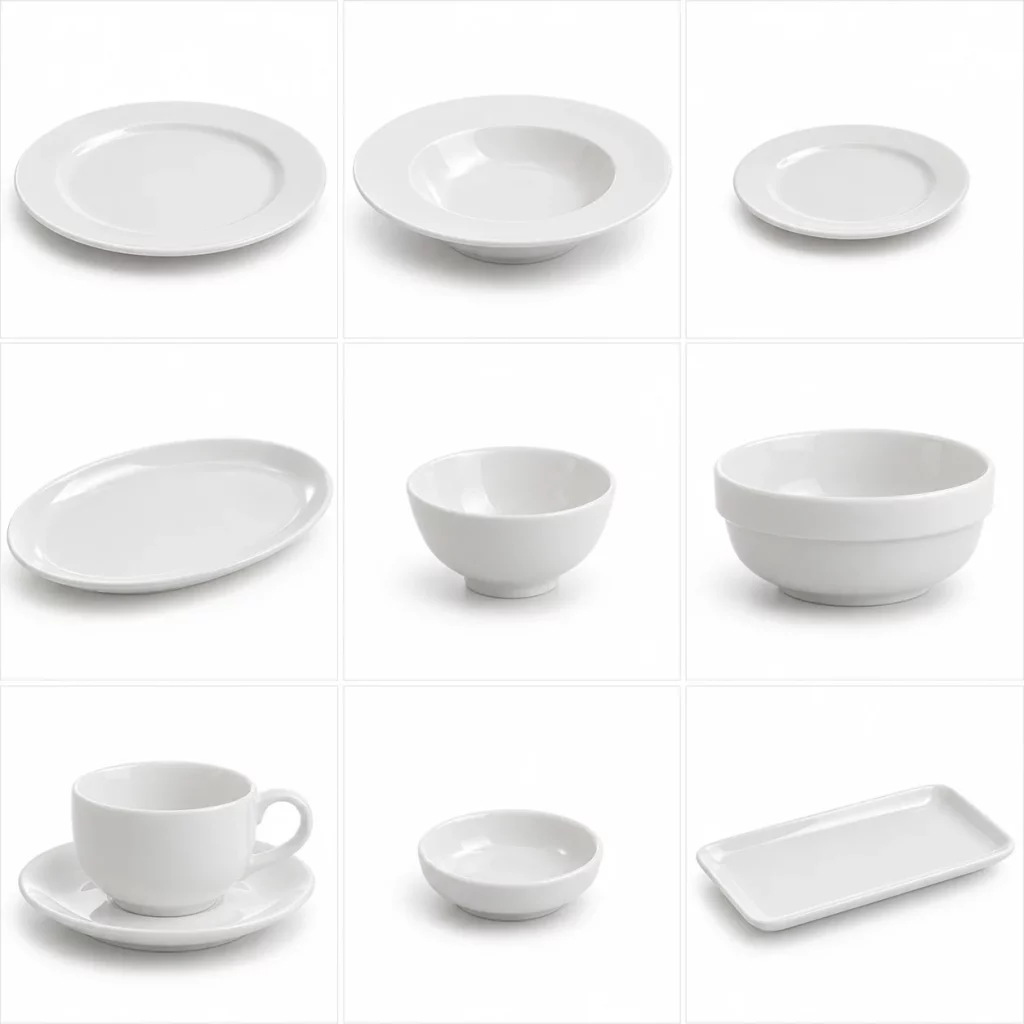
These are the nine hotel shapes in our standard hotel line, and where each usually works.
| Shape | Breakfast | Restaurant | Banquet | Room service | Lounge |
|---|---|---|---|---|---|
| Rimmed dinner plate | Yes | Yes | Yes | ||
| Rimmed side plate | Yes | Yes | Yes | Yes | Yes |
| Soup plate with wide rim | Yes | Yes | |||
| Oval platter | Yes | Yes | Yes | ||
| Deep serving bowl | Yes | Yes | Yes | ||
| Small bowl | Yes | Yes | Yes | Yes | |
| Cup and saucer | Yes | Yes | Yes | Yes | Yes |
| Sauce dish | Yes | Yes | Yes | ||
| Rectangular tray | Yes | Yes | Yes |
A small number of shapes used across several services is easier to stock, wash and replace than a different shape for every outlet. Most hotels can run breakfast, restaurant and room service from the same core shapes and add a few for banquets or the lounge.
Working out the quantities
Start from the covers, not from the catalogue.
- Covers per service. The number of guests served at the busiest sitting of each service.
- Pieces per cover. The shapes each guest uses at that service, from the table above.
- Rotation. How many sets of each shape you need in circulation while others are in the dishwasher, in use or being cleared. Set this from your own kitchen’s turnaround.
- Breakage reserve. Pieces held back for the first months of service, before the first replacement order arrives.
Multiply covers by pieces per cover by rotation, then add the reserve. That is the first order for each shape, and with our hotel minimum of 200 pieces per shape, even a small outlet can order exactly the shapes it needs. A typical first hotel order with us is 2,000–20,000 pieces.
8. Think about the people carrying it
Hotel porcelain is carried, stacked and washed by staff many times a day, so weight and handling matter as much as strength.
Weight per piece
A 27 cm plate in our range weighs 760 g, and a 30 cm plate 920 g. A stack of ten 27 cm plates is over 7.5 kg before food. Choose the lightest shape that meets the strength specification, and keep weight consistent: we hold piece weight to ±3%, so a stack of new plates weighs the same as a stack of old ones and sits the same in a rack.
Stacking and racks
Plates that stack level and sit in a dishwasher rack without rocking break less often. That is why the warp limit of 1.2 mm and the rim tolerance of ±1.5 mm matter: a plate that rocks in a rack is knocked by every cycle. When you test samples, load them into your own racks and trolleys, not just onto a table.
Rims that survive the pass
Most chips start at the rim, when a plate is set down, stacked or pushed across a pass. A rolled or thickened rim takes those knocks better than a thin, sharp one, and strengthened porcelain at 120 MPa or more resists them better than standard porcelain.
9. Plan the roll-out, not just the order
Large buyers rarely switch all their tableware at once. A roll-out plan keeps the first order small enough to test and the later orders consistent.
Sample, trial, roll-out
- Samples. Two stock samples of each shape are free, sent within 3 days; custom samples with your logo take 7–15 days and come with test data.
- Trial. A first order for one outlet or one service, run through your own dishwashers for a few weeks.
- Roll-out. The full order, made to the approved sample, with the molds, logo plates and glaze recipe kept on file.
Hainan Airport’s selection followed this pattern on a large scale: a first batch of 6 shapes and 32,000 pieces for its VIP lounges, chosen for the lounges’ dishwasher conditions, within a supply arrangement that runs from 2026 to 2028.
Deliveries for an opening date
A new hotel has a fixed opening date, and its tableware has to arrive before the kitchen is commissioned. Plan back from that date: 30–40 working days for a hotel order, plus inspection, loading and transit to your country. Our guide to shipping ceramics from China lists transit times by region, and DDP delivery to the US, Canada and the EU puts the door-to-door cost in one price.
Packing for the kitchen, not just the container
Ask for cartons packed by shape and labelled by shape and quantity, so the kitchen can put stock away without opening every carton. Our hotel cartons are five-ply corrugated with molded pulp or EVA inserts, drop-tested from 1.2 m to ISTA 1A and 3A, and every carton is coded so a broken piece can be traced to its kiln run.
10. Treat gold and front-of-house pieces as a separate line
Gold rims sell fine dining, VIP lounges and Middle Eastern hotel ware, and they need different handling from everyday service ware.
What gold can and cannot do
Our gold lines are fired onto the glaze and checked with a 50-rub test: the line must stay continuous with no base showing. Even so, gold wears faster than the glaze around it in a commercial dishwasher, and it is never microwave safe. Plan gold pieces as front-of-house ware, washed by hand or on a gentler cycle, and keep them out of room service and buffets where they will be microwaved or machine-washed with everything else.
Stock them separately
Because gold pieces wear at a different rate, they are replaced on a different schedule. Give them their own line in the replacement plan, and keep the gold-rim version and the plain version of a shape as separate SKUs with separate care instructions. Our guide to dishwasher-safe dinnerware explains which decorations wear first.
Questions to put in a hotel tender
A tender that asks the same questions of every supplier is easier to compare. These are the ones that separate hotel porcelain from retail dinnerware.
- Bending strength in MPa, glaze hardness in Mohs and water absorption, with the test method for each.
- A commercial dishwasher test report, with the cycle count and the shapes and decorations it covers.
- Rim tolerance, ovality and plate warp, and how they are measured.
- The logo method for each shape, and whether it sits on a surface that touches food.
- Which molds, logo plates and glaze recipes are kept on file, and for how long replacements will be available.
- The colour limit between batches, with the instrument and light source.
- Minimum per shape for replacement orders, and the lead time for them.
- Food-contact reports for your market, covering every shape and decoration you order.
- Carton packing by shape, and the drop test on the actual carton.
A supplier that answers all nine in writing, with numbers, is one you can hold to the answers later.
Who we supply, and what they asked for
Hotel and foodservice buyers specify differently, and the differences show up in the order.
A hotel group
Atour Hotels has bought from us since 2022: 9 shapes for rooms and public areas, with a custom logo, about 180,000 pieces a year. The decisions that mattered were the logo method, the reorder plan and matching colour across years of top-ups.
A hotel supply distributor
A Dubai distributor of hotel supplies takes gold-rim and hotel porcelain from us, about 420,000 pieces a year, and receives the EN 12875 dishwasher report with its orders. The distributor sells to many hotels, so the report has to travel with the goods to its own customers.
An airport lounge
Hainan Airport selected our porcelain for its VIP lounges for 2026 to 2028. The first batch was 6 shapes and 32,000 pieces, including high-white cups and saucers, plates and tea cups, chosen for the lounges’ dishwasher conditions.
A restaurant chain
Restaurant chains usually start larger, at 50,000–200,000 pieces, and care most about chip resistance, stacking and one colour across every outlet. Strengthened porcelain bowls, plates and sauce dishes are the core of the order.
Minimums and lead times for hotel ware
| What you order | Minimum | Lead time |
|---|---|---|
| Hotel and project order | 200 pcs per item | 30–40 days |
| Top-up from stock | 48 pcs mixed | 7–10 days |
| Your colour glaze | 1,000 pcs | 30–35 days |
| New hotel shape | 3,000 pcs | 45–55 days |
Lead times are working days from the deposit and signed sample. A typical first hotel order is 2,000–20,000 pieces.
The checklist on one page
| Item | What to specify | Our standard |
|---|---|---|
| Body | Reinforced porcelain, strength as a number | 120 MPa or more |
| Glaze | Hardness as a number | 6 Mohs or harder |
| Commercial dishwasher | EN 12875 report covering your shapes | 1,000 cycles, 9 hotel shapes |
| Thermal shock | ASTM C554 | 180 °C to 20 °C, no cracks |
| Rim and warp | Tolerances in the contract | Rim ±1.5 mm, ovality ≤ 1.5%, warp ≤ 1.2 mm |
| Logo | Underglaze or in-glaze on food surfaces | Underglaze or in-glaze only |
| Colour between batches | ΔE limit | ΔE 2.0 between batches |
| Replacements | Mold and recipe on file, minimum per shape | Kept on file, 200 pcs per shape, 30–40 days |
| Food contact | Reports for your market | FDA, LFGB, Prop 65, Canada, Japan |
See our restaurant and hotel dinnerware range, or request hotel samples and test them in your own dish machine before you decide. Every piece is made in our factory in Jingdezhen.