Tea shops often say a gaiwan is a beginner’s tool, something you graduate from when you buy a clay teapot. Gaiwans and other tea ware take 1.8 million pieces a year of capacity in our Jingdezhen factory, and we see it the other way round. A good porcelain gaiwan is one of the most honest brewing vessels you can buy: it adds nothing to the tea, shows you the leaves, and pours in seconds.
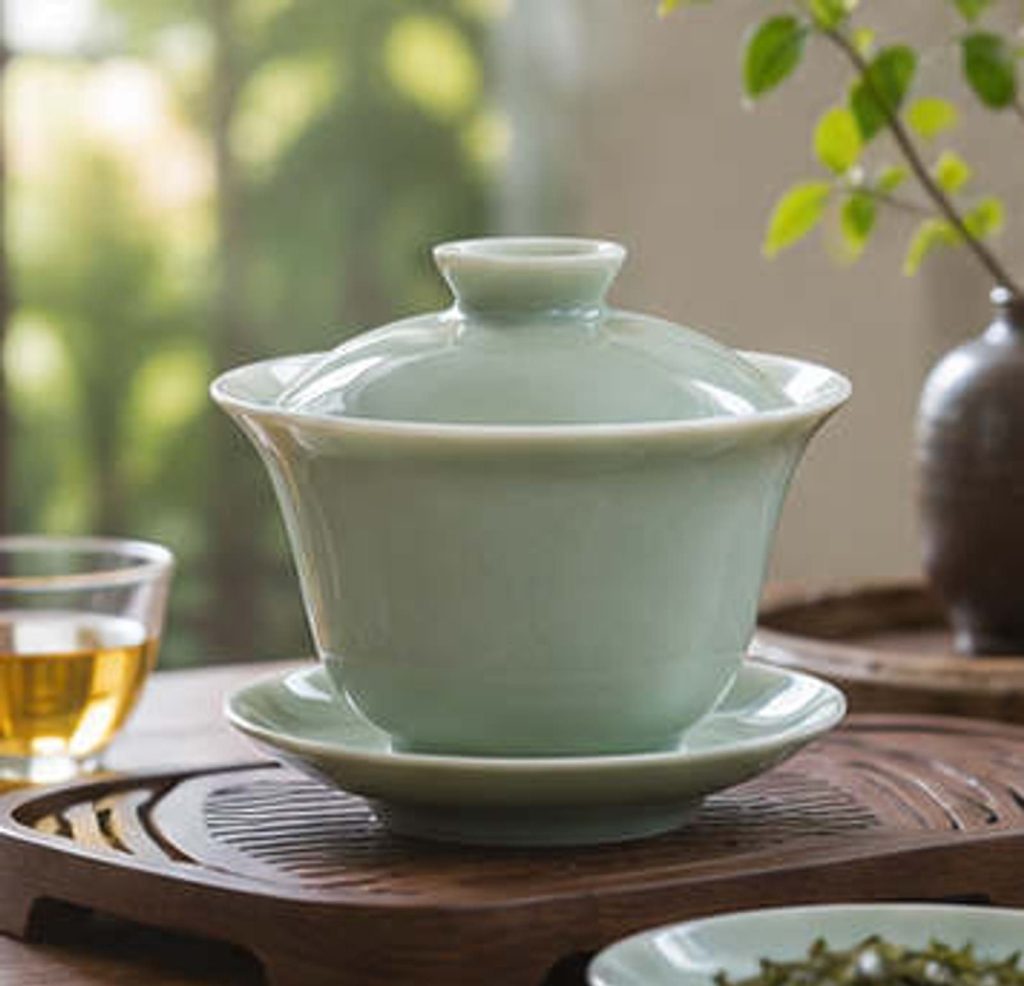
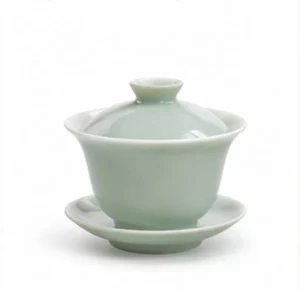
A gaiwan (盖碗, “lidded bowl”) has three parts: a saucer, a bowl and a lid. Our version is called Sancai, “three powers”, after the old reading of those parts as earth, people and heaven. You brew in the bowl, hold the lid back a few millimetres and pour through the gap.
How to use a gaiwan, in five steps
- Warm it. Pour hot water into the bowl, put the lid on, then empty it. A warm bowl keeps the brewing temperature steady.
- Add the leaves. Roughly 1 g of tea for every 15–20 ml of water, more for oolong and pu’er, less for green tea.
- Pour the water to just below where the rim starts to flare. Not to the top.
- Steep briefly. 10–30 seconds for the first infusions, longer as the leaves open.
- Pour. Thumb and middle finger on the flared rim, index finger on the lid knob, lid tilted back slightly. Pour into a pitcher or straight into cups, and drain every drop.
Most people burn their fingers at step 3, which brings us to the myths.
Water temperature and leaf, as a starting point
A gaiwan makes it easy to adjust each infusion, so start simple and change one thing at a time. As a common starting point, green and white teas are brewed with water around 80–85 °C, and oolong, black and dark teas with water from 90 °C to just off the boil. Short infusions, from a few seconds to under a minute, suit a gaiwan best, with each one a little longer than the last.
The amount of leaf depends on the tea and on taste. What matters for the vessel is that the leaves have room to open below the flare of the rim. A gaiwan packed to the top with leaf is harder to pour and hotter to hold.
Preheating, and why it matters
Rinse the gaiwan with hot water before the first infusion. A cold porcelain bowl takes heat out of the water, and the first infusion tastes thinner than the second. Preheating also shows you, before there are any leaves in it, how hot the rim will feel at a given fill level.
Myth 1: “Burnt fingers mean you are holding it wrong”
Partly. Grip matters, but so do fill level and shape.
The rim of a gaiwan flares outwards so that your fingers sit on porcelain the water never touches. Fill above the flare and the rim heats up like the rest of the bowl. A shape with a narrow flare gives you almost nothing to hold.
When you compare samples, fill each one to below the flare with boiling water and hold it for a full pour. That test tells you more than any product photo.
Myth 2: “A bigger gaiwan is easier for beginners”
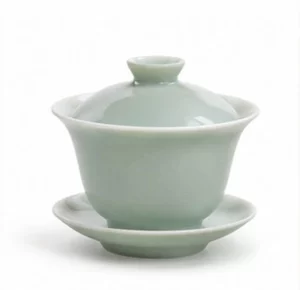
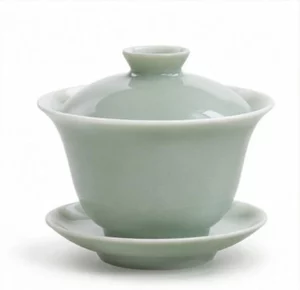
It is the other way round. A gaiwan is held by the fingertips, and the weight adds up quickly.
| Model | Capacity | Size (Ø × H) | Weight, empty | Per carton | Per 40HQ |
|---|---|---|---|---|---|
| GW-100 | 100 ml | 8.4 × 7.2 cm | 320 g | 36 | 44,244 |
| GW-130 | 130 ml | 9.0 × 7.8 cm | 385 g | 36 | 35,928 |
| GW-160 | 160 ml | 9.6 × 8.2 cm | 430 g | 30 | 27,480 |
| GW-200 | 200 ml | 10.4 × 8.8 cm | 490 g | 24 | 22,944 |
Weights include the lid and saucer. Full of water, our 100 ml gaiwan weighs about 420 g in the hand; the 200 ml weighs about 690 g, most of it near-boiling. For someone learning, 100–130 ml is far easier to control. Choose 160–200 ml when you brew for several people and already pour with confidence.
Why hand size matters more than capacity
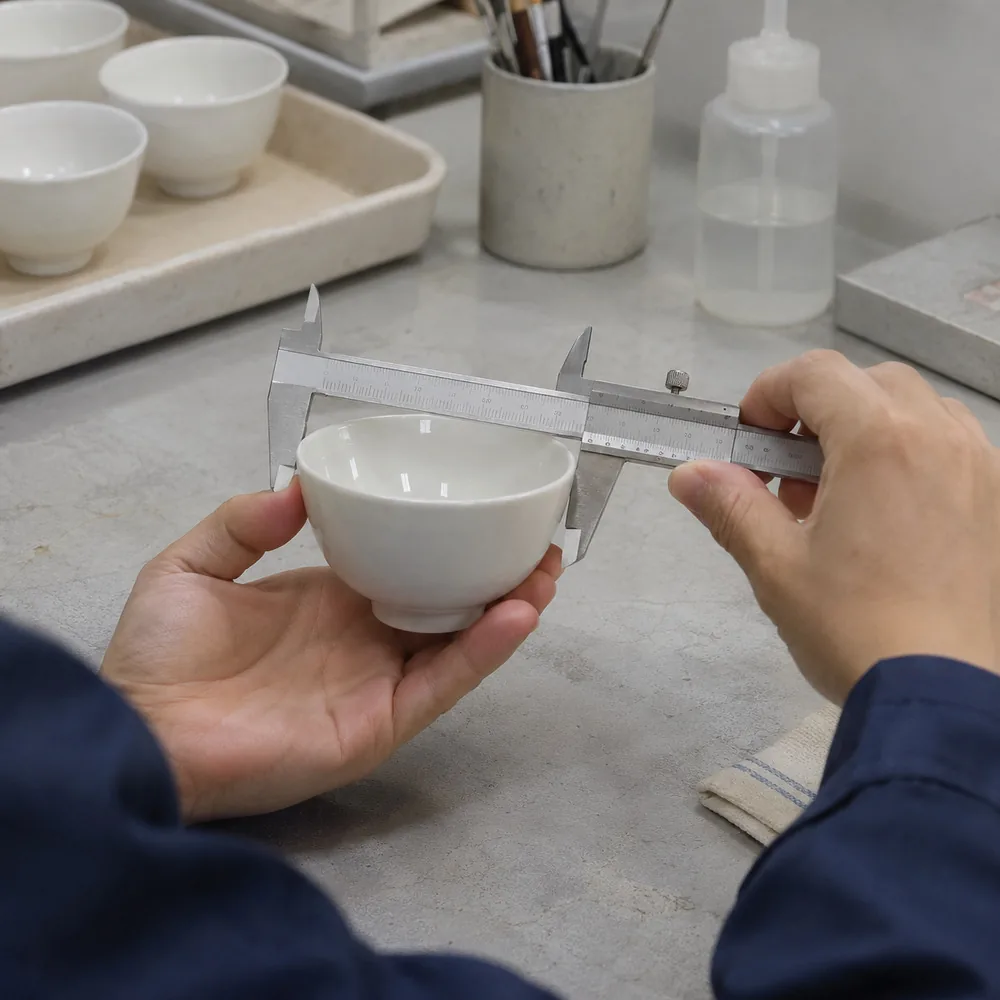
A gaiwan is held between the thumb and middle finger on the rim, with the index finger on the lid knob. The span across the rim decides whether that grip is comfortable. Our GW-100 measures 8.4 cm across and the GW-200 10.4 cm. For a smaller hand, two centimetres is the difference between a firm grip and a stretch. When a shop sells to the public, the smaller sizes return less often.
A quick test on samples
Fill each sample to just below the flare with hot water and lift it the way a customer will. If you have to rush the pour, the size is wrong for that hand. Ask two or three people with different hand sizes to try it.
Myth 3: “Use a gaiwan for green tea and a clay pot for everything else”
A clay teapot of unglazed stoneware slowly absorbs the oils of whatever is brewed in it, which is why tea drinkers keep one pot per type of tea. Glazed porcelain does not. Our porcelain absorbs 0.5% of its weight in water or less, and a glazed bowl gives the tea nothing to soak into, so nothing carries over from one tea to the next.
That makes a porcelain gaiwan the right tool for tasting: a green tea in the morning, a roasted oolong in the afternoon, and each tastes of itself. Tea shops and tea brands use gaiwans to cup new teas for the same reason. Our guide to porcelain vs ceramic explains why the absorption number matters.
Myth 4: “Thicker walls keep the tea hotter, so thick is better”
For a gaiwan, thick walls mostly keep your fingers hotter. The tea spends seconds in the bowl, not minutes, so heat retention matters less than a body that warms evenly and stays comfortable to hold.
What matters is that the wall is even. A wall that is thick on one side and thin on the other heats unevenly and is more likely to crack when boiling water hits it. We check wall thickness on the line every two hours and hold it to ±0.4 mm.
How we keep the wall even
Our gaiwans are formed on six high-pressure casting machines, which press the slip into the mold under pressure and give a more even wall than open casting. Wall thickness is held to ±0.4 mm and checked during production every two hours. An even wall heats evenly, cools evenly and feels the same wherever the fingers rest.
Check the wall against the light
Hold an empty sample up to a bright light. Fine porcelain shows the light through it; an even wall shows it evenly. A darker band near the foot or a patch on one side means a thicker area, and that is where the heat will build up.
Myth 5: “If it says Jingdezhen, it is handmade”
Jingdezhen has two kinds of gaiwan makers. Studios throw and paint gaiwans by hand, one at a time, and each is a little different. Factories like ours make them on molds, so the 10,000th gaiwan matches the first and the lid fits every bowl.
Both are real Jingdezhen porcelain; they are different products at different prices. What you should check is that the piece is made in Jingdezhen at all, because the name sells. Our guide to Jingdezhen porcelain lists four checks, from the factory address to a live video walk.
Our own Sancai shape is protected by design patent ZL 2024 3 0744188.3 (GW-160), and our Qing’ai tea ware won a 2026 silver award for daily-use ceramic design from the China Ceramic Industry Association.
Studio gaiwans and factory gaiwans
| Studio gaiwan | Factory gaiwan | |
|---|---|---|
| Forming | Thrown or cast by hand | High-pressure casting |
| Decoration | Hand-painted, each piece different | Underglaze, in-glaze or glaze colour, repeated exactly |
| Consistency | Each piece is unique | Size, weight and colour to a tolerance |
| Volume | A few to a few hundred | Thousands, with reorders that match |
| Best for | Collectors, tea masters, one-off gifts | Tea shops, brands, gift sets, hotel tea service |
For a shop or brand, the factory gaiwan is the one that can be reordered next year and still match the stock on the shelf.
Myth 6: “Decoration is only on the outside, so it does not matter”
Your lips touch the rim when you drink straight from a gaiwan, and hot tea runs over the inside of the lid on every pour. Both are food-contact surfaces.
On those surfaces we decorate underglaze or in-glaze only, as blue and white has been done in Jingdezhen for centuries: the cobalt sits under the clear glaze, where tea and lips never reach it. We check lead and cadmium release on our own Agilent 7900 ICP-MS and hold it to half the legal limit. If a supplier’s gaiwan has a printed pattern on the rim or inside the lid, ask how it was applied and for the test report that covers it.
Decoration that suits a gaiwan
Three looks work well on a gaiwan, and all three keep the drinking surfaces safe.
- Blue and white. Cobalt under the glaze, the classic Jingdezhen look, sealed by the glaze inside and out.
- Coloured glaze. Celadon greens, soft blues and whites, where the colour is the glaze itself. Our Qing’ai tea ware series, which won a silver design award from the China Ceramic Industry Association in 2026, takes its look from glaze and form.
- A mark on the saucer. A brand logo under the saucer or on its rim, away from the lips and the tea.
What to check before you order gaiwans
If you are buying gaiwans for a tea brand, a shop or a gift programme, check these five things on the samples:
| Check | How |
|---|---|
| Lid fit | The lid sits level, does not rock, and leaves an even pouring gap all round |
| Flare | Fill below the flare with boiling water; you can hold it through a full pour |
| Wall | Hold it to the light; the glow should be even, with no thick patches |
| Inside glaze | Fully glazed, smooth, no pinholes where tea collects |
| Reports | Lead and cadmium reports for your market, covering the decoration you chose |
Two checks buyers forget
The lid fit
The lid should sit low in the bowl, move freely when tilted and leave a narrow, even gap for pouring. A lid that rocks, or one that jams when hot, makes every infusion harder. Pour boiling water through each sample a few times; porcelain expands slightly when hot, and a fit that is tight cold can stick.
The saucer under a full bowl
Put the full gaiwan on its saucer and slide the saucer across a table. The bowl should stay centred. A saucer with a shallow well lets the bowl slide when it is carried, which is how most gaiwans are dropped.
How a factory gaiwan is made
A gaiwan looks simple: a bowl, a lid and a saucer. Making three parts that fit every time, at thousands a month, is where factory gaiwans differ from one another.
Forming: pressure-cast, not thrown
Our gaiwans are formed on six high-pressure casting machines, the same line that makes our teapots. Casting under pressure packs the porcelain evenly through the wall, which is what lets us hold wall thickness to ±0.4 mm and keep the flared rim the same height on every bowl. The lid and saucer are cast separately to fit that bowl.
Firing: shuttle kilns for tea ware
Tea ware is fired in our shuttle kilns at 1,250–1,300 °C rather than in the large tunnel kilns used for plates and mugs. A shuttle kiln fires one batch at a time, so a tea-ware glaze can be fired on its own curve. We make about 1.8 million pieces of tea ware a year on this line.
Fit: bowl, lid and saucer as one part number
The lid is checked on its own bowl, not on a gauge alone. A lid that sits a fraction too deep traps steam and is hard to lift; one that sits too high rocks when the bowl is tipped. Because the three parts are matched, a replacement lid from a later order still has to fit an earlier bowl, which is why we keep the molds and the glaze recipe on file for every gaiwan we make.
Our four gaiwans, filled
Capacity on a product sheet is measured to the brim. In use, a gaiwan is filled to just below the flare, and the weight in the hand is the empty weight plus the water.
| Model | Capacity | Rim across | Empty, with lid and saucer | Filled, approximately |
|---|---|---|---|---|
| GW-100 | 100 ml | 8.4 cm | 320 g | About 420 g |
| GW-130 | 130 ml | 9.0 cm | 385 g | About 515 g |
| GW-160 | 160 ml | 9.6 cm | 430 g | About 590 g |
| GW-200 | 200 ml | 10.4 cm | 490 g | About 690 g |
Two things follow. A 200 ml gaiwan full of near-boiling water weighs about 270 g more than a full 100 ml one, held by the fingertips. And the rim span grows by 2 cm across the range, which decides whether a smaller hand can hold the rim and lid together. For a public-facing shop, stock the 100 and 130 ml sizes deepest.
The GW-160 shape
The GW-160 is our own design, protected by Chinese design patent ZL 2024 3 0744188.3.
Matching the gaiwan to the tea
A gaiwan works for almost any tea, but the size and the way it is used change with the leaf.
| Tea | Size that suits it | Why |
|---|---|---|
| Green and white teas | 130–160 ml | More water at a lower temperature; the leaves open without stewing |
| Oolong | 100–130 ml | More leaf for the water and many short infusions |
| Dark and aged teas | 100–130 ml | Short, hot infusions; a small bowl keeps the heat even |
| Tasting several teas | 100 ml, several bowls | Same size and glaze, so only the tea differs |
These are starting points, not rules. A tea brand that sells one kind of tea can choose a single size that suits it and print its own brewing card for that size.
White, celadon or coloured?
White inside
A white or high-white interior shows the colour of the tea liquor, which is how many drinkers judge a brew. Our high-white porcelain absorbs 0.3% water or less, so it does not take up tea stains the way a more porous body does, and a white bowl looks the same after a year of use.
Celadon and soft glazes
Celadon suits green tea and sits well with wood and linen in a tea room. Our Qingai celadon tea ware won a 2026 silver award for daily-use ceramic design from the China Ceramic Industry Association. A soft glaze outside with white inside gives the look without hiding the tea.
Your own colour
Your glaze colour, matched to your Pantone in our 300 m² sample room, starts at 1,000 pieces. Approve it on a fired gaiwan, not a tile, because the colour on a curved flare reads differently from a flat sample.
Packing three parts so they arrive as one
Inside the carton
Bowl, lid and saucer travel in one insert that keeps the lid from rattling against the rim. The rim and the lid edge are the parts most likely to chip. Our gaiwans pack 36 to a carton for the 100 and 130 ml sizes, 30 for the 160 ml and 24 for the 200 ml, in five-ply cartons drop-tested from 1.2 m to ISTA 1A and 3A.
In a container
A 40HQ holds 44,244 GW-100 gaiwans or 22,944 GW-200s. If a range includes both, the large size nearly doubles freight per piece, which is worth knowing before you set the retail price. Our container loading guide has the figures for every model.
Gaiwans for shops, brands and gifts
We make about 1.8 million pieces of tea ware a year, gaiwans among them, and supply them in three main ways.
Shops and tea brands
A Japanese retail chain buys our gaiwans, small dishes and side-handle teapots, about 960,000 pieces a year, with every SKU tested under Japan’s Food Sanitation Act. For a shop or brand, an existing gaiwan with your glaze or mark is the usual start: 500 pieces per model in our glaze, 1,000 for your glaze colour.
Gift sets
A gaiwan with two or four cups makes a compact gift set. We pack sets from 1,000 sets, in colour boxes or rigid gift boxes with EVA inserts, and the box design is part of our design work. Our guide to ceramic corporate gifts covers timing and decoration for gift orders.
Hotels and tea rooms
Hotel tea service usually pairs a gaiwan for tasting with teapots for table service. Hotel and project orders start at 200 pieces per item, with a lead time of 30–40 days.
A first gaiwan range for a tea brand, planned
Here is how a tea brand might plan a first range with us, using only existing shapes, so no mold is needed.
The range
| SKU | What it is | Why it is in the range |
|---|---|---|
| Everyday gaiwan | GW-100 in white | The entry point for new customers; easiest to hold |
| Brand-colour gaiwan | GW-130 in the brand’s glaze | The hero product, in the brand colour |
| Tasting set | Three GW-100 bowls | For customers comparing teas side by side |
| Gift set | GW-130 with cups in a gift box | For seasonal gifting |
Minimums
The white GW-100 is an existing model in our glaze, from 500 pieces. The GW-130 in the brand’s own glaze starts at 1,000 pieces. A logo as a decal starts at 1,000 pieces, and that minimum can be spread across models and colours, so the same mark can go on the white and the coloured gaiwans within one order. Gift sets in a box start at 1,000 sets.
Timing
Existing models in our glaze take 25–30 working days from deposit, a new glaze colour 30–35, and a decal logo 35–40. July to October adds 7–10 days. For a gift set aimed at a festival, plan back from the date the boxes must be in your warehouse, not from the festival itself.
What to approve, in order
- Gaiwan size in the hand, on stock samples, sent free within 3 days.
- The brand glaze, on a fired gaiwan.
- The logo position and size, on a custom sample (7–15 days, refunded when you order).
- The gift box, with the gaiwan and cups inside, drop-tested in its export carton.
- Food-contact reports for the markets you sell in, covering every glaze and decoration.
Growing the range later
Once the first range sells, a teapot in the same glaze is the usual next step, so customers can brew for a group. Our guide to gaiwan vs teapot compares the two, and a shape of your own, with a 3D-printed prototype in 3 days and a mold from 3,000 pieces, is the step after that.
Caring for a porcelain gaiwan
Glazed porcelain is easy to keep. Rinse it with hot water after use; tea oils do not soak into a body that absorbs 0.5% water or less, so it needs no seasoning and holds no flavour between teas. A plain or underglaze gaiwan can go in a dishwasher. In a cold room, warm it with hot tap water before the first boiling pour, and never put it on a stove or a flame.
Ordering gaiwans and tea sets from us
Stocking teapots as well? Our gaiwan vs teapot comparison sets the two side by side, with sizes, weights and carton counts.
- Our shapes as they are: from 500 pcs, ready in 25–30 days.
- Your glaze colour, matched to your Pantone in our 300 m² sample room: from 1,000 pcs.
- Your logo, underglaze, in-glaze or as a decal on the outside: from 1,000 pcs.
- Tea sets in a gift box with a magnetic lid and EVA insert: from 1,000 sets. We made a co-branded tea set for FAW-Audi; see our ceramic corporate gift ideas.
- A shape of your own: from 3,000 pcs, starting with a 3D-printed prototype in 3 days.
A gaiwan is for hot water, never for a stove or an open flame.
See our tea ware range for the GW gaiwans and TP teapots, or send us your brief and we will post two stock samples in 3 days, so you can run the boiling-water test yourself.