“FDA approved” is the most common claim on Chinese dinnerware listings, and it describes something that does not exist. The FDA does not approve plates or mugs. It sets limits on how much lead and cadmium may leach from them, and it tests imports against those limits at the border. What a buyer needs is not an approval but a lab report showing the product was tested to the right standard for the market it is sold in.
Each market has its own rules, methods and paperwork. Here is what applies where, and how to check that a supplier’s report actually covers your goods.
What is being tested, and why decoration matters
Food-contact tests on ceramics measure leaching: the amount of lead and cadmium that comes out of the glaze or decoration when an acidic liquid sits in the piece. The US method, ASTM C738, fills the ware with 4% acetic acid for 24 hours at room temperature and measures what dissolves.
Clay itself is rarely the problem. The risk sits in glazes and coloured decoration, particularly reds, yellows and oranges, and in decoration that is fired at too low a temperature to seal into the glaze. That is why we keep decals and gold off every surface that touches food. Food-contact surfaces at our factory are underglaze or in-glaze only, fired at 1,260–1,320 °C.
It also means a report on a plain white plate tells you nothing about the same plate with your pattern on it. Every decoration change needs its own coverage.
How a leaching test works
The basic method is the same in most markets. The piece is filled with a weak acid, 4% acetic acid, and left covered at room temperature for 24 hours. The acid stands in for acidic foods such as vinegar, fruit juice and tomato sauce. It is then analysed for lead and cadmium, and the result is reported in milligrams per litre for hollow pieces or per square decimetre for flat ones.
The acid only touches the inside surface. That is why the method tests what reaches food, not the whole piece, and why decoration on the outside wall is tested separately when it sits close to where a mouth touches the rim.
Flat, small, large: why the shape decides the limit
Regulators sort ceramics into categories by shape: flatware such as plates, small hollowware such as bowls, large hollowware such as serving dishes, and cups and mugs. A deep piece holds more liquid against more surface for longer, so it can release more. The limit tightens accordingly, and cups and mugs, which are used every day and held to the lips, have among the tightest limits.
Which category your product is in
Check the category on the report, not only the result. A mug tested as a “small hollowware” item, or a deep bowl tested as “flatware”, has been held to the wrong limit. The result may look like a pass and still not support your claim.
The rules by market
| Market | Rule | What it sets |
|---|---|---|
| United States | FDA CPG Sec. 545.450 (lead) and 545.400 (cadmium), tested by ASTM C738 | Action levels by ware type; imports over them can be detained |
| California | Proposition 65 | A warning is required unless exposure is below the state’s thresholds |
| Canada | Glazed Ceramics and Glassware Regulations, SOR/2016-175 | Leachable lead and cadmium limits for food-contact ware |
| European Union | Regulation (EC) No 1935/2004 and Directive 84/500/EEC; in Germany also LFGB §30/§31 | Migration limits plus a Declaration of Conformity for each product |
| Japan | Food Sanitation Act, MHLW Notice 370 | Lead and cadmium elution limits by ware type |
The US limits depend on the shape of the piece, because a deep mug holds acidic liquid against more glaze for longer than a flat plate does:
| FDA category | Lead, µg/mL | Cadmium, µg/mL |
|---|---|---|
| Flatware (25 mm deep or less), average of 6 units | 3.0 | 0.5 |
| Small hollowware under 1.1 L, other than cups and mugs | 2.0 | 0.5 |
| Cups and mugs | 0.5 | 0.5 (small hollowware) |
| Large hollowware, 1.1 L or more, other than pitchers | 1.0 | 0.25 |
| Pitchers | 0.5 | 0.25 (large hollowware) |
Lab reports often cite these guides by their older numbers: CPG 7117.07 for lead and 7117.06 for cadmium. They are the same limits.
Source: FDA CPG Sec. 545.450 and CPG Sec. 545.400.
Notice that cups and mugs share the tightest lead limit, a sixth of the limit for plates. A supplier that passes plates comfortably can still fail on mugs with the same glaze.
For the EU, the limits are set in Directive 84/500/EEC, and every shipment needs a written Declaration of Conformity from the manufacturer. Ask your lab to confirm the version in force on your import date.
Canada, Japan and California
| Market | Rule | How it works |
|---|---|---|
| Canada | Glazed Ceramics and Glassware Regulations, SOR/2016-175 | Lead and cadmium limits for glazed food-contact ceramics, by product category |
| Japan | Food Sanitation Act, MHLW Notice No. 370 | Specifications for apparatus and containers that touch food, including lead and cadmium release |
| California | Proposition 65 | A warning law: products that expose consumers to listed chemicals above set levels need a warning label |
Proposition 65 is the one buyers misread most. It is not an approval scheme. Retailers selling into California usually ask suppliers for test results showing the product is below the levels at which a warning is needed, so that no warning has to go on the box. Ask your retailer which levels it requires before the test is booked.
What our reports cover
These are the tests behind our current lines. Each report carries the issuing lab’s number, which you can check with that lab; the document images are on our certifications page.
| Market | Test | Covers |
|---|---|---|
| US | Lead and cadmium release, FDA CPG 7117.06/07, ASTM C738 and C927 | 14 series, 62 SKUs |
| California | Proposition 65, lead and cadmium | 38 US-line SKUs |
| Canada | SOR/2016-175, leachable lead and cadmium | 38 Canada-line SKUs |
| EU and Germany | LFGB §30/§31 and EC 1935/2004 food contact | All food-contact shapes |
| EU | Declaration of Conformity, food contact | All categories, issued per batch |
| Japan | Food Sanitation Act, MHLW Notice 370 | 22 Japan-line SKUs |
ASTM C927 in the US report measures lead and cadmium from the lip and rim area, where external decoration sits closest to the mouth.
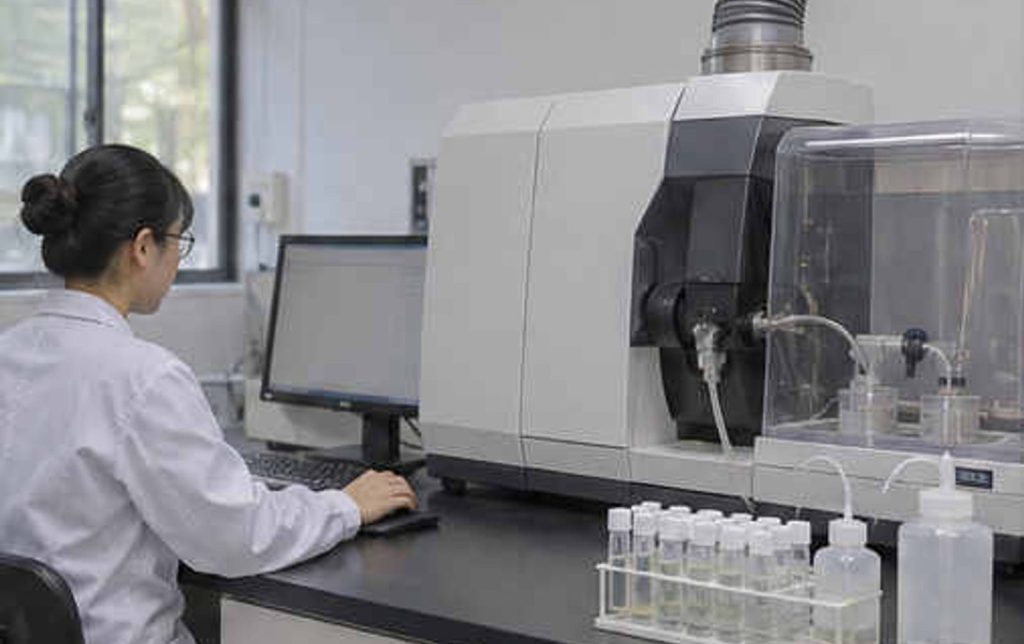
Before a batch goes to the outside lab, we test it on our own Agilent 7900 ICP-MS against an internal limit of half the legal limit. A result at 90% of the limit is a pass on paper and a warning to us: glaze chemistry drifts, and the next batch may not pass. The 50% line gives us room to catch that drift before it reaches a customer.
Coverage on our current lines
| Test | Coverage |
|---|---|
| FDA guides; ASTM C738 and C927 | 14 series, 62 SKUs |
| California Proposition 65 | 38 SKUs in our US line |
| Canada SOR/2016-175 | 38 SKUs in our Canadian line |
| LFGB; Regulation (EC) No 1935/2004 | All food-contact shapes |
| EU declaration of conformity | Issued per batch, with the goods |
| Japan, MHLW Notice No. 370 | 22 SKUs in our Japanese line |
Reports travel with the container and can be sent ahead of the goods. If your SKU, decoration or market is not in the table, the test is planned into the sample stage of your order.
How to read a supplier’s test report
A report is only useful if it matches what you are buying. Check six things:
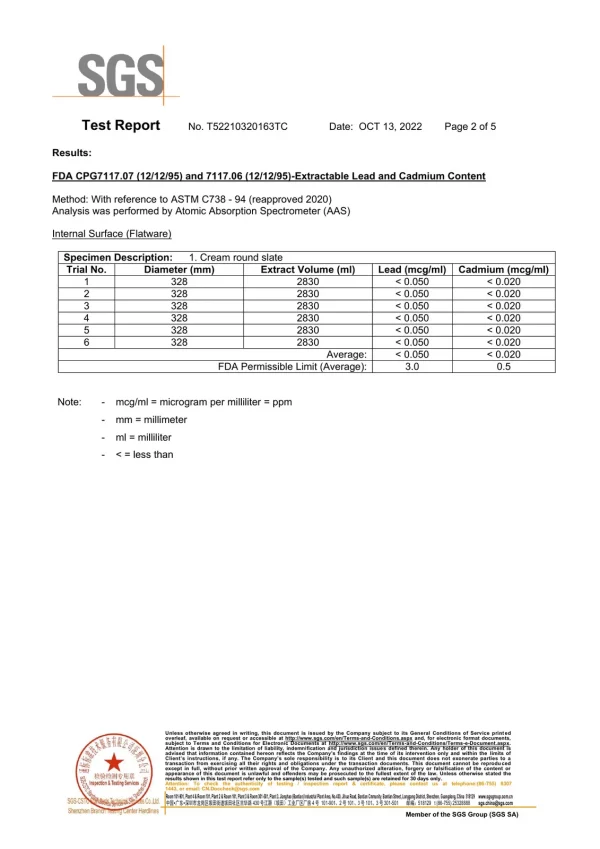
- The standard. It should name the rule for your market, not a general “food safe” test.
- The lab and report number. Accredited labs such as SGS, Intertek, Bureau Veritas and TÜV can usually confirm whether a report number is genuine.
- The date. Treat a report older than a year as a starting point, not proof. Glazes and suppliers change.
- The sample description and photo. The tested item should match your SKU: same shape, same glaze, same decoration.
- The result against the limit. Look at the measured value, not just “Pass.” A mug at 0.45 µg/mL against a 0.5 limit passed, but only just.
- Who sent the sample. A sample the factory chose is the best-case piece. For a large programme, have your inspector draw samples from the bulk order and send them to the lab directly.
One of our US warehouse club customers receives an SGS report inside every container. That is the standard to aim for on a large programme: test results tied to the batch you received, not to a sample from last year.
Red flags on a test report
Most reports that cause problems are real reports for the wrong thing. Look for these:
- A generic product description. “Ceramic cup” covers every cup the supplier makes. A useful report names the model, the size and the decoration.
- A sample that does not match. Ask for the photo of the tested sample, which most labs include. Compare it with what you are buying.
- The wrong market. An FDA result does not cover an EU shipment, and an EU result does not cover Canada.
- An old report for a new decoration. A new decal or a new glaze colour is a new version. The old report covers the old version.
- Only a pass mark. A report should show the measured value, the limit and the method. “Pass” alone does not tell you how close the result was.
How close to the limit is close enough?
A result at 90% of the limit is a pass, and a result that may fail on the next batch. That is why we set our own limit at 50% of the regulatory limit for every food-contact shape. The gap is there for the variation between batches, not for the test.
Why we never write “lead-free”
We don’t use “lead-free” on our products, and we suggest you don’t put it on your packaging either. No test proves zero; it proves a result below a detection limit, and detection limits vary by lab and method. The phrase also means different things in different markets, and a retailer’s compliance team or a regulator can ask you to prove it.
What you can defend is specific: the standard, the report number and the result. “Tested to FDA CPG 7117.06/07 and ASTM C738”, with the lab’s report number beside it, survives scrutiny. “Lead-free” invites it. The same goes for “non-toxic” and “100% safe.”
Claims to avoid, and what to write instead
| Avoid | Write instead |
|---|---|
| Lead-free | Tested to ASTM C738 and C927 for lead and cadmium release, for the tested lines |
| FDA approved | Meets FDA guidance levels for lead and cadmium release, per test report for this SKU |
| Non-toxic | Tested for lead and cadmium release to [standard] |
| 100% safe | Food-contact tested for [market] |
The longer wording is less catchy and much easier to defend. It says what was tested, to which standard, and for which products.
How we keep release low before any test
A test report shows the result for the samples tested. What keeps every batch below the limit is the way the product is made.
Decoration where food cannot reach it
On every surface that touches food or a mouth, we decorate underglaze or in-glaze only. Colour under or within the glaze is sealed by it. Decals and gold go on outer walls, away from food and lips. This single rule removes most of the risk before any test is run.
A patented underglaze process
We hold a Chinese invention patent, ZL 2023 1 0822016.8, for an underglaze decoration process designed for low lead and cadmium release. It was developed for exactly this problem: getting the colour range buyers want under the glaze, without the release that some pigments bring.
Testing every batch in-house
Before a batch goes to an outside lab, we test it on our own Agilent 7900 ICP-MS, to the FDA and LFGB methods. The limit we test against is our internal one, 50% of the regulatory limit, so a problem shows up in our lab first. The outside lab confirms the result; it is not where we expect to find one.
What to ask before you order
Send your supplier three questions in the first email: which markets their current reports cover, which of your SKUs are on those reports, and whether your decoration needs a new test. If the answer to the last one is “no” and your decoration is new, get a second opinion.
Our certifications page lists every current report and audit with its number and date, and our quality control page shows where in production each check happens. For the wider order process, see our guide to sourcing ceramic dinnerware from China. If you are planning a line for a specific market, tell us the market and the SKUs and we will tell you which reports already cover them.