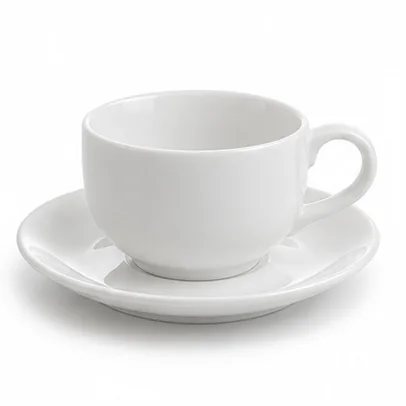
A café’s cups go through a commercial dishwasher several times a day, so a logo that looks perfect on the sample can be grey by the end of the first year. The method used to put the logo on matters more than the artwork. Underglaze and laser logos cannot wash off; a decal fades with washing; gold wears fastest of all.
This guide covers how to choose the method, where to put the logo, which sizes to brand, what the minimums are, and how to keep reorders matching the cups already on your shelf.
Choose the logo method for the dishwasher, not the photo
The method decides how long the logo lasts. Choose it for the way the cups are washed, then fit the artwork to the method.
| Method | How it looks | In a café dishwasher | Best for |
|---|---|---|---|
| Underglaze logo | Soft-edged, under a layer of glaze | Cannot wash off | Everyday cups, single-colour marks |
| In-glaze decoration | Sunk into the glaze during firing | Holds up well | Colour marks that need to last |
| Decal on the outer wall | Sharp, any Pantone, fine detail | Fades over time; lasts longer washed by hand | Detailed or multi-colour logos, retail mugs |
| Laser marking | Engraved into the glaze, one tone | Permanent | Small marks, saucer rims, serial numbers |
| Gold line or gold logo | Metallic | Wears fastest; never microwave safe | Retail and gift cups, not daily service |
Cups for daily service
For cups that run through a commercial machine every day, we recommend underglaze, in-glaze or laser. These marks are part of the glaze or under it, so the detergent and the knocks in the rack cannot reach the colour.
Cups and mugs to sell or take home
Keep decals for retail mugs and take-home cups that will be washed less often. A decal can carry any Pantone colour, gradients and fine type, which suits merchandise. Our guide to underglaze vs overglaze covers each method in detail, and dishwasher-safe dinnerware explains what a dishwasher test actually measures.
What each method does to your artwork
Underglaze and in-glaze
These suit simple marks in one colour, or a few flat colours. Very thin lines soften slightly under the glaze, so a logo with fine type may need the type thickened.
Decal
A decal reproduces the artwork as it is, including photographs and gradients. Each colour needs its own printing plate, so a five-colour logo costs more to set up than a one-colour one.
Laser
Laser marking is one tone, engraved into the glaze surface. It is best for small marks, numbers and wordmarks rather than filled shapes.
Put the logo where it is seen and not touched
Placement affects both how the logo is seen and how long it lasts.
On the cup
The logo works best on the outer wall, on the side facing the customer when the handle is to the right. Inside the cup and on the rim, keep to underglaze or in-glaze only, because those surfaces touch the drink and the mouth.
On the saucer
The saucer is a good second place for a small laser or underglaze mark, near the rim where the cup does not cover it. A mark in the well of the saucer is hidden by the cup and scuffed by every placement.
On the base
A back stamp under the cup carries the brand, the range name or a production code without affecting the design. Laser or underglaze back stamps last as long as the cup.
Pick sizes from the menu, then keep the range small
Our café cups and saucers run from 180 to 300 ml. Fewer sizes mean less stock, faster replacement and a single logo layout. Our guide to coffee cup sizes matches each size to the drinks on a menu; most cafés need two or three sizes, not five.
Our four café cups, measured
| Model | Cup | Saucer | Unit weight | Per carton | Per 40HQ |
|---|---|---|---|---|---|
| CF-180 | 180 ml | 14 cm | 225 g | 36 | 39,240 |
| CF-220 | 220 ml | 15 cm | 260 g | 36 | 33,444 |
| CF-260 | 260 ml | 16 cm | 300 g | 30 | 27,090 |
| CF-300 | 300 ml | 17 cm | 340 g | 24 | 20,496 |
The container column matters for a chain buying in volume: a 40HQ holds nearly twice as many CF-180 sets as CF-300 sets, so freight per piece on the largest cup is about 1.9 times that of the smallest.
Check the logo on each size
A mark that fits a 300 ml latte cup may need scaling down for a 180 ml cup, and may need its own decal or logo plate. Approve the logo on a sample of each size, not on one.
Weight and feel
Heavier cups keep heat longer and feel more substantial; lighter cups are easier for staff to carry by the tray. Our cups hold piece weight to ±3%, so a reorder feels the same in the hand as the first order.
Colour: a brand glaze or a white cup with a mark?
Most cafés choose between two looks: a white cup with a coloured logo, or a cup glazed in the brand colour.
White cups with a logo
A white interior shows the colour of the coffee and the crema, which is why many cafés keep the inside white even when the outside is coloured. A white body also makes a reorder easy to match. Our high-white porcelain absorbs 0.3% water or less, so it resists the coffee and tea stains a more porous body takes up.
Cups in your brand colour
We match glaze to your Pantone reference in our 300 m² sample room and fire colour tiles before the sample is made. Your own glaze colour starts at 1,000 pieces. A coloured outside with a white inside is a common combination, and approving the colour on a fired sample, not a printed chip, avoids surprises.
Heat, preheating and the espresso machine
Café cups live on top of espresso machines and go from the warmer to the dishwasher and back many times a day.
Thermal shock
Our porcelain is tested by quenching from 180 °C into 20 °C water with no cracks, to ASTM C554. That covers the normal swing from a hot cup warmer to a cold rinse. What it does not cover is a cup with a hidden crack from a knock in the rack, so retire chipped cups rather than keep them in service.
Microwaves behind the counter
Plain, underglaze and in-glaze cups are fine in a microwave. Anything with gold or metallic decoration is never microwave safe, which is another reason to keep gold for retail pieces. Our guide on whether porcelain is microwave safe explains the test.
Minimums and lead times
| Order | Minimum | Lead time |
|---|---|---|
| Our cups, no logo | 500 pcs per model | 25–30 working days |
| Hotel and restaurant projects, plain | 200 pcs per shape | 30–40 working days |
| Your logo, one-colour decal | 1,000 pcs | 35–40 working days |
| Your logo, multi-colour or gold | 1,500 pcs | 35–40 working days |
| Underglaze or laser logo plate | Plate made in 5 days | With the order |
| Your own glaze colour | 1,000 pcs | 30–35 working days |
Lead times run from deposit and signed artwork. The decal minimum of 1,000 can be spread across cup sizes and colours. July to October adds 7–10 days, because every holiday programme is in production at once.
Samples before the order
Stock samples
Two stock cups go out free within 3 days; you pay the courier. Use them to check size, weight and how the cup sits on your saucers and in your machine.
Custom samples
A custom sample with your logo or glaze takes 7–15 days after the artwork is approved. It is charged, then refunded when you order. Approve the logo position, size and colour on this sample; it becomes the standard the order is checked against.
Plan for breakage and reorders from the start
Cafés lose cups steadily, so the first order is only the start.
Keep the tools on file
We keep molds, decal or logo plates and the glaze recipe for every customer’s range, so a reorder uses the same tools and the same recipe as the first order.
Put the colour limit in writing
We hold ΔE 2.0 between batches, so a reorder sits next to the first cups without looking like a different set. Our guide to glaze colour matching explains the limits.
Size the reorder to your breakage
Count how many cups you replace in a quarter, by size, and reorder before the shelf runs short rather than after. For a chain, pool the reorder across sites so it reaches the minimum without holding too much stock in each café.
For chains and coffee brands
One standard across every site
A chain needs every store’s cups to match. Order all sizes in one production run where possible, with one approved sample per size, and keep a reference set at head office for checking deliveries.
Retail mugs alongside service cups
Many coffee brands sell mugs as merchandise. These can carry a full-colour decal, because they are washed at home less often, while service cups use underglaze or laser. Our branded mugs page covers retail mugs and gift boxes.
Lessons from airport and hotel service
Commercial buyers specify cups the same way. Hainan Airport’s first order for its VIP lounges included high-white cups and saucers, chosen for lounge dishwasher use, and its orders ship with dishwasher test reports. Atour Hotels takes porcelain with its own logo for rooms and public areas from us, nine shapes and about 180,000 pieces a year. Our guide to hotel and restaurant dinnerware covers the full specification.
Three buyers, three different orders
The same cup can be ordered three quite different ways. Here is how the decisions above play out for three common buyers.
An independent café
One site, two or three drink sizes, and cups replaced a few at a time. The simplest route is our stock cups in white with an underglaze or laser logo: the mark survives the machine, and plain cups without a logo can be reordered from 500 pieces per model if the logo minimum is too high for a single café. If 1,000 logo cups are more than one site needs, spread the decal minimum across two sizes.
A café chain
Many sites, one standard. Order every size in one production run where possible, approve one sample per size, and keep a reference set at head office. Pool reorders across sites so each one reaches the minimum, and keep the molds, logo plates and glaze recipe on file so a reorder two years later matches the first.
A coffee roaster with a retail line
Service cups for the roastery bar, mugs for the shop shelf. Use underglaze or laser on the service cups and a full-colour decal on the retail mugs, which are washed less often and sell on their artwork. Put the retail mugs in a printed colour box or gift box carrying only your brand, and check the food-contact reports for the market where the mugs are sold, not only where the café is.
Send us your logo and menu
Send the logo file, your menu sizes and an estimate of how many cups you use a year. We will suggest the logo method and sizes, and send a sample with your logo before the order. You can also see our coffee cups and saucers, or contact us.