Since 2018 we have shipped quarterly reorders of eight SKUs to a Nordic home retailer: 16.8 million pieces over eight years. With a delivery every quarter, new stock always ends up next to old, so their specification has one colour line that matters more than any other: ΔE 1.5 or less. Three things hold it. The glaze recipe is locked to them, the tunnel kiln temperature is logged at nine points on every run, and a sample from each batch is kept for three years.
None of that is unusual technology. What is unusual is writing the colour down as a number and controlling each cause of drift separately. Here are the six mistakes we see most often when a reorder comes back a shade off, and what fixes each one.
What ΔE means, and the two limits to write down
ΔE is a single number for how far a measured colour sits from a reference. Below about 1.5, most people cannot see a difference with two pieces side by side. Above 2 to 3, a buyer standing at the shelf usually can.
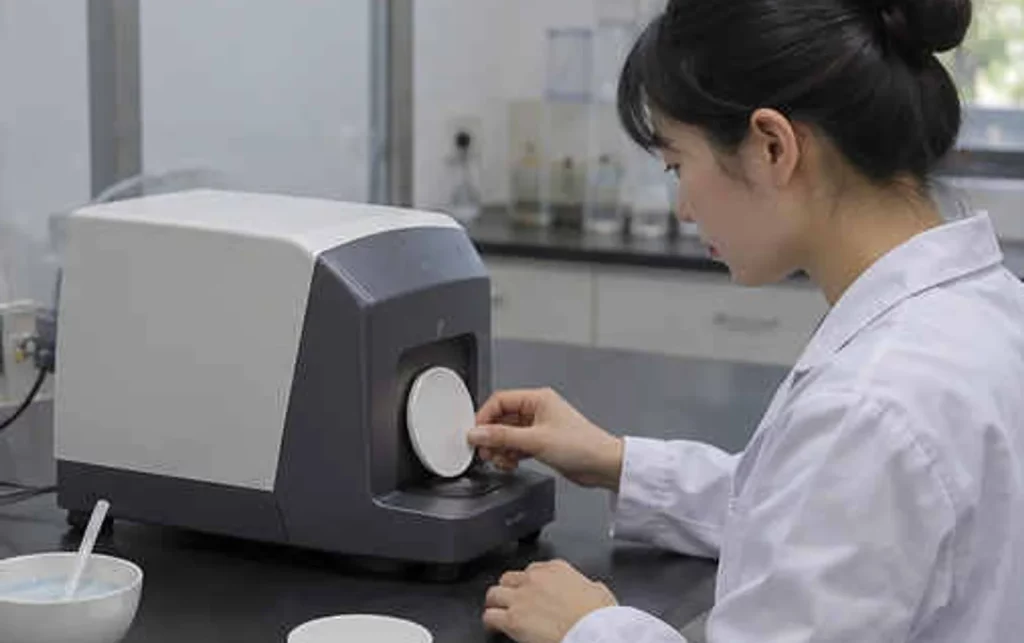
We work to two limits, measured on an X-Rite Ci7800 spectrophotometer under D65 daylight at a 10° observer:
| Comparison | Our limit | What it protects |
|---|---|---|
| Pieces within one batch | ΔE ≤ 1.5 | A set matches in the box |
| One batch against the next | ΔE ≤ 2.0 | A reorder matches the shelf |
The instrument and the light are part of the limit. “ΔE 2.0” with no instrument and no illuminant is a number nobody can check.
What the numbers look like on a shelf
As a rough guide, a trained eye starts to see a difference between two pieces side by side at around ΔE 1, and most shoppers notice one at around 2 to 3, especially on pale or neutral colours. That is why the within-batch limit is the tighter one. Pieces from one batch sit next to each other on a shelf and in a set; pieces from different batches usually meet only when a customer replaces a broken plate.
Colour also matters more on some products than others. A white hotel plate with a ΔE of 2.0 against the last order looks the same in use. A deep green mug range displayed in a long row on a store shelf will show the same difference at once.
Ask which formula the number uses
ΔE can be calculated in more than one way, and the same pair of pieces gives different numbers under different formulas. When you put a limit in a contract, write the formula, the instrument, the illuminant and the observer angle next to it. A limit without them can be met on paper and missed on the shelf.
Mistake 1: approving the colour on a screen or a chip
A Pantone chip is ink on paper. A glaze is glass fused onto a ceramic body at over 1,260 °C, and the same pigment looks different on a white porcelain body than on paper or on a monitor. Approving a colour from a PDF means the first time anyone sees the real colour is in production.
Approve a fired piece instead. We match glazes to your Pantone reference in our 300 m² sample room, fire colour tiles in our electric kilns at 1,280 °C, and measure them against your reference before a production sample is made. The signed, fired sample then becomes the standard the order is inspected against.
How we match a colour to your reference
Our sample room covers 300 m², and colour matching is done there, against your Pantone reference or a physical sample. The first trial glazes are fired as colour plates in our electric sample kilns at 1,280 °C, measured on the spectrophotometer and compared with the reference. When a plate is close, it is fired again on the real shape, because a glaze on a curved mug wall reads differently from the same glaze on a flat test tile.
You approve the fired piece, not the plate. That piece, signed and dated, becomes the colour standard for the order.
Keep the approved piece at both ends
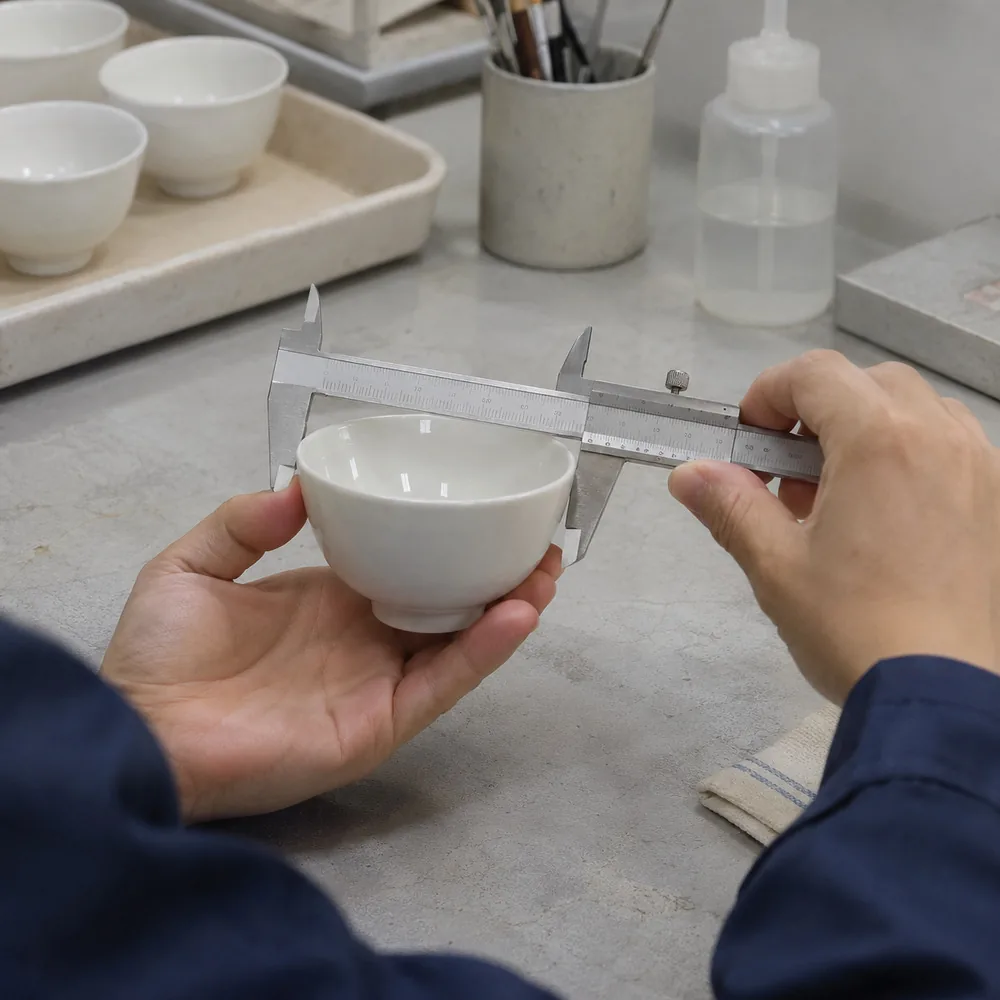
Keep one signed piece and send us its twin. At inspection, the bulk order is measured against the piece in our sample room; when the goods arrive, you can measure against yours. Two copies of the same standard leave nothing to argue about.
Mistake 2: no number in the contract
“Colour to match sample” invites an argument at inspection, because two people looking at the same plates will disagree. A number does not.
Write the limit, the instrument and the illuminant into the purchase order: within-batch ΔE, between-batch ΔE, and the reference it is measured against. If your inspector will measure colour at the factory, agree on the instrument model before the order starts. Our guide to sourcing ceramic dinnerware from China lists the other sample limits worth writing down at the same time, from rim diameter to plate warp.
Wording you can put in the purchase order
Here is the colour clause we suggest, filled in with our own limits:
Colour standard: the signed fired sample dated [date]. Within-batch colour difference ΔE 1.5 or less, between-batch ΔE 2.0 or less, measured on an X-Rite Ci7800 spectrophotometer, illuminant D65, 10° observer, on the glazed outer wall, three readings per piece averaged.
The last part, where and how many times the piece is measured, is the one most often left out. A reading on the rim and a reading on the body can differ on the same mug.
Mistake 3: treating glaze thickness as a detail
A thicker glaze layer reads darker and deeper; a thinner one lets more of the white body show through. On a coloured glaze, a few hundredths of a millimetre changes the colour you see.
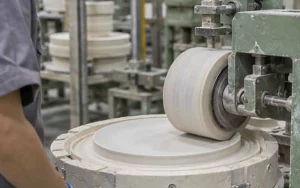
That is why thickness is a measured step on our line, not a hand skill. Glaze goes on 0.25–0.35 mm thick, applied by 12 glazing robots that repeat to ±0.02 mm, and thickness is checked in process every two hours. Ask a supplier how glaze thickness is controlled and recorded. If it is dipped by hand with no log, colour will follow whoever was on shift.
How glaze is applied, and why it varies
Glaze goes on in three ways: dipping, spraying and pouring. Each lays down a different amount on different parts of a shape. Dipping coats inside and outside together but can pool at the foot; spraying is even on outer walls but thinner in recesses; pouring suits large or deep shapes. The method is chosen for the shape, and then held the same for every order of that shape.
We apply glaze with 12 glazing robots, to a target of 0.25–0.35 mm and a repeatability of ±0.02 mm. Glaze thickness is one of the in-process checks recorded every two hours, next to dimensions and decal position.
Why the same glaze looks different on two shapes
A thick-walled bowl and a thin cup in the same glaze can look like two colours. The glaze pools in curves and thins on edges, and the body under it shows through by different amounts. If a range mixes shapes, approve the colour on each shape, not on one.
Mistake 4: ignoring the kiln
Glaze colour develops in the firing. A run that peaks hotter or cooler, or a kiln with hot and cold zones, produces different shades from the same glaze bucket.
Our four tunnel kilns fire at 1,260–1,320 °C and hold ±8 °C across the kiln, with nine thermocouples writing the temperature curve into our MES on every run. Every piece is traced to its kiln run and team, so if a shade drifts we can find the run it came from instead of sorting the whole order. That traceability is also what makes a supplier audit worth doing: ask to see the firing records for a recent order, not just the kiln.
Where the temperature is measured
Each of our tunnel kilns has 9 thermocouples along its length. The firing curve of every run is written to our production database, so the temperature a batch saw is a record, not a memory. When a colour moves, the first check is the kiln record for that batch.
Reorders fired on the same kiln line
A colour approved on one kiln line is reordered on the same line where possible. Our high-white dinnerware runs on tunnel kilns 1 and 2, strengthened porcelain and stoneware on kiln 3, and large and irregular pieces on kiln 4. Keeping a product on its kiln line removes one of the six causes of drift before the order starts.
Mistake 5: changing the body or the recipe between orders
The colour of a glaze depends on what is under it. Iron and other impurities in the clay shift whiteness, and whiteness shifts every colour on top of it. A factory that buys a cheaper clay batch, or a supplier that moves part of your order to another factory, changes your colour without changing the glaze name.
We check iron and impurities on incoming clay, mill each body for 18 hours and hold our porcelain to a whiteness of 78 or more, so the base under the glaze stays put. For ranges that reorder for years, we lock the glaze recipe to the customer, as we do for the Nordic retailer above and for a German discount chain whose 16- and 20-piece sets arrive in 12 deliveries a year. Keep the whole range with one factory, and put “no change of body or glaze recipe without written approval” in the contract.
Reserving a recipe for your range
For ranges that will be reordered for years, we can reserve a glaze recipe for one customer. An exclusive glaze takes 20 days to develop, and its development fee is refunded once orders reach 5,000 pieces. A German discount retailer that takes 16-piece and 20-piece sets from us in twelve deliveries a year has its glaze recipe reserved this way.
Keeping samples from every batch
For our longest-running customer, a Nordic home retail group, we keep a sample from every batch for three years. When a reorder is made, it can be measured against the last batch and against the first. That is how a colour stays inside ΔE 1.5 across eight years of quarterly orders.
Mistake 6: choosing a colour the method cannot hold
Not every colour is equally easy in every decoration method. Some bright Pantone colours, mostly saturated reds and oranges, are harder to hold in a glaze fired at porcelain temperatures than in a decal fired at 780–850 °C.
If an exact brand colour matters more than anything else, the decal is often the right tool, on the outer wall where it never touches food. If the colour is the glaze of the whole piece, choose it from fired tiles, not from the Pantone book. Our guide to underglaze vs overglaze compares the five decoration methods, and porcelain vs ceramic explains why a vitrified porcelain body gives the steadiest base for colour.
Which colours each method can hold
| Method | Palette | Colour consistency | Best for |
|---|---|---|---|
| Coloured glaze | Wide, but each colour is a recipe | Very good once the recipe is locked | A whole range in one brand colour |
| Underglaze | Narrow; pigments must survive full firing | Very good | Blue and white, food-contact surfaces |
| In-glaze | Wider than underglaze | Very good | Logos and patterns on hotel and café ware |
| Overglaze decal | Any Pantone colour, gradients, fine type | Very good, set by printing | Exact brand colours on outer walls |
If a colour has to be exact and has to sit on a food-contact surface, the answer is usually a coloured glaze developed for that colour, not a decal.
When a batch falls outside the limit
A batch outside the colour limit does not ship. It is re-sorted piece by piece against the signed standard, measured again, and the pieces that pass are packed; the rest are remade. The cause is traced through the records: kiln curve, glaze thickness, body batch.
If a colour problem is found after delivery, our terms apply as for any quality claim: report it within 30 days of arrival and we send a first 8D report draft within 48 hours, with the measurements, the cause and the correction.
A colour checklist for your next order
- Approve a fired sample, not a chip or a screen.
- Write ΔE within a batch and between batches, with instrument and illuminant.
- Keep the signed sample at both ends: one with you, one at the factory.
- Ask how glaze thickness and kiln temperature are controlled and logged.
- Keep the range in one factory, and lock the recipe in writing if you will reorder.
- Check the colour under your store lighting as well as daylight, because two colours that match in one light can part in another.
If you are matching a brand colour or a colour from an earlier supplier, send us the Pantone reference or a physical piece through our custom dinnerware page, with the product and quantity. We will send fired tiles with the measured ΔE before anything goes into production.