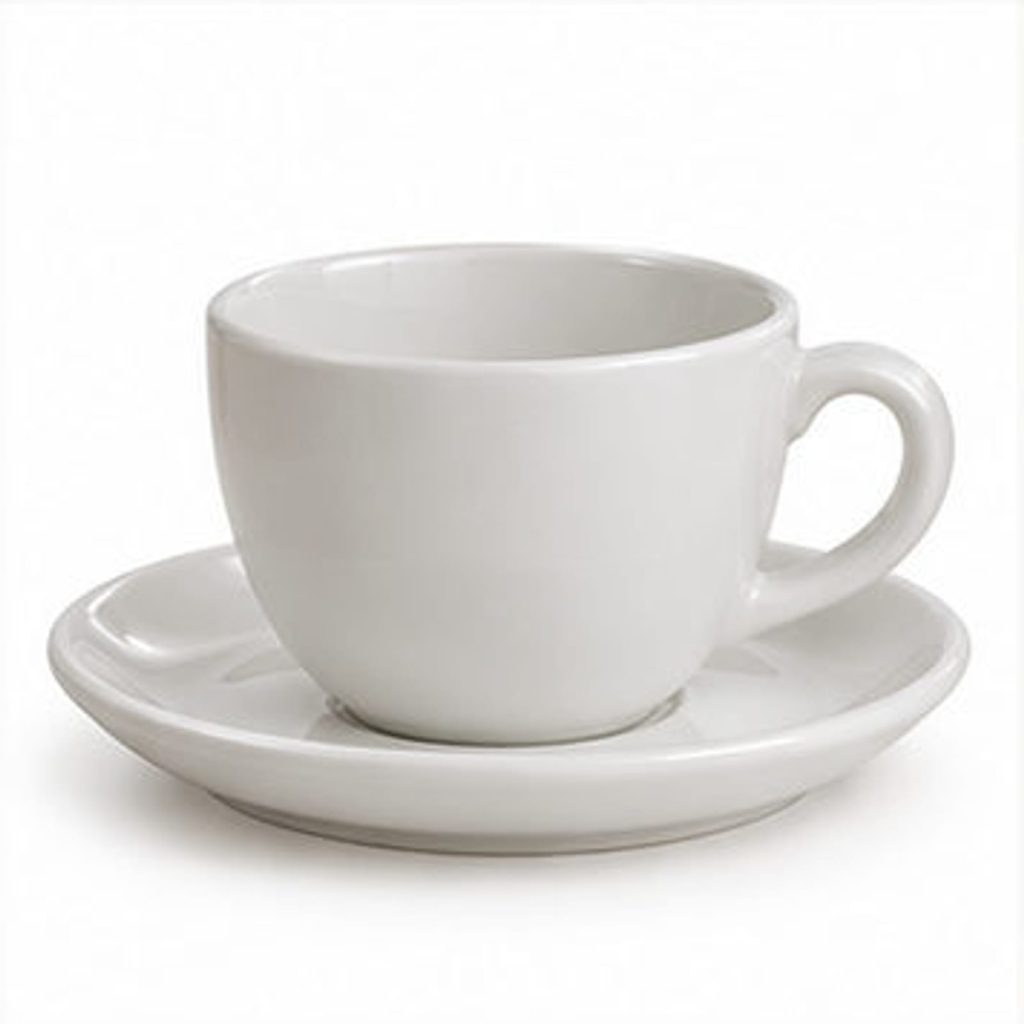
You have a menu, a coffee machine and a supplier asking how many cups you want. The size you pick now decides how every drink looks on the counter, how much milk each one takes, and whether the cups still match the ones you reorder next year.
We make cups and saucers for cafés, hotels and airport lounges in Jingdezhen. This guide starts from the drink, not the cup.
Start from the drink
Cup sizes follow the drinks on your menu. These are the common café serves and the cup that suits each one:
| Drink | What is in it | Cup size | Our cup |
|---|---|---|---|
| Espresso | A single or double shot | 60–90 ml demitasse | Not in our CF range; a new shape |
| Cortado, flat white | Double shot, a little milk | 150–180 ml | CF-180 |
| Cappuccino | Shot, milk, deep foam | 180–260 ml | CF-220 or CF-260 |
| Latte | Shot, more milk, thin foam | 260–350 ml | CF-300, or a mug |
| Americano, filter | Shot or brew, hot water | 220–350 ml | CF-260, CF-300 or a mug |
These ranges are common café practice, not fixed rules. Size the cup to your recipe: the drink should come to just below the rim, with room for foam and no spill on the way to the table. A cup that is too big makes a correct drink look short.
Leave room above the drink
A cup’s rated capacity is what it holds filled to the brim. Nobody serves a drink that way. Milk drinks need space for foam and for latte art, and a cup that is carried from the bar to the table needs a few millimetres more so it does not spill on the saucer. As a working rule, choose a cup whose brim capacity is comfortably above the serve, not equal to it.
When a supplier quotes a size, ask whether it is brim capacity or a working fill. Ours are brim capacities, measured on production pieces.
The saucer is part of the size
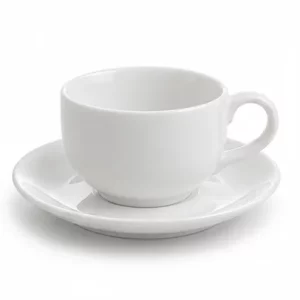
Each CF cup comes with its own saucer: 14 cm for the CF-180, 15 cm for the CF-220, 16 cm for the CF-260 and 17 cm for the CF-300. The saucer carries the spoon, a biscuit and any spill, and its well has to hold the cup still when a server walks quickly. A cup from one supplier on a saucer from another rarely fits well, which is one reason to buy them as a pair.
Our four café cup sizes
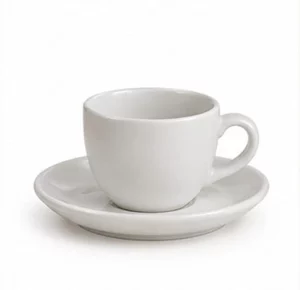
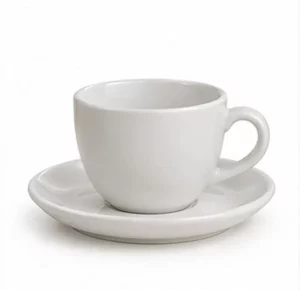
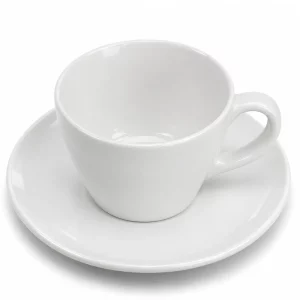
Every CF model is a cup with its own saucer.
| Model | Capacity | US fl oz | Saucer | Weight | Per carton | Per 40HQ |
|---|---|---|---|---|---|---|
| CF-180 | 180 ml | 6.1 oz | 14 cm | 225 g | 36 | 39,240 |
| CF-220 | 220 ml | 7.4 oz | 15 cm | 260 g | 36 | 33,444 |
| CF-260 | 260 ml | 8.8 oz | 16 cm | 300 g | 30 | 27,090 |
| CF-300 | 300 ml | 10.1 oz | 17 cm | 340 g | 24 | 20,496 |
For drinks larger than 300 ml, a mug often works better than a cup and saucer. Our mug sizes guide covers seven mugs from 250 to 500 ml.
What the sizes do to freight
Size changes how many cups fit in a container, and that changes the freight on every cup. A 40HQ carries 39,240 sets of our CF-180 but 20,496 sets of the CF-300, so the larger cup costs about 1.9 times as much to ship per set. If your menu can work with the smaller size for a drink, the saving is on every reorder, not just the first one.
Weight and heat
A heavier cup has more porcelain to warm. Pre-warmed on the machine, it keeps a drink hot for longer; taken cold from a shelf, it pulls heat out of the first sips. Cafés that warm their cups on the machine can choose a heavier cup; cafés that serve from a cold stack often prefer a lighter one. The CF-180 weighs 225 g with its saucer and the CF-300 weighs 340 g.
How many sizes does a café need?
Fewer than most menus suggest. Every extra size is another stack on the shelf, another par level to track and another reorder.
| Café type | Sizes we suggest | Why |
|---|---|---|
| Espresso bar, short menu | Demitasse + 180 ml | Shots and flat whites cover most orders |
| Neighbourhood café | 180 ml + 260 ml | Small and regular; cappuccino and latte share the 260 |
| All-day café with large drinks | 180 + 260 + a 350 ml mug | Mug for lattes, filter and large drinks |
| Hotel breakfast and lounge | 220 ml + 300 ml | One cup for coffee, one for tea and larger serves |
Then buy enough of each. A common rule of thumb in hospitality is three of each piece per seat: one in use, one in the dish machine, one on the shelf. Our guide to hotel and restaurant dinnerware explains how to set a replacement point against that.
A worked example for a 40-seat café
Say a café serves espresso, flat whites, cappuccinos and lattes, with 40 seats. Two sizes can cover the menu:
| Size | Drinks | Pieces at three per seat |
|---|---|---|
| CF-180 | Flat white, cappuccino, double espresso | 120 sets |
| CF-300 | Latte, large cappuccino | 120 sets |
Espresso can be served in the CF-180 or in a dedicated small cup; it is a choice of style, not a need. The three-per-seat figure is a common hospitality rule of thumb, not a rule. Breakage, the dishwasher cycle and how quickly the bar turns cups decide the real number. What the table shows is that a fourth or fifth size adds stock without adding drinks.
Check five things on the sample
A café cup is picked up, washed and stacked many times a day. Before you sign off samples, check:
- Does the saucer fit? The cup should sit in the saucer’s well without sliding when you carry it.
- Does it fit the machine? Put the cup under your group head. A taller cup may not fit under the spouts with a portafilter in place.
- Does it stack? Cups that stack on the machine’s cup warmer save counter space. Ask for the stacking height.
- Is the rim even? Many chips start at the rim. We hold rim size to ±1.5 mm and ovality to 1.5% or less, so cups sit flat and do not rock in a rack.
- Will a reorder match? A café replaces cups for years. We keep the mold and glaze recipe on file and hold colour to ΔE 1.5 within a batch and 2.0 between batches, measured on an X-Rite Ci7800.
Two checks that only show at volume
The stack
Stack ten cups and ten saucers the way your staff will. A stack that leans, or cups that lock together and have to be pulled apart, will cost you breakage at the busiest hour. Rim diameter within ±1.5 mm and ovality of 1.5% or less are what let our cups stack straight.
The handle with a full cup
Fill the sample to your serving line and carry it by the handle across the room. A handle that looks comfortable when empty can feel awkward with 300 ml of milk in the cup. Check that a finger fits through and that the handle does not get hot.
Porcelain, and why weight matters
A café cup should be porcelain. Our porcelain absorbs 0.5% of its weight in water or less, so coffee does not stain the body where the glaze wears thin, and the body does not soak up water in the dish machine. Our guide to porcelain vs ceramic explains the difference from stoneware.
Weight matters more than most buyers expect. Our CF-180 weighs 225 g; the CF-300 weighs 340 g. Staff carry trays of them all day, and freight is charged on them by volume. A 40HQ carries 39,240 of our smallest cup sets but only 20,496 of the largest, about half.
For commercial washing, ask for an EN 12875 report and check which shapes it covers. Nine of our hotel shapes have passed 1,000 cycles under EN 12875-1 and -5 (SGS-CSTC-2026-QZ-05310).
Whiteness and what a cup shows
Coffee stains show on any cup, but a whiter body makes a coffee’s colour look as the barista intended. Our porcelain is at least 78 on the whiteness scale, and our high-white porcelain, the body most often chosen for airline and lounge cups, absorbs 0.3% water or less. Less absorption means fewer stains that soak in and less chance of a cup holding a smell.
Ask which shapes the dishwasher test covers
An EN 12875 report covers the shapes tested, not a whole catalogue. Our commercial dishwasher testing covers 9 hotel shapes to 1,000 cycles. If your café cup is not one of them, ask whether it is the same body, glaze and decoration as a tested shape, or whether it needs its own test.
How our café cups are made
Cups and saucers have their own line in our factory: 4 roller-forming lines, with capacity for about 1.6 million cups and saucers a year, and 1.28 million delivered in 2025.
Cup and saucer as one part
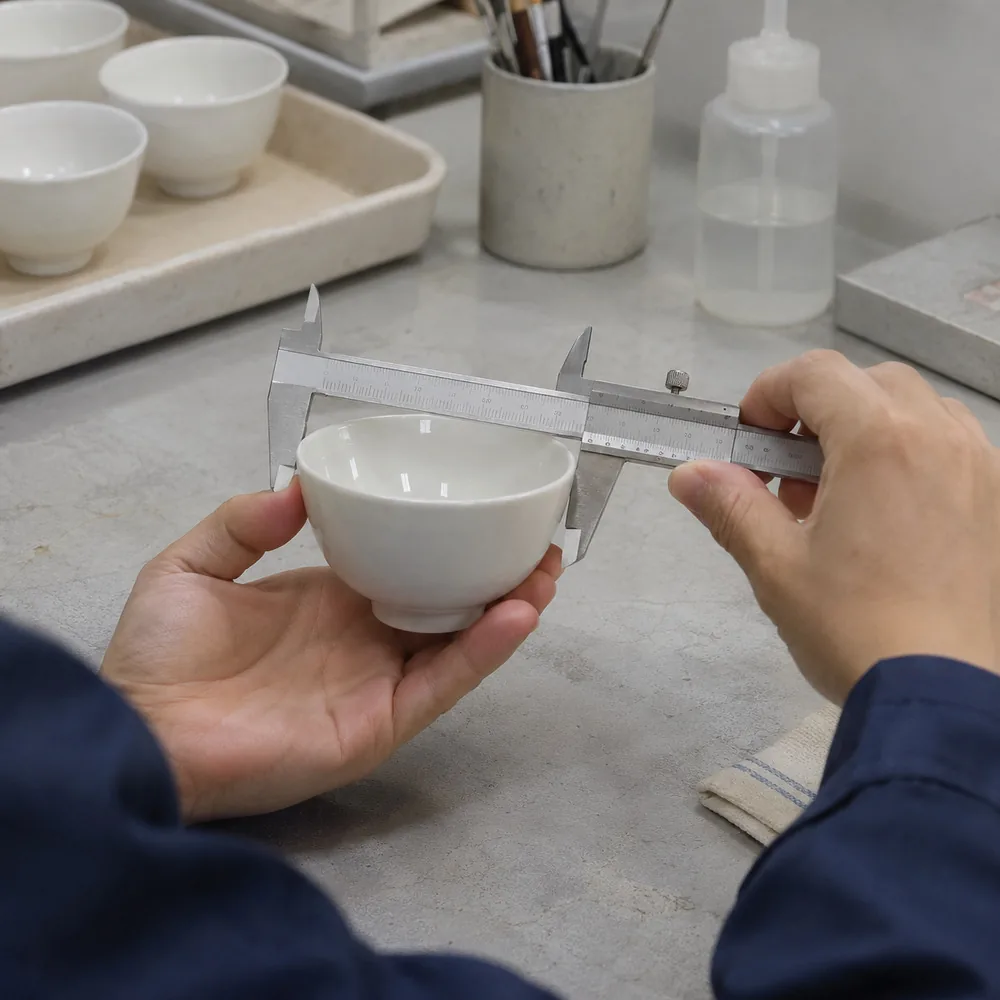
The cup and the saucer are formed separately, but they are designed, glazed and approved as a pair. The saucer’s well has to seat the cup’s foot without rocking, and the saucer’s rim has to leave room for a spoon. When we check a sample, we check the pair together, full, at the angle a barista sets it down.
Wall and weight
Roller forming gives an even wall, which is what lets us hold piece weight to ±3%. For a café, that means a cup reordered next year feels the same in the hand and sits the same on the machine’s cup warmer as the first batch.
Heat
Our thermal shock test quenches pieces from 180 °C into 20 °C water with no cracks, to ASTM C554. That covers the daily swing from a hot cup warmer to a cold rinse. What breaks café cups in practice is knocks at the rim in the dishwasher rack, so a rolled rim and strengthened porcelain are worth asking for on cups that work hardest.
Packing cups and saucers
| Model | Cup | Saucer | Per carton | Carton size | Per 40HQ |
|---|---|---|---|---|---|
| CF-180 | 180 ml | 14 cm | 36 | 48 × 34 × 31 cm | 39,240 |
| CF-220 | 220 ml | 15 cm | 36 | 50 × 36 × 33 cm | 33,444 |
| CF-260 | 260 ml | 16 cm | 30 | 50 × 37 × 33 cm | 27,090 |
| CF-300 | 300 ml | 17 cm | 24 | 50 × 38 × 34 cm | 20,496 |
Each cup and saucer sits in an insert that keeps the two from touching, inside a five-ply carton drop-tested from 1.2 m to ISTA 1A and 3A. The largest cup ships at about half the container count of the smallest, so freight per set nearly doubles from CF-180 to CF-300.
Cups for different buyers
The same four sizes serve quite different buyers, and each one asks for something different.
| Buyer | Usual sizes | What matters most |
|---|---|---|
| Independent café | Two or three sizes matched to the menu | Logo that survives the dishwasher; easy reorders |
| Café chain | The same two or three sizes in every outlet | One colour and one weight across all sites |
| Hotel breakfast and room service | One cup for coffee, one for tea | Strength, stacking, a commercial dishwasher report |
| Airport and business lounge | High-white cups and saucers | A consistent look across the lounge; dishwasher conditions |
| Coffee brand or roaster, retail | Cups and mugs for the shop shelf | Box, logo artwork, food-contact report for the selling market |
| E-commerce brand | A single cup or a cup-and-saucer set | Parcel-proof packing, light boxes |
Hainan Airport’s first order for its VIP lounges, for example, included high-white cups and saucers selected for the lounges’ dishwasher conditions. Our guide to hotel and restaurant dinnerware covers commercial specifications in full.
Where our cups go
Cups and saucers are one of our main lines in Asia-Pacific, alongside gaiwans and small dishes, and are sold there through lifestyle chains and online.
A café cup range in your colour
The colour
A cup in your brand colour starts at 1,000 pieces, matched to your Pantone reference in our 300 m² sample room and approved on a fired cup rather than a printed chip. Many cafés keep the inside white so the crema shows; a coloured outside with a white inside is a common combination.
The mark
Your logo as an underglaze or laser mark cannot wash off in a café dishwasher; a decal on the outer wall can carry more detail but fades over time. Logo plates for underglaze and laser marks are made in 5 days.
The sample
Two stock cups and saucers are free, sent within 3 days. A custom sample in your colour or with your logo takes 7–15 days after approval and is refunded when you order.
Reordering cups a year later
The first order sets the look. The reorders decide whether a café’s cups still match after a year of breakage.
What has to match
Colour, weight and size. We hold colour to ΔE 1.5 within a batch and ΔE 2.0 between batches, single-piece weight to ±3% and rim diameter to ±1.5 mm. Those limits are what make a cup from the third order sit next to one from the first without looking like a different supplier.
What we keep on file
For every customer shape, we keep the glaze recipe, the mold and a signed reference sample. A reorder of an existing model is ready in 25–30 days, and stock top-ups in 7–10 days. For lounges and hotels, that reorder speed matters more than the first order’s price.
A lounge example
Hainan Airport chose our porcelain for its VIP lounges for 2026 to 2028. The first batch was 6 shapes and 32,000 pieces, including high-white cups and saucers, selected for the lounges’ dishwasher conditions. Every later batch is checked against the same limits as the first.
Your colour and your logo
Cafés and coffee brands usually want their colour on the cup and their mark on the side.
- Glaze colour matched to your Pantone, from 1,000 pcs.
- Logo underglaze, in-glaze or as a decal on the outer wall, from 1,000 pcs; multi-colour or gold from 1,500.
- Our cups as they are, from 500 pcs in 25–30 days.
- A new shape, such as an espresso demitasse, from 3,000 pcs, starting with a 3D-printed prototype in 3 days.
Gold lines look right in a hotel lounge but are never microwave safe. On the rim and inside the cup, where lips and coffee touch, we decorate underglaze or in-glaze only.
Airlines and airports typically order high-white cups and saucers in runs of 10,000 to 50,000 pieces. Hainan Airport chose our porcelain for its VIP lounges from 2026 to 2028, for use in commercial dishwashers.
See our coffee cups and saucers range, or send us your menu and we will suggest the sizes and send two stock samples in 3 days, so you can pull a shot into them on your own machine.
Minimums and lead times for café cups
| What you order | Minimum | Lead time |
|---|---|---|
| Mixed stock cups and saucers | 48 pcs | 7–10 days |
| One stock model | 500 pcs | 7–10 days from stock; 25–30 days if made |
| Your glaze colour | 1,000 pcs | 30–35 days |
| Underglaze or laser logo | Plate fee refunded on orders from 2,000 pcs | Plate made in 5 days |
| One-colour decal logo | 1,000 pcs | 35–40 days |
Lead times are in working days from the deposit and signed artwork, with 7–10 days added from July to October. Two free stock samples leave our sample room in three days; you pay the courier. Our guide to branded mugs and cups covers logo methods in more detail.