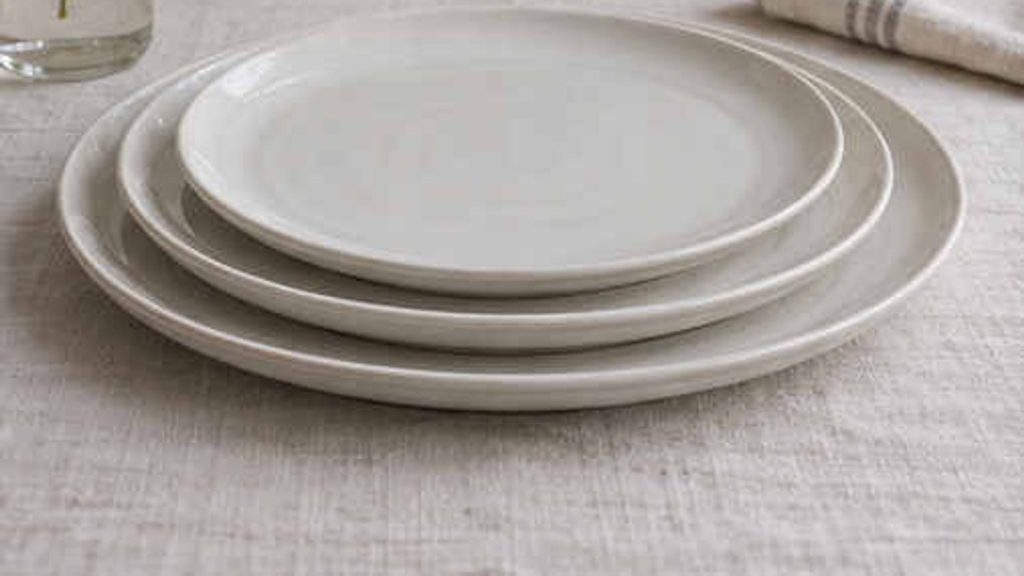
The plates that hotels trust most with their dishwashers are porcelain. Ours are reinforced porcelain of 120 MPa or more, and nine hotel shapes have been through 1,000 commercial dishwasher cycles under EN 12875 without failing. So the idea that porcelain is the delicate option, and “ceramic” the sturdy everyday one, has the facts the wrong way round.
It also asks the wrong question. Porcelain is a ceramic. So are stoneware, earthenware and bone china. What separates them is how hot the clay is fired and how much water the finished body can still soak up, and that decides how a plate behaves in your kitchen for the next ten years.
Porcelain is a type of ceramic, not its opposite
“Ceramic” covers anything made from clay and hardened by fire. When a shop labels one set “porcelain” and another “ceramic”, the second one is usually earthenware or stoneware, and the label is hiding which.
| Earthenware | Stoneware | Porcelain | Bone china | |
|---|---|---|---|---|
| Typical firing | about 1,000–1,150 °C | about 1,180–1,280 °C | about 1,250–1,400 °C | high bisque, lower glaze firing |
| Water absorption | high, often several percent or more | low, usually under about 3% | 0.5% or less | 0.5% or less |
| Body | thick, porous, opaque | dense, often grey or speckled | white, hard, slightly translucent when thin | very white, translucent |
| Where you meet it | decorative pieces, cheap mugs | café ware, rustic sets | everyday sets, hotels, mugs | formal and gift tableware |
The ranges for other materials are typical industry figures, not our test results. Our own numbers for porcelain are in the next section.
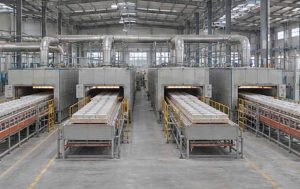
We fire our porcelain at 1,260–1,320 °C in four natural-gas tunnel kilns, held within ±8 °C across the kiln and logged by nine thermocouples per kiln. Tunnel 3 also fires stoneware, at 1,280–1,310 °C, so we see both bodies come out of the same building every day. How that compares with the wood kilns Jingdezhen used for centuries is in our guide to Jingdezhen porcelain.
What happens in the kiln
The difference between the bodies is made in the firing. Porcelain clay is a mix of kaolin, feldspar and quartz; ours is ball-milled for 18 hours and vacuum de-aired twice before forming. At full temperature the feldspar melts into glass, flows between the kaolin and quartz particles and binds them. When the piece cools, that glass fills the pores. This is vitrification, and it is why porcelain barely takes up water.
Stoneware goes part of the way there. Earthenware, fired lower, stays porous and relies on its glaze to hold liquid. The body you get depends on the clay and on how hot and how evenly it is fired, which is why our kilns hold their temperature within ±8 °C, recorded by 9 thermocouples in each tunnel kiln.
Water absorption is the number that matters
Ask any supplier one question about material: what is the water absorption? The line for porcelain is 0.5%. Below it, the body is vitrified, meaning the clay has partly melted into glass and the pores have closed.
Our porcelain tests at 0.5% or less, and our high-white porcelain at 0.3% or less.
Why a buyer should care:
- Stains and smells. Wherever glaze is missing, on the unglazed foot ring or along a hairline chip, a porous body takes in coffee, oil and detergent. A vitrified body has nowhere to take it.
- Crazing. When a porous body absorbs moisture over months, it swells slightly and can crack the glaze into a fine web. Porcelain gives the glaze nothing to push against.
- Dishwashers and microwaves. Water trapped in a porous body heats up and expands. A vitrified body has very little to trap; 41 of our SKUs are tested through 20 microwave cycles at 700 W for 5 minutes.
The same 0.5% line defines porcelain in floor and wall tiles under ANSI A137.1, measured by the ASTM C373 boil test. We also make ceramic tiles and sanitary ware (CCC certified, 2025011001794677), and the rule is the same: the absorption number decides whether something is porcelain, not the word on the box.
How absorption is measured
The test is simple. A piece, or a broken fragment of it, is dried and weighed, then saturated with water under vacuum and weighed again. The weight gained, as a percentage of the dry weight, is the water absorption. We run it on a vacuum absorption rig in our own lab. Ask a supplier for the number and the method; “low absorption” is not a number.
Whiteness, the second number
For tableware, whiteness is the other figure buyers ask about, because it decides how food and coffee look on the piece. Our porcelain is 78 or higher on the whiteness scale. High-white porcelain, the body we use for airline cups and fine-dining plates, combines that whiteness with absorption of 0.3% or less.
“Porcelain chips easily” is backwards
Thin is not the same as weak. A porcelain cup can be thinner than a stoneware mug because the fired body is stronger, and that thinness is what makes people think it is fragile.
These are the numbers we hold our porcelain to, and the tests behind them:
| Property | Our figure | How it is tested |
|---|---|---|
| Bending strength (reinforced porcelain) | 120 MPa or more | Factory lab |
| Glaze hardness | 6 Mohs or harder | Factory lab |
| Thermal shock | 180 °C to 20 °C water quench, no cracks | ASTM C554 test report |
| Commercial dishwasher | 1,000 cycles, 9 hotel shapes | EN 12875-1 / -5 test report |
| Microwave | 700 W × 5 min × 20 cycles, 41 SKUs | Microwave test report |
That is why hotels and airports buy porcelain. Atour Hotels takes 180,000 pieces a year from us across 9 shapes, and Hainan Airport chose our porcelain for its VIP lounges from 2026 to 2028 because it had to survive commercial dishwashers. More on that in our restaurant and hotel dinnerware range. For a full specification list, see our hotel dinnerware checklist.
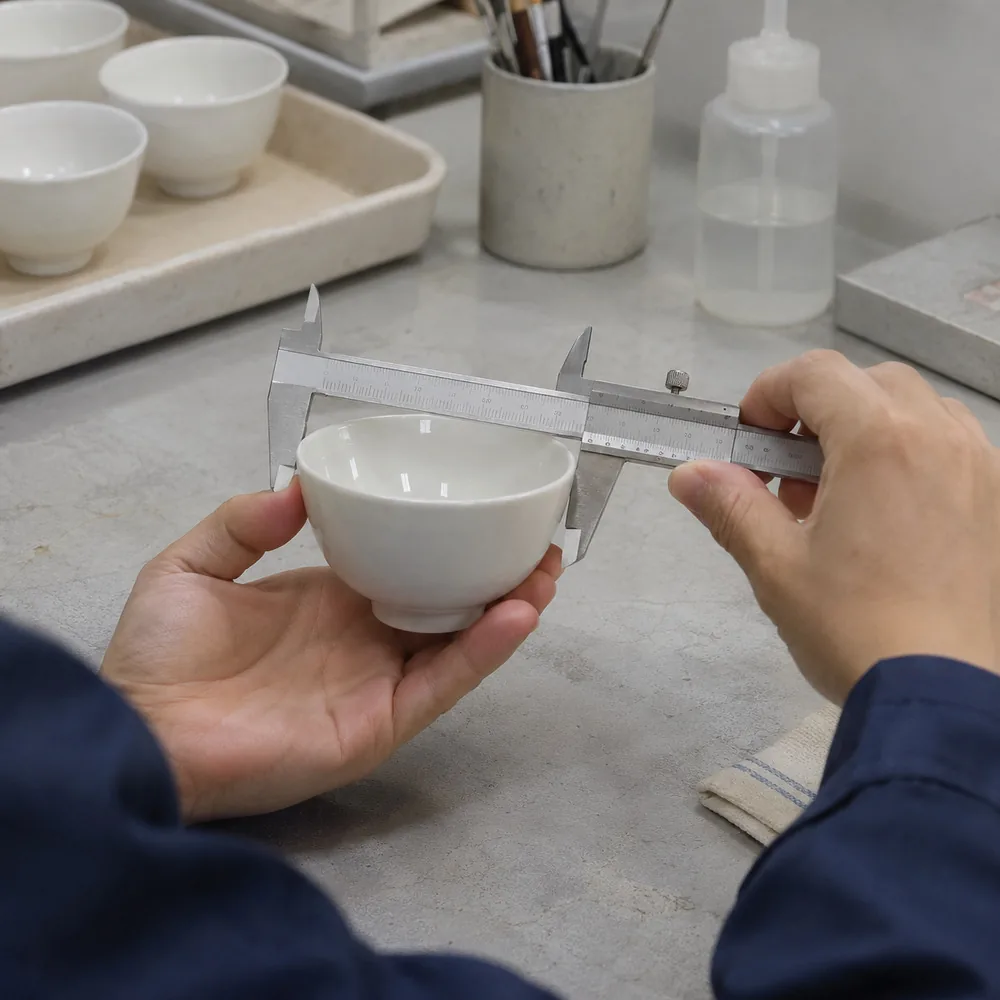
What chips porcelain is usually the rim: a thin edge knocked against a tap or another plate. We hold rim size to ±1.5 mm and ovality to 1.5% or less, so our plates stack flat instead of rocking against each other in the rack.
Why thin porcelain survives
A porcelain cup can be thin because the strength is in the material, not in the thickness. A vitrified body with a hard glaze resists bending and scratching better than a porous body twice as thick. What decides whether a thin piece survives daily use is the shape at the edges: a rim that is slightly rolled or thickened spreads a knock, and an even wall avoids weak spots. We hold wall thickness to ±0.4 mm for that reason.
How we test for chips
Our lab drops a 100 g steel ball onto pieces from 1 m to test impact, and measures bending strength on a three-point bending tester. These tests tell you how a body behaves under a knock, which is the real question behind “does it chip?”
Where stoneware is the better choice
We make both, so we can say this plainly: stoneware wins on look, not on performance.
Choose stoneware when you want a heavy, hand-made feel, a speckled body, or reactive glazes that break into different colours over the edges. Those glazes need a body and a firing curve that porcelain does not give. A thick stoneware mug also holds heat a little longer simply because there is more of it.
Choose porcelain when the piece will be washed hundreds of times, stacked, microwaved, or reordered and expected to match. We hold porcelain colour to ΔE 1.5 within a batch and 2.0 between batches, measured on an X-Rite Ci7800, and that consistency is easier on a white, dense body than on a speckled one. Our guide to glaze colour matching covers what makes batches drift.
We fire both, on different kilns
Our strengthened porcelain and our stoneware share one tunnel kiln, kiln 3, firing at 1,280–1,310 °C, while high-white porcelain runs on kilns 1 and 2 at 1,290–1,320 °C. The bodies need different curves, so they are fired apart. If a range mixes porcelain plates with stoneware mugs, expect two kiln lines and two sets of samples to approve.
The difference shows at customs too
Porcelain and stoneware tableware are classified under different customs headings: porcelain under HS 6911.10.00 and other ceramic tableware, including stoneware, under 6912.00.00. The heading affects the duty in some markets. Give your customs broker the body as well as the product name, and make sure the supplier’s invoice describes the material correctly.
Bone china is porcelain with bone ash in it
Bone china is a porcelain-type body made with bone ash, which British definitions set at no less than 30% of the body. It fires very white and lets light through even at normal thickness. It is a premium choice for formal and gift tableware.
If a supplier offers bone china, ask for the bone-ash percentage in writing. “New bone china” and “fine china” are trade names with no fixed content, and some contain little or none.
Our three bodies, side by side
“Porcelain” on our price list means one of two porcelain bodies, and we also fire stoneware. Each has its own kiln line and its own job.
| Body | Kiln | Firing | Measured property | Where we use it |
|---|---|---|---|---|
| High-white porcelain | Tunnel kilns 1 and 2 | 1,290–1,320 °C | Water absorption 0.3% or less; whiteness 78 or more | Mugs, cups, plates, bowls, dinner sets |
| Strengthened porcelain | Tunnel kiln 3 | 1,280–1,310 °C | Bending strength 120 MPa or more | Hotel and restaurant ware, chain restaurants |
| Stoneware | Tunnel kiln 3 | 1,280–1,310 °C | Classified under HS 6912.00 | Ranges where the look of stoneware is the point |
The high-white body is our own formula, protected by an invention patent (ZL 2022 1 1044719.3). Whiteness matters for more than looks: a whiter body shows colour truer, so a logo or a glaze colour reads the same on every piece.
The glaze is the half you actually touch
The body decides strength and absorption. The glaze decides how a piece feels, how it cleans and, on surfaces that touch food, what it releases.
Thickness and hardness
Our glazes go on 0.25–0.35 mm thick, applied by 12 robots that repeat to ±0.02 mm, and fire to a hardness of 6 Mohs or more. An even glaze layer is what keeps colour even and stops thin spots that wear first.
Decoration and food contact
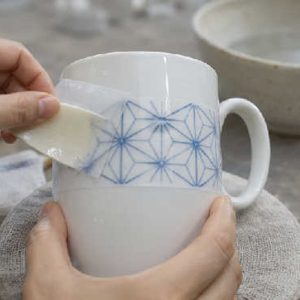
Anything that touches food or a mouth is decorated underglaze or in-glaze, so the colour sits under or inside the glaze rather than on top of it. We hold an invention patent on a low lead-and-cadmium underglaze process (ZL 2023 1 0822016.8), and we hold lead and cadmium release to half the legal limit on our own ICP-MS before the outside lab sees the batch. Our guide to underglaze vs overglaze covers the five decoration methods.
Defects you can see
Glaze defects are judged against written limits, not by eye: pinholes up to 2 per piece, 0.5 mm or less and never on a food-contact surface; specks one per piece, 0.8 mm or less; orange peel not visible at 30 cm under 500 lux.
Porcelain in daily use
Most of the practical differences between porcelain and other ceramics show up in three places: the microwave, the dishwasher and sudden changes of temperature.
Microwave
A vitrified body holds almost no water for a microwave to heat. Our microwave test runs 700 W for 5 minutes, 20 times, checking for heating, cracking and sparking, and 41 of our SKUs are covered by it. Gold and metal decoration is never microwave safe, whatever the body. Our guide on whether porcelain is microwave safe explains the test.
Dishwasher
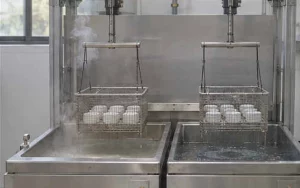
Nine of our hotel shapes are tested for 1,000 commercial dishwasher cycles under EN 12875. The body survives; what wears is decoration on top of the glaze. Our dishwasher-safe dinnerware guide shows which decorations hold up.
Hot to cold
Our thermal shock test quenches pieces from 180 °C into 20 °C water, with no cracks allowed, to ASTM C554. That covers a hot plate rinsed under a cold tap. Repeated knocks at the rim are a different stress, which is where strengthened porcelain earns its place.
What to write in a porcelain specification
If porcelain matters to your range, put it in numbers rather than in the product name.
- Body: porcelain, with water absorption of 0.5% or less (0.3% or less for high-white).
- Strength, for hotel or heavy use: bending strength 120 MPa or more.
- Glaze hardness: 6 Mohs or more.
- Thermal shock: 180 °C to 20 °C water quench, no cracks, ASTM C554.
- Colour: ΔE 1.5 within a batch and 2.0 between batches, with the instrument and light source.
- Decoration on food-contact surfaces: underglaze or in-glaze only.
- Food-contact reports for each market, naming the SKUs and decorations.
A supplier that can sign up to each line, with a report behind it, is selling porcelain. One that can only say “porcelain” is selling a word.
How to tell what you are holding
You can sort most pieces in a few minutes, before you ask for a lab report.
- Hold it to the light. Thin porcelain and bone china glow slightly at the rim. Stoneware and earthenware stay dark.
- Look at the foot ring. The unglazed ring underneath shows the real body. Porcelain is white and smooth. Earthenware is chalky; stoneware is often grey, buff or speckled.
- Wet the foot ring. Put a drop of water or a line of washable marker on the bare clay. If it soaks in or leaves a dark mark, the body is porous.
- Tap the rim. Vitrified porcelain rings with a clear, sustained note. Porous bodies give a short, dull clack.
- Ask for the number. A water absorption result to ASTM C373 settles it. Ask us for ours.
Four checks, from the shop floor to the lab
| Check | What porcelain shows | What it does not prove |
|---|---|---|
| Hold it to the light | Thin areas let light through | Thick porcelain may not show it |
| Tap the rim with a fingernail | A clear, ringing sound | A crack or a thick base can dull it |
| Touch the unglazed foot ring | Smooth, dense, cool | Polishing changes the feel |
| Ask for the water absorption | 0.5% or less | Only the number settles the question |
The first three are quick screens. Only the fourth is a measurement.
Food safety is about the glaze, not the body
Porcelain, stoneware and earthenware can all be food safe or unsafe, because lead and cadmium come from glazes and decorations, not from clay. A porcelain plate with a cheap decal on its eating surface can fail a test that a plain stoneware plate passes. Our guide to decoration methods shows which ones are safe where.
We check lead and cadmium on our own Agilent 7900 ICP-MS and hold them to half the legal limit. Our tested lines are covered by lead and cadmium test reports to FDA CPG 7117.06/07 and ASTM C738, and by LFGB food-contact test reports. Food-contact surfaces are decorated underglaze or in-glaze only. Which lead and cadmium test applies depends on where you sell; see ceramic food safety testing by country. Gold lines are never microwave safe, whatever the body, and our microwave safety guide explains what the test checks. Our quality control page lists the full defect standard.
Porcelain or ceramic, product by product
| Product | Our recommendation | Why |
|---|---|---|
| Hotel and restaurant plates | Strengthened porcelain | 120 MPa bending strength, 1,000-cycle dishwasher testing on hotel shapes |
| Café cups and saucers | High-white porcelain | Whiteness, stain resistance, lighter weight |
| Everyday mugs | Porcelain | Microwave and dishwasher use, many years of washing |
| Hand-made-look mugs and bowls | Stoneware | Speckled body, reactive glazes, weight in the hand |
| Vases and figurines | Porcelain or stoneware | Decided by the look; no food contact |
| Tea ware | Glazed porcelain | Holds no flavour between teas |
What to write on a label or a listing
If the body is porcelain, say porcelain; it is the most informative word. If it is stoneware, say stoneware rather than “ceramic”, because shoppers who care know the difference. And put the numbers that support the care lines on the product page: dishwasher, microwave and thermal shock testing, version by version.
Which one to choose
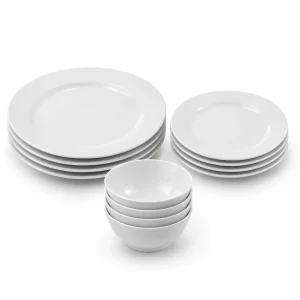
| You are buying for | Choose | Why |
|---|---|---|
| A hotel, restaurant or airport lounge | Reinforced porcelain | 120 MPa or more, 1,000 dishwasher cycles, replacement orders match |
| Everyday sets for retail | Porcelain | Low absorption, microwave and dishwasher safe, consistent colour |
| Logo mugs and corporate gifts | Porcelain, high-white if the logo is colour-critical | Clean white ground for decals and Pantone glazes |
| A café or a rustic home range | Stoneware | Reactive glazes and a heavier feel |
| Formal or luxury gift sets | Bone china or high-white porcelain | Whiteness and translucency |
If you are importing, the material is only one line of the decision. Our guide to sourcing ceramic dinnerware from China covers test reports, samples and landed cost.
Not sure which body suits your product? Send us the use, the quantity and the market and we will send two stock samples in 3 days so you can run the light, foot-ring and tap tests yourself.