
Custom Dinnerware: Shape, Glaze and Logo
In a dinner set every piece has to match, and so does every reorder. We hold colour to ΔE 1.5 within a batch and 2.0 between batches, so your reorder looks like your first order.
Two ways to start
| Existing mold | New mold | |
|---|---|---|
| Starting point | One of our 16 dinnerware models or 3,800 molds | Your drawing, sample or 3D file |
| MOQ | 500 pcs; 1,000 pcs with your glaze or decal | 3,000 pcs |
| Lead time | 25–40 days | 45–55 days |
| Best for | Fast launches and testing a design | A shape only your brand sells |
Models to start from
Start from an existing set or shape and change the glaze, rim or decal. New and older lines can be mixed in one order.
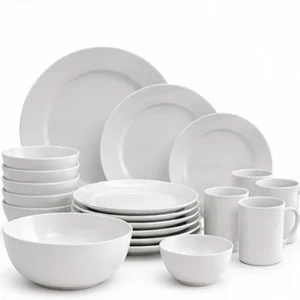
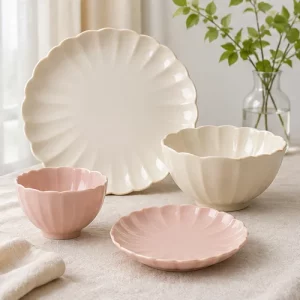
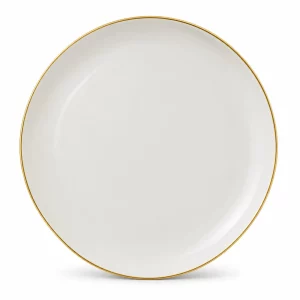
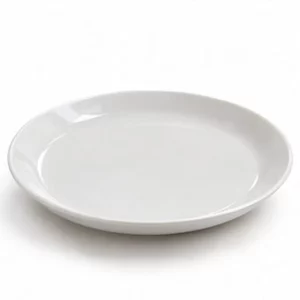
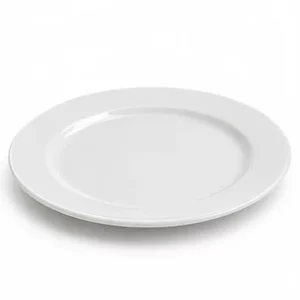
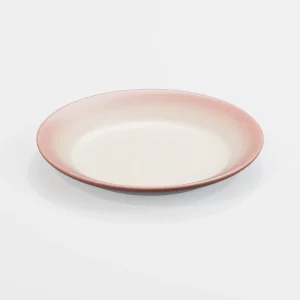
See all our dinnerware sets and the plate sizes in ceramic plates.
Glaze and decoration
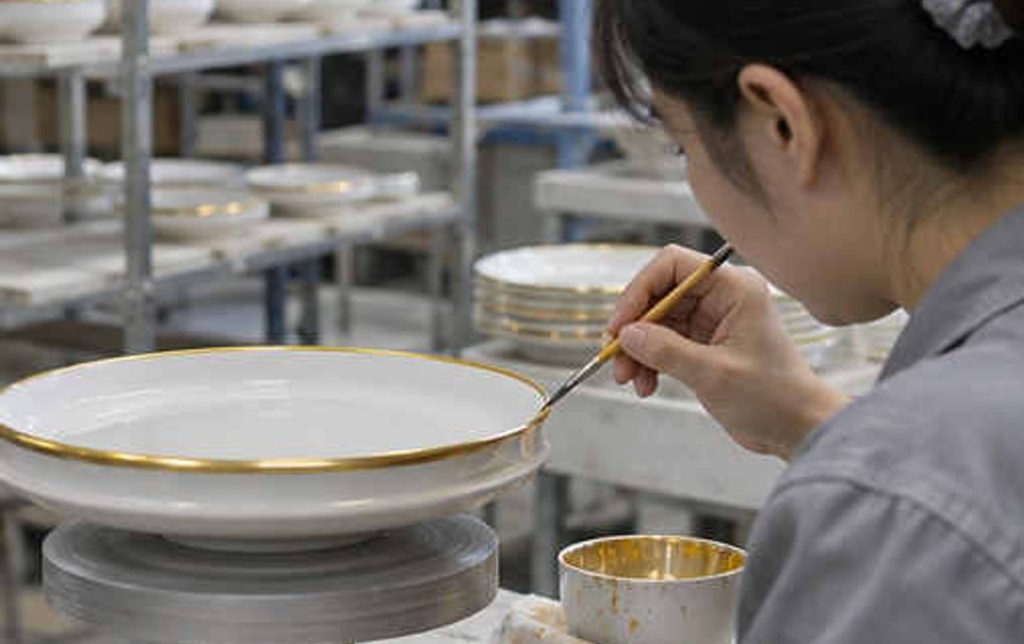
Underglaze and in-glaze decoration, decals, gold lines and laser marks, on any glaze colour you match to Pantone. Food-contact surfaces use underglaze or in-glaze decoration. Every glaze is fired at 1,260–1,320 °C and checked for lead and cadmium on our own ICP-MS, against an internal limit of half the legal limit.
Set building
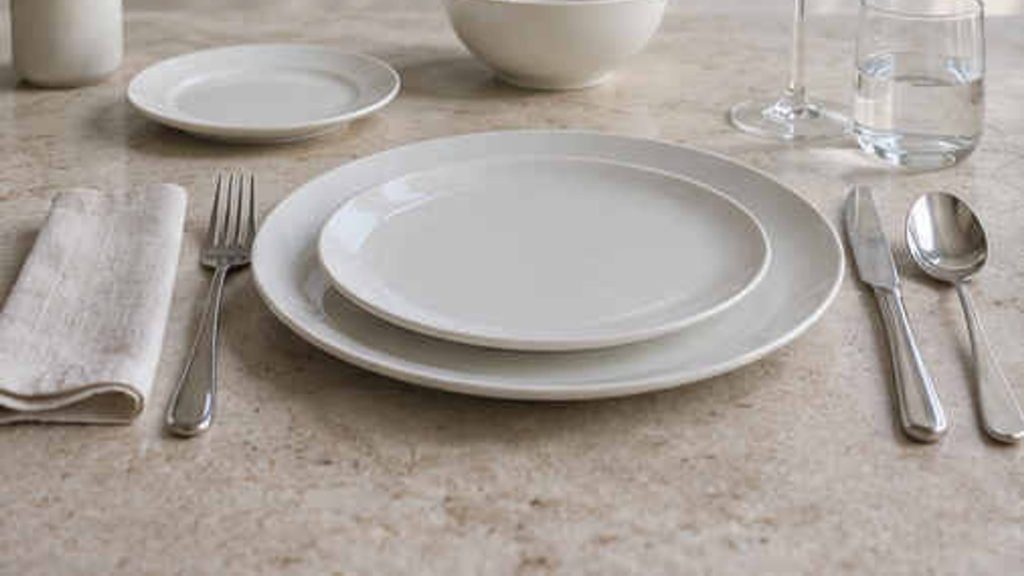
We build 12, 16, 20 and 24-piece sets from plates of 18–30 cm, bowls of 11.5–18 cm and matching mugs, packed in a single colour box or gift box. Our Fendai dinner set won gold at the 2024 Jiangxi Industrial Design Competition.
Heritage shapes
We make replica shapes and IP products for the China Ceramics Museum in Jingdezhen. Since 2023 that has meant 12 shapes and about 90,000 pieces a year. If your collection needs a historic form, send us the original or photographs and we develop the mold from there.
Three ways to form a plate
The forming route decides how flat, thin and consistent your plates will be.
| Route | Equipment | Best for |
|---|---|---|
| Roller forming | 14 roller lines | Plates, bowls and cups in volume; wall ±0.4 mm |
| Slip casting | 3 slip-casting lines, 6 high-pressure casting machines | Oval, square and irregular shapes, lidded pieces |
| Isostatic pressing | 2 presses at 280–320 bar | Flat coupe and rim plates with even density and low warp |
Private label dinnerware, from the first sample to the fortieth delivery
Custom dinnerware is a long programme more often than a single order. A Nordic home retailer has reordered the same eight SKUs from us every quarter since 2018; a German discount chain buys its 16 and 20-piece sets on a glaze recipe that belongs to it and is locked so it cannot drift. What those buyers needed from us was not the lowest minimum but a way to make each delivery match the last: glaze approved on a fired tile, measured on a spectrophotometer and held to ΔE 2.0 between batches.
For a new range we usually start from one of our existing shapes in your colour or decoration, at 1,000 pieces per model, and only cut new molds where the shape itself is the point. Private label packaging, barcodes and carton marks carry your brand only.
Read next: Private label ceramics · Glaze colour matching · Custom and private label guides
Plates, bowls and sets: how the shape is chosen
A custom dinnerware range is usually built from three kinds of piece. Flat plates are formed on isostatic presses, which keeps them flat enough to stack in a commercial kitchen and to hold rim size to ±1.5 mm. Bowls and cups come off roller lines with walls held to ±0.4 mm. Serving pieces with unusual outlines are slip-cast or pressure-cast, which is also how we make shapes too deep or too irregular for a roller.
So a buyer choosing shapes is also choosing a forming method, and with it a minimum and a cost. Our existing dinner plate, side plate and bowl shapes cover most retail sets; we suggest keeping those and putting the design into the glaze and decoration, then adding one or two pieces of your own shape where they carry the range.
What we hold you to
These are the limits every custom dinnerware order is checked against.
Read next: Quality control
A private-label case
D-01, a German discount supermarket, has sold our 16- and 20-piece sets under its own brand since 2019. We deliver about 3.4 million pieces a year in 12 deliveries, on a glaze recipe kept only for them, so a set bought in January matches one bought in December.
Planning a private-label range
Private-label programmes start at 5,000 pcs per SKU and the first order takes 50–65 working days, because molds, glaze and packaging are approved in sequence. Reorders run on standard lead times.
Supermarket buyers usually ask for three things before the first order: audit reports, food-contact test reports and carton marks that show only their brand. We hold BSCI, SMETA, FCCA, IWAY, Target, Costco and Disney audits, and print cartons with your brand only, with barcodes and origin marked to the destination's rules.
Samples and approvals
Custom dinnerware samples take 7–15 days and arrive with test data. You approve shape, colour and decoration on the sample, and that sample becomes the standard the order is checked against at inspection.
For new shapes we print a 3D prototype in 3 days before making molds. A set of molds takes 12–15 days for the model and 15–20 days for production molds, and the molds belong to you.
Glaze and decoration choices
Reactive glazes give each piece a slightly different finish, which suits stoneware-style ranges; plain glazes are held to ΔE 1.5 within a batch. Underglaze and in-glaze patterns survive dishwashers; decals allow fine detail; gold lines suit occasion ranges but are hand-wash only and not microwave safe.
Our invention patent ZL 2023 1 0822016.8 covers an underglaze process with low lead and cadmium release, and food-contact surfaces never carry on-glaze decoration.
Stock shapes or your own?
Our stock range covers plates from 18 to 30 cm, bowls, serveware and sets from 12 to 24 pieces. Using stock shapes with your glaze and decoration starts at 1,000 pcs and takes 30–40 working days.
Your own shapes start at 3,000 pcs per model with new molds, which belong to you. A private-label programme with packaging and exclusive glaze starts at 5,000 pcs per SKU and takes 50–65 working days for the first order.
Capacity for dinnerware
Dinnerware has 6.4 million pieces of capacity a year on 6 roller lines and 2 isostatic presses, with tunnel kiln 2# firing high-white porcelain sets.
Read next: Company facts
Hotel and restaurant versions
If your dinnerware is for hotels or restaurant chains, ask for strengthened porcelain. It is fired in tunnel kiln 3# at 1,280–1,310 °C and reaches a bending strength of at least 120 MPa. Our EN 12875 report covers 9 hotel shapes through 1,000 commercial dishwasher cycles, and hotel orders start at 200 pcs per shape.
Who owns what
Molds, decal plates and box artwork made for your range belong to you and stay on file for reorders. Cartons, labels and inserts carry your brand only, with barcodes and origin marked to the destination's rules.
Before you send a brief
The fastest briefs list the pieces in the set with their sizes, the glaze colour as a Pantone reference or a physical sample, any decoration as vector artwork, the packing and your market. Add your target date so we can confirm at once whether it fits the lead time for your order type.
We reply within 24 hours on working days and send a formal quotation within 48 hours.
Reorders
Reorders reuse your molds, decal plates and glaze recipe and run on standard lead times. Colour is held to ΔE 2.0 between batches, every piece is traced to its kiln run and team, and for programmes like D-01 the glaze recipe is kept for one customer only, so plates bought years apart still match.
Markets we already ship custom dinnerware to
Our custom dinnerware goes to supermarket private label in Germany and the US, importers in Canada, hotel suppliers in the Middle East and lifestyle chains in Japan. Each market has its own report, label and packing rules, and we have shipped to all of them, so your range can be built to the right rules from the first sample.
Custom dinnerware: the figures in brief
Tooling, minimums and reports for a custom plate, bowl or set, pulled from our full tables.
| Topic | What applies here | Full details |
|---|---|---|
| Minimums and lead times | New colour or glaze: 1,000 pcs, 30–35 days; Custom decal, one colour: 1,000 pcs, 35–40 days; New mold: 3,000 pcs, 45–55 days; Private-label programme: 5,000 pcs per SKU, 50–65 days for the first order. | Shipping and trade terms |
| Tooling and samples | New mold: 12–15 days for the model, 15–20 days for the molds; Decal plates: 5–7 days; Exclusive glaze colour: 20 days. | Samples and quotes |
| Production steps | 2 Forming: Roller forming, slip casting or isostatic pressing; wall thickness ±0.4 mm; 4 Glazing: Dip, spray or pour; glaze 0.25–0.35 mm thick, robot repeatability ±0.02 mm; 5 Decoration: Underglaze, in-glaze, decal, gold line, laser marking; food-contact surfaces use underglaze or in-glaze only. | Factory |
| Test reports | FDA CPG 7117.06/07, ASTM C738, ASTM C927, covering 14 series, 62 SKUs; EN 12875-1 / -5, 1,000 cycles, covering 9 hotel shapes; LFGB §30/31, (EC) No 1935/2004, covering All food-contact shapes. | Certifications |
| How an order runs | Samples: Samples and test data; Approval: Order confirmation and production schedule; Inspection: Inspection report. | Shipping and trade terms |
| Packing | Inner packing: Molded pulp or EVA inserts; sets get corrugated dividers; Colour boxes: Four-colour print, hot foil, UV, matt film; FSC-certified board on request. | Shipping and trade terms |
| Who orders | Supermarket private label: 16- and 24-piece sets, mugs, storage jars, typically 30,000–80,000 pcs; Hotels and projects: Strengthened plates, wide-rim plates, cups and saucers, typically 2,000–20,000 pcs; Restaurant chains: Strengthened bowls, plates, sauce dishes, typically 50,000–200,000 pcs. | Customer cases |
| Transit times | US West Coast: 16–20 days; Northern Europe: 28–33 days; Middle East: 20–24 days. | Shipping and trade terms |
| Trade terms | Incoterms: EXW, FOB Ningbo, FOB Shanghai, FOB Yantian, CIF, CFR; DDP to the US, Canada and the EU; Inspection: AQL 2.5 by default, 1.5 on request; major 2.5, minor 4.0. | Shipping and trade terms |
| Lab tests | ICP-MS (Agilent 7900): Lead and cadmium release to FDA and LFGB methods; Spectrophotometer (X-Rite Ci7800): Colour difference ΔE at D65/10°; Bending tester: Three-point bend, 0–5 kN. | Quality control |
Questions about custom dinnerware
What is the minimum for custom dinnerware?
Can you make a set to our own list of pieces?
How flat will the plates be?
Can we have a glaze no one else has?
Is decoration food-safe?
How long does a custom set take?
Can I order for hotels?
Will reorders match?
Can you make a stoneware-style range?
Can I mix your stock shapes with new ones?
Tell us what you need
A product, a quantity and a market are enough to start. We reply within 24 working hours.
By sending this form you agree to our privacy policy. We use your details only to answer your enquiry.