
Containers · Transit · Landed cost · Claims
Shipping and Importing Ceramics from China: Containers, Transit and Landed Cost
Porcelain is heavy, breakable and shipped in volume, so freight decisions change the cost per piece more than most buyers expect. These guides cover packing, container planning, routes and transit times, the real landed cost of an order, and what to do when cartons arrive broken.
2 core guides2 articles4 product ranges
Start from where your order is
Find the line that matches where your order is now.
| Where you are | What to settle | Read |
|---|---|---|
| You are choosing between two models at a similar price | Pieces per carton and per 40HQ for each | Container loading |
| You are comparing suppliers on price | Freight per piece, breakage, testing and delay on one line | Landed cost |
| You are booking your first container | Cartons, season, transit, Incoterms, HS codes, papers | Shipping ceramics from China |
| You need goods in Europe fast | Rail at 18 to 22 days against sea at 28 to 33 | Shipping and trade terms |
| Cartons arrived broken | Photos, counts and the 30-day window | After-sales and claims |
Start with the core guides
Each core guide sets out the whole decision and links to the shorter articles that settle one detail each.
 Core guide · 17 min readShipping Ceramics From China: Seven Mistakes That Break Plates and BudgetsSeven mistakes that break plates and budgets when shipping ceramics from China: cartons, container loads, season, transit, Incoterms, HS codes and papers.Read the guide
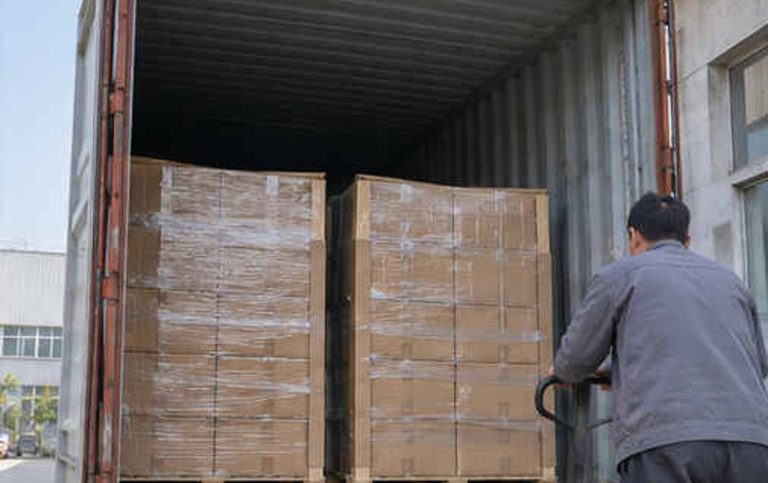 Core guide · 13 min readCeramic Container Loading: How Many Pieces Fit in a 40HQ, Model by ModelHow we work out how many pieces of each model fit in a 40HQ, where weight fills the box before volume, and how to plan a mixed container.Read the guide
All Shipping & Import articles
Newest first. New articles in this topic are added here as they are published.
- Broken Ceramics on Arrival: How to Make a Claim That Gets PaidWhat to photograph, count and send within 30 days when ceramics arrive broken, who pays (supplier, insurer or carrier), and how an…
- The True Cost of Importing Dinnerware, Line by LineFreight per piece, breakage, testing, delays and claims: how to compare dinnerware quotes on landed cost, with real carton and container figures.
Where freight cost really comes from
A container is limited by weight as often as by volume. Dinner sets and heavy stoneware reach the weight limit of a 40HQ before the box is full; mugs and cups fill the volume first. That is why freight per piece can differ several times between two models at the same unit price, and why we give container loads model by model rather than as one number. Container loading shows how we plan a mixed load at 60 m³ usable and 92% fill.
The cost that buyers miss most often is not freight but loss: broken pieces, a container that misses its selling season, a failed test at the port. The true cost of importing dinnerware puts these on one line with the unit price, and shipping ceramics from China lists seven mistakes that break plates and budgets.
Porcelain travels heavy, and that changes the arithmetic
Most of our containers leave from Ningbo; the rest go from Shanghai and Yantian. From there it is 16 to 20 days to the US West Coast, 28 to 33 days to Northern Europe and 20 to 24 days to the Middle East. Those times are predictable. What is less predictable is the season: July to October is our peak season and adds 7 to 10 days, and every buyer who books late competes for the same kiln time and the same ships.
Ceramics are unusual cargo because they are dense. A container of dinner sets reaches its weight limit long before the box looks full; a container of coffee cups fills its volume first. So the cheapest freight is not the cheapest route but the right mix of models in one box, and the guides work this out model by model. Breakage is the other half of the arithmetic. Our 2025 transit breakage rate was 0.21%, and it was reached with 5-ply cartons that each passed a 1.2 m drop on six faces, three edges and one corner, not with luck.
Paperwork travels with the porcelain. An importer in the US, Canada or the EU will need the commercial invoice and packing list, the bill of lading, a certificate of origin and the test reports for the SKUs on board; we send the full set within three working days of sailing. For North American programmes we can also hold forward stock in Los Angeles and Toronto, which is how a Canadian importer we supply keeps its shelves filled between containers.
Transit times from our ports
78% of our containers leave from Ningbo, 15% from Shanghai and 7% from Yantian.
| Route | Time |
|---|---|
| Ports used | Ningbo 78%, Shanghai 15%, Yantian 7% |
| US West Coast | 16–20 days |
| US East Coast | 30–34 days |
| Northern Europe | 28–33 days |
| Middle East | 20–24 days |
| Australia | 14–18 days |
| South America | 32–38 days |
| China–Europe rail | 36 hours to the Xi'an hub, 18–22 days door to door |
| Air | Samples and urgent top-ups, 5–7 days |
| Forward stock | Los Angeles and Toronto, for North American programmes |
How we pack for export
Every new carton design is dropped from 1.2 m on six faces, three edges and one corner before it is used. Our transit breakage rate in 2025 was 0.21%.
| Item | Our standard |
|---|---|
| Carton | 5-ply corrugated, tested to ISTA 1A and 3A; every new carton passes a 1.2 m drop |
| Inner packing | Molded pulp or EVA inserts; sets get corrugated dividers |
| Container loading | 40HQ planned at 60 m³ usable and 92% fill |
| Pallets | 1,100 × 1,100 mm, four-way entry, stretch-wrapped with corner boards |
| Carton marks | Your brand only; barcodes and origin marked to the destination's rules |
| Colour boxes | Four-colour print, hot foil, UV, matt film; FSC-certified board on request |
| Gift boxes | Magnetic or lid-and-base rigid boxes, EVA inserts, fabric lining, carrier bags |
| Documents | Invoice, packing list, bill of lading, certificate of origin, test reports, declaration of conformity |
Our transit breakage rate is 0.21%.
Read next: Shipping and trade terms · After-sales and claims
Where these orders usually go wrong
Planning by volume only
Heavy pieces reach the weight limit before the box is full. Ask for the container load per model, not per CBM.
Booking in peak season without a margin
July to October adds 7 to 10 days to production, before any port delay.
Counting freight but not breakage
A cheap carton that loses 2% of a container costs more than the carton saved.
Waiting to report damage
Claims run from the arrival date. Photograph the container on opening, before the cartons move.
What to send with your enquiry
With these details we can answer in one reply instead of three. A first reply comes within 24 hours on working days.
Send these details- Destination port or address
- Incoterm you want (EXW, FOB, CIF, DDP)
- Mixed or single-model container
- Carton marks and barcodes
- Pallets or floor-loaded
- Shelf date, so we can plan sailing
Products these guides apply to



Related pages
New in other topics
 Dinnerware, Mugs & Cups · 23 Nov 2026Branded Coffee Cups for a Café: Logo, Minimums and Reorders
 Dinnerware, Mugs & Cups · 20 Nov 2026Building a Custom Dinnerware Set From Your Own Piece List
 Tea Ware · 15 Nov 2026Gaiwan vs Teapot: Which to Stock, Brew With and Gift
 Dinnerware, Mugs & Cups · 15 Nov 2026Dishwasher-Safe Dinnerware: What the Label Should Be Based On
Shipping & Import: questions buyers ask
How long does sea freight take from China to the US or Europe?
From our ports, 16 to 20 days to the US West Coast, 30 to 34 days to the East Coast and 28 to 33 days to Northern Europe. China to Europe rail runs 18 to 22 days door to door.
What HS code does porcelain dinnerware use?
Porcelain tableware is usually 6911.10.00 and other ceramic tableware 6912.00.00. Confirm the code with your customs broker for your market before booking.
What happens if pieces arrive broken?
Report it within 30 days of arrival with photos and a count. We send the first 8D report within 48 hours. The after-sales page explains what to photograph and how the claim is settled.
Which Incoterms do you offer?
EXW, FOB from Ningbo, Shanghai or Yantian, CFR and CIF, and DDP to the US, Canada and the EU.
Other topics
Have a specific order in mind?
Send the shape, quantity and market. We reply within 24 hours on working days and send a written quotation within 48.