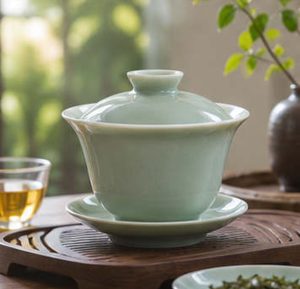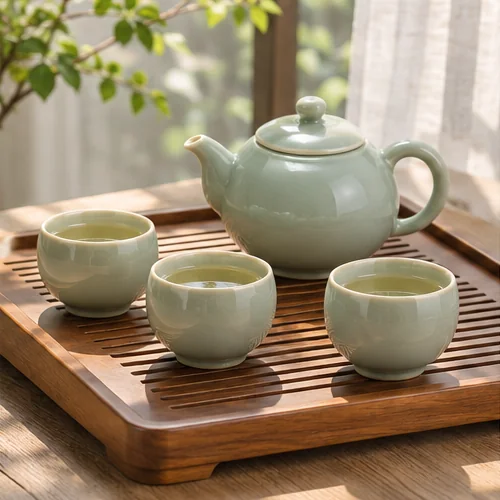
You are putting together a tea range for a shop, a tea brand or a gift programme, and the first decision is the vessel. A gaiwan is a lidded bowl on a saucer that holds 100 to 200 ml. A teapot holds 400 to 800 ml and pours through a spout. They brew the same leaves very differently, sell to different customers and fill a container very differently.
Here is the comparison on our own porcelain, with real sizes and weights, and which one suits which buyer.
The short answer
Choose a gaiwan for short, repeated infusions of a small amount of tea, for tasting different teas, and for customers who already know Chinese tea. Choose a teapot for brewing a larger volume at once, for serving several people, and for customers who drink tea the Western way. A tea shop or tea brand usually needs both: gaiwans for cupping and for enthusiasts, teapots for everyone else.
Gaiwan and teapot side by side
| Gaiwan | Teapot | |
|---|---|---|
| Our sizes | 100, 130, 160, 200 ml | 400, 600, 800 ml |
| Weight, empty | 320–490 g with lid and saucer | 420–640 g |
| Brewing style | Many short infusions, more leaf per ml | One or two longer infusions |
| Serves | One person, or small cups for two to four | Two to six mugs or cups |
| Skill needed | Some; held by the fingertips while pouring | Very little |
| Best for | Tasting, gongfu brewing, tea shops | Everyday brewing, hotels, gifts for non-specialists |
| Cleaning | Open bowl, nothing hidden | Spout and lid need rinsing and drying |
Both are glazed porcelain, which matters more than most buyers expect. A clay pot absorbs the oils of whatever is brewed in it. Our porcelain absorbs 0.5% water or less, so neither vessel carries one tea’s flavour into the next.
Control over the brew
With a gaiwan, the brewer sees the leaves the whole time and decides the moment to pour by tilting the lid. The gap between lid and bowl acts as the strainer, so the infusion can be stopped in a second. That control is why tea shops use gaiwans for tasting: ten short infusions of the same leaf show how a tea changes, and the brewer can adjust each one.
With a teapot, the leaves are out of sight and the pour takes longer, because the tea has to run through the filter holes and the spout. The trade is convenience: a teapot pours cleanly into several cups without skill and can be carried to a table.
Heat in the hand
A gaiwan is held by the rim and the saucer while it is full of near-boiling water. A teapot is held by a handle, away from the hot body. For staff serving many guests, or for customers who have never used a gaiwan, that difference decides the choice more often than taste does.
Cleaning and keeping flavours apart
Both of our vessels are glazed porcelain, and the body absorbs 0.5% water or less. Glazed porcelain holds no flavour from one tea to the next, so the same gaiwan or teapot can brew a green tea in the morning and a smoky black tea in the afternoon. An unglazed clay pot is the opposite: it absorbs oils over time, which is why tea drinkers often keep one clay pot for one type of tea.
Size and weight, model by model
These are measured figures from our tea ware line. Gaiwan weights include the lid and saucer.
| Model | Capacity | Size | Weight | Per carton | Per 40HQ |
|---|---|---|---|---|---|
| GW-100 gaiwan | 100 ml | Ø8.4 × 7.2 cm | 320 g | 36 | 44,244 |
| GW-130 gaiwan | 130 ml | Ø9.0 × 7.8 cm | 385 g | 36 | 35,928 |
| GW-160 gaiwan | 160 ml | Ø9.6 × 8.2 cm | 430 g | 30 | 27,480 |
| GW-200 gaiwan | 200 ml | Ø10.4 × 8.8 cm | 490 g | 24 | 22,944 |
| TP-400 teapot | 400 ml | 15.2 × 9.0 cm | 420 g | 24 | 23,232 |
| TP-600 teapot | 600 ml | 16.8 × 9.8 cm | 520 g | 18 | 15,390 |
| TP-800 teapot | 800 ml | 18.4 × 10.6 cm | 640 g | 12 | 9,468 |
The container column changes the economics. A 40HQ holds 44,244 of our smallest gaiwan against 9,468 of our largest teapot, so freight per piece on the TP-800 is more than four times that of the GW-100. Our container loading guide has the same figures for every model.
On the gaiwan side, smaller is easier to use. Full of water, the 100 ml gaiwan weighs about 420 g in the hand and the 200 ml about 690 g. For customers new to gaiwans, 100–130 ml sizes cause fewer burnt fingers and fewer returns. Our gaiwan guide covers how to use one and what to check on a sample.
Freight per piece across the range
The container figures in the table change the economics of a tea range more than the unit price does. A 40HQ carries 44,244 of our GW-100 gaiwans, but only 9,468 of our TP-800 teapots. Shipping one TP-800 therefore costs about 4.7 times as much as shipping one GW-100, whatever your forwarder charges for the container.
That matters when you price a set. A gift set of a 600 ml teapot and four cups costs far more to ship than a gaiwan and two cups, even if the factory prices are close. Our container loading guide shows the same calculation for every model.
Matching vessel size to how many people drink
As a starting point:
- GW-100 and GW-130: one or two people, tasting-size infusions.
- GW-160 and GW-200: two to four people, or a tea shop’s tasting counter.
- TP-400: two people, or one person with refills.
- TP-600: a table of four.
- TP-800: a family table or a hotel tea service.
These are suggestions based on capacity, not rules. Tea shops that pour small tasting cups often choose a smaller gaiwan than the number of guests suggests, because they brew more infusions.
Which one for which buyer
| You are | Lead with | Why |
|---|---|---|
| A tea shop or tea brand | Gaiwans, with matching teapots | Gaiwans for cupping and enthusiasts; teapots for the rest of your customers |
| A gift company | Teapot sets | Easier for the recipient to use; a teapot and cups fill a presentation box well |
| A hotel or restaurant | Teapots | One pot per table, simple for staff; hotel orders start at 200 pcs per shape |
| A homeware retailer | Both, in one glaze | A gaiwan and a teapot in the same glaze sell as a range, not as two items |
| A tea education or tasting business | Gaiwans, 100–130 ml | Precise, easy to clean between teas |
Our tea ware customers split the same way. A Japanese retail chain buys gaiwans, small dishes and kyusu side-handle teapots from us, with every SKU tested to Japan’s Food Sanitation Act. Tea brands order teapots matched to their gaiwans and cups, and gift buyers take tea sets in magnetic gift boxes from 1,000 sets.
A tea shop
Stock both. The gaiwan is for the tasting counter and the regular customers who buy loose-leaf tea; the teapot is for customers who want something that works the first time they use it at home. Keep the gaiwans in two sizes at most, so the counter and the shelf use the same pieces.
A tea brand building a gift set
A teapot set looks more generous in a box, but it is heavier, bulkier and more fragile. A gaiwan with two or four cups fits a smaller box, ships at a lower cost per set and still reads as a complete gift. We pack gift sets from 1,000 sets, in colour boxes or rigid boxes with EVA inserts.
A hotel, restaurant or lounge
Teapots, almost always. Service staff pour for guests, the pot travels to the table, and the handle keeps hands away from the hot body. Choose a size that fits the service: a TP-400 for one or two guests, a TP-600 for a table.
An online shop
Both work, but return rates depend on the instructions. A gaiwan sent with a clear card showing the grip and fill level comes back far less often as “too hot to hold”. A teapot needs less explanation.
What to check on a sample, gaiwan or teapot
Both vessels hold near-boiling water in thin porcelain, so the checks overlap.
- Lid fit. The lid should sit without rocking. On a gaiwan, a small gap is needed to pour; on a teapot, the lid should stay put when tilted, with a hand on it.
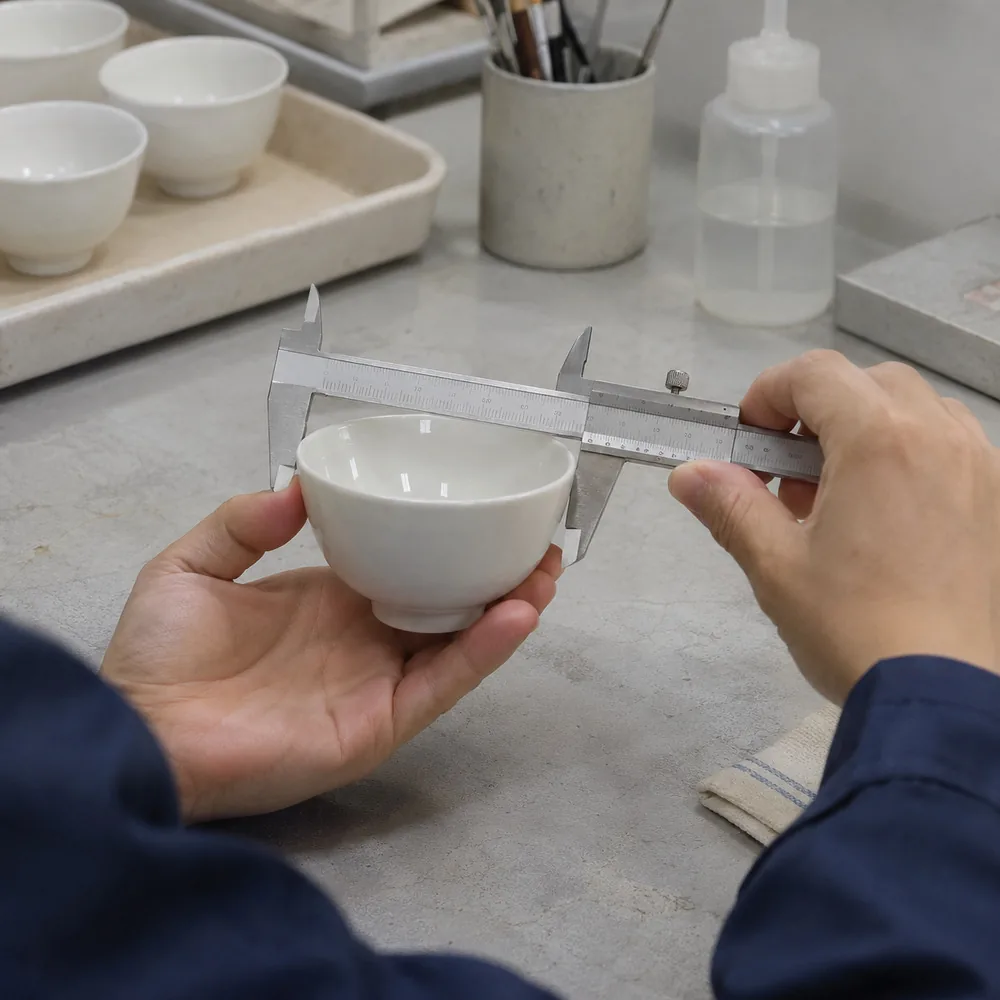
- Even walls. A wall thicker on one side heats unevenly and is more likely to crack. We hold wall thickness to ±0.4 mm on the line.
- Rim and flare. A gaiwan’s flared rim is what keeps fingertips off the hot bowl; check it on the size you plan to sell.
- Pour. Fill a teapot with water and pour it out at full tilt. It should pour in a clean stream and not dribble down the spout.
- Decoration placement. Anything on a surface that touches tea should be underglaze or in-glaze. Decals belong on outer walls.
Teapots are for hot water only, never a stove or an open flame. Put that on the care card.
Tests a tea ware sample should come with
A sample that looks right still needs numbers behind it. For tea ware, ask for three.
Thermal shock
Tea ware holds near-boiling water poured into a room-temperature piece. Our tea ware passes ASTM C554 thermal shock testing, from 180 °C into 20 °C water with no cracks.
Food contact for your market
Lips touch the rim of a gaiwan and the inside of every cup. The report has to cover the SKU and the decoration, for the country where it will be sold. A Japanese retail chain that buys our gaiwans, small dishes and side-handle teapots has had every SKU tested under Japan’s Food Sanitation Act, because that is the market’s rule.
Dimensions that affect use
On a gaiwan, the evenness of the wall (our tolerance is ±0.4 mm) and the fit of the lid. On a teapot, how the lid sits during the pour and whether the spout drips. Pour a full pot of water and time it; a pot that pours slowly or dribbles will be returned, however good it looks.
Decorating a tea range
Tea ware is decorated in the places a drinker sees and touches, so the method matters as much as the design.
Where the decoration can go
On the inside of a gaiwan bowl, the rim of a cup and the inside of a teapot, we use underglaze or in-glaze decoration only. These surfaces touch tea and lips, and decoration sealed under or into the glaze cannot be reached by either. Blue and white is the classic example: cobalt painted under the glaze, fired at full temperature.
On the outside of a teapot, the underside of a saucer or a gift box insert, decals and laser marks are fine. A logo on the base of a saucer is a common choice for tea brands: visible when the piece is turned over, out of the way when it is in use.
Colour glazes
A coloured glaze gives a tea range its identity without any printed decoration. Our Qing’ai tea ware series won a silver design award from the China Ceramic Industry Association in 2026, and its look comes from glaze colour and form, not from pattern. A glaze change on an existing model starts at 1,000 pieces, with a lead time of 30–35 days.
Minimums and lead times for tea ware
| What you order | Minimum | Lead time |
|---|---|---|
| Existing gaiwan or teapot, our glaze | 500 pcs per model | 25–30 days |
| Glaze or colour change | 1,000 pcs | 30–35 days |
| One-colour custom decal | 1,000 pcs | 35–40 days |
| Multi-colour or gold decal | 1,500 pcs | 35–40 days |
| Gift set in a box | 1,000 sets | Depends on the set |
| New shape with a new mold | 3,000 pcs | 45–55 days |
Lead times are counted in working days from the deposit and signed artwork; add 7–10 days between July and October. Our guide to dinnerware MOQs explains what each tier pays for.
Ordering gaiwans and teapots from us
Our existing gaiwans and teapots start at 500 pcs per model. A new glaze or your decal across a tea range starts at 1,000 pcs, and a gaiwan and teapot can share one glaze so the range matches. Our Qingai celadon tea ware won a 2026 silver award for daily-use ceramic design from the China Ceramic Industry Association.
See our porcelain gaiwans, ceramic teapots and tea sets, or tell us what your range needs and we will suggest sizes for your customers.