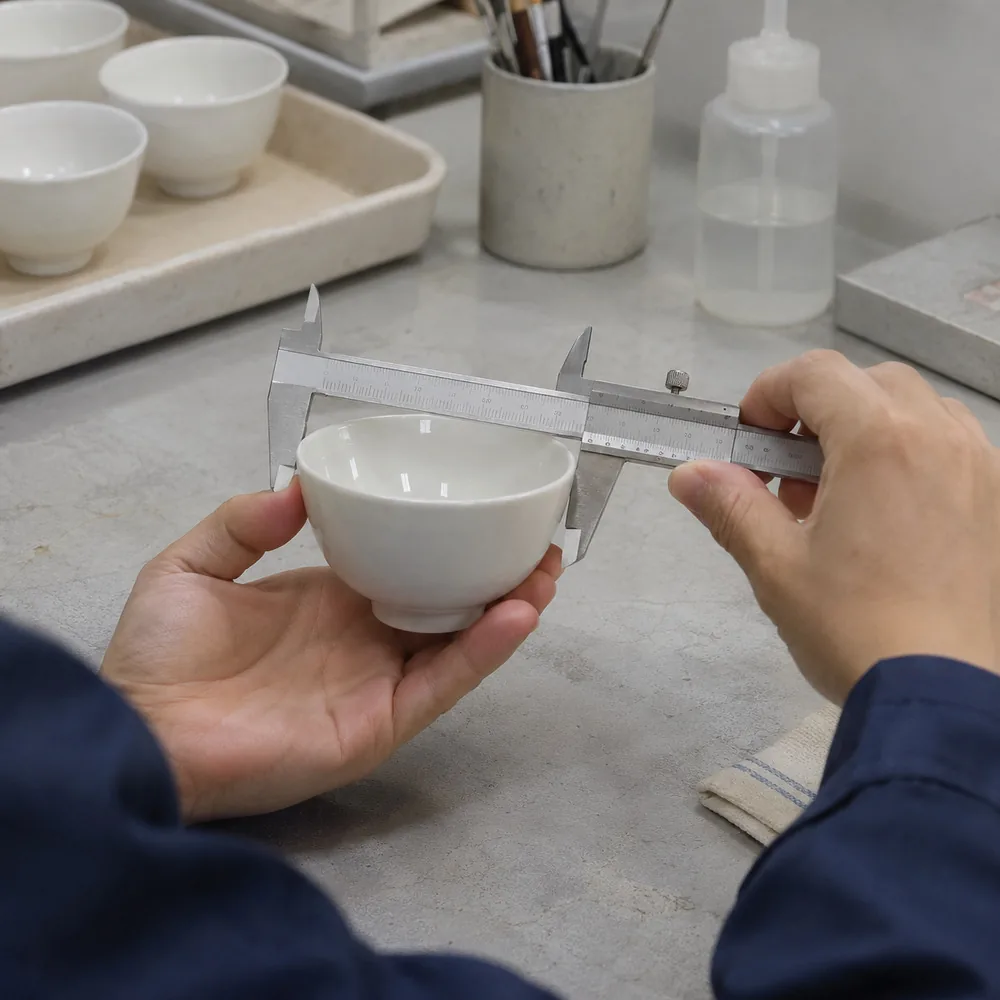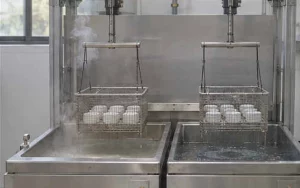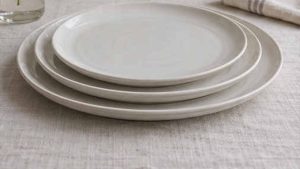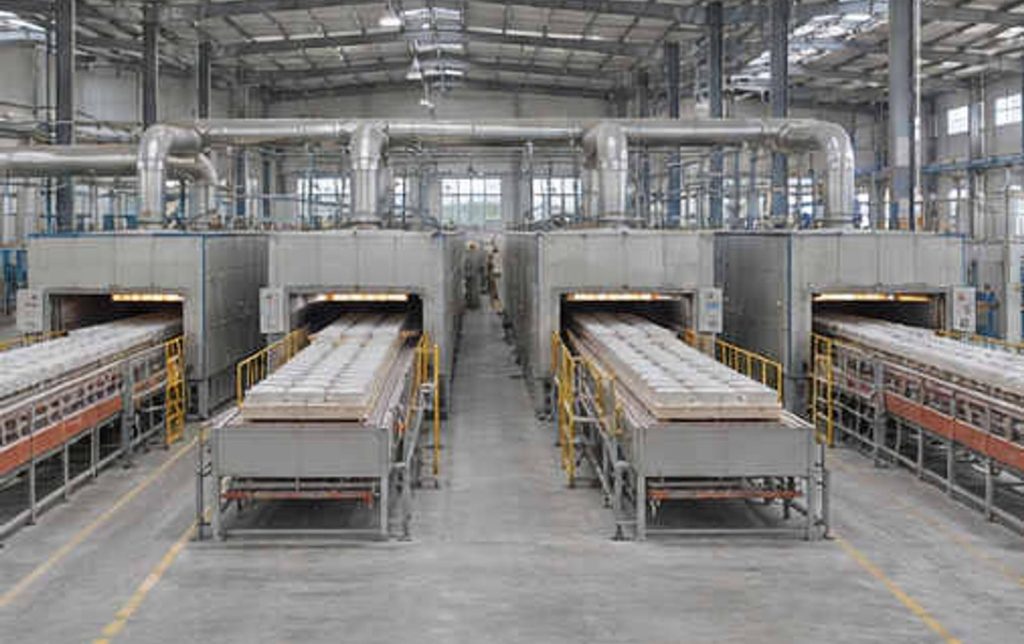
When the China Ceramics Museum in Jingdezhen wanted replicas of pieces from its own collection, it did not go to a hobby studio. Since 2023 we have made 12 of those shapes for the museum, about 90,000 pieces a year, on the same production floor that fires mugs for a US warehouse club and dinner sets for a German discount retailer.
That is Jingdezhen porcelain today: a thousand-year craft tradition running on natural-gas tunnel kilns, glazing robots and an ICP-MS lab. Here is what the name means, what changed, what did not, and how to tell whether a piece was really made here.
Our container loading guide gives the pieces per 40HQ for every model, and shows where trays and bottles fill a box by weight before volume.
What “Jingdezhen porcelain” means
Jingdezhen is a city in Jiangxi province, in south-east China, that has made porcelain for longer than almost anywhere on earth. It took its name from the Jingde reign of Emperor Zhenzong, around 1004, when it became a major kiln site. Its blue and white porcelain dates from the 1330s, and the Ming emperors set up their imperial kiln factory here in 1369. The history is well told on Wikipedia’s Jingdezhen porcelain page.
The clay itself carries the town’s name around the world. Kaolin, the white clay in every porcelain body, is named after Gaoling, a village near Jingdezhen where it was dug.
Today “Jingdezhen porcelain” is also a protected geographical indication in China. CNIPA, China’s IP office, names blue and white, famille rose and linglong (rice-grain pierced) among its traditional types, and the name is protected for porcelain made in Jingdezhen.
Why the imperial kilns were here
From the Ming dynasty onward, the imperial court ran its own kilns in Jingdezhen, making porcelain for the palace to standards set in the capital. Pieces were checked against official designs, and work that fell short was destroyed. Two things came out of that system that still shape the town: a workforce divided into specialist trades, from clay preparation to throwing, painting and firing, and the habit of measuring porcelain against a written standard rather than a maker’s judgement.
The specialist trades are still visible in the studio city. The written standard is what a modern factory runs on.
There are two Jingdezhens now
Walk through the city and you will see both. One is the studio city: thousands of small workshops, kiln yards and art students throwing and painting by hand. The other is the industrial zone, where tableware is made by the million.
They do different jobs. A hand-painted vase from a master’s studio is a one-off, and its value is in the hand. A hotel plate has to be the same as the 180,000 pieces before it, every year, so the value is in control. Our gaiwan guide shows what that difference means for one everyday piece. Our plant sits in the Jingdezhen High-tech Zone, 12 km from the airport, and it is built for the second job:
| What we run | |
|---|---|
| Site | 136,000 m², 168,000 m² of floor space |
| Main workshop | Workshop 6, 60,000 m²: forming, glazing and firing on one floor, 42 m average move between steps |
| Forming | 14 roller lines, 3 slip-casting lines, 6 high-pressure casting machines, 2 isostatic presses |
| Kilns | 4 natural-gas tunnel kilns (390 m in total), 6 shuttle kilns, 3 decal kilns, 4 electric kilns |
| Decoration | 12 glazing robots, 6 automatic decal machines, 4 laser markers, 2 gold-line lines |
| People | 268, including 42 in design and R&D and 32 in quality |
| Output | 22 million pieces of capacity; 17.8 million delivered in 2025 |
The studio city and the industrial zone, side by side
| Studio city | Industrial zone | |
|---|---|---|
| Typical maker | A master, a family workshop or a small studio | A factory with forming lines, tunnel kilns and a lab |
| Volume | One piece to a few hundred | Thousands to millions of pieces |
| Firing | Small gas or electric kilns, sometimes wood | Continuous tunnel kilns, shuttle kilns for small runs |
| Consistency | Each piece is its own | Pieces measured to a tolerance |
| Best for | Art, collectors, one-off gifts | Retail ranges, hotels, private label, corporate orders |
Neither is the “real” Jingdezhen. A buyer simply needs to know which one is quoting.
Where we sit
Our plant is in the Jingdezhen High-tech Zone, on 94.7 mu (about 63,100 m²) of industrial land we acquired in 2021, inside a 136,000 m² site. Production runs in one 60,000 m² building, Workshop 6, on three floors, with forming and firing on the same floor. A piece travels an average of 42 metres between process steps, from clay to finished product, without leaving the building.
What changed: fire, glaze and measurement
For most of its history, Jingdezhen fired with wood, and a kiln master judged temperature by the colour of the flame. Results varied from one end of the kiln to the other, and a whole firing could be lost to one bad night.
Our tunnel kilns fire at 1,260–1,320 °C and hold within ±8 °C across the kiln, logged by nine thermocouples to our MES system for every batch. Glazing robots lay glaze 0.25–0.35 mm thick and repeat to ±0.02 mm. Every piece passes machine vision and a manual check, and colour is measured on an X-Rite Ci7800 to ΔE 1.5 within a batch.
Food safety is measured too. We check lead and cadmium on our own Agilent 7900 ICP-MS and hold them to half the legal limit, and our tested lines carry SGS reports to FDA CPG 7117.06/07 and TÜV Rheinland reports to LFGB.
The fuel changed as well. The kilns run on natural gas, the roof carries 6.2 MW of solar panels, 62% of process water is reused, and gas use per piece is down 18% on 2019. In 2025 the plant was named a National Green Factory.
The kilns behind a modern plant
| Kiln | Length or volume | Temperature | Pieces | Used for |
|---|---|---|---|---|
| Tunnel kilns 1 and 2 | 108 m each | 1,290–1,320 °C | 22,000 a day each | High-white porcelain: cups, bowls, plates, dinner sets |
| Tunnel kiln 3 | 96 m | 1,280–1,310 °C | 15,000 a day | Strengthened porcelain and stoneware |
| Tunnel kiln 4 | 78 m | 1,260–1,300 °C | 9,000 a day | Large and irregular pieces, second glaze firings |
| Shuttle kilns S1–S6 | 18, 24 and 36 m³ | 1,250–1,300 °C | 1,800–4,500 per firing | Vases, figurines, samples, small runs |
| Roller decorating kilns R1–R3 | 36 m | 780–850 °C | Continuous | Decals, gold and overglaze decoration |
| Electric kilns E1–E4 | 1.2 m³ | 1,280 °C | 60–120 per firing | Samples and colour trials |
The four tunnel kilns are 390 metres long in total and run 320 days a year.
From wood smoke to measured energy
The move from wood to gas changed the air in Jingdezhen and the economics of firing. In our plant, waste heat from the tunnel kilns dries the unfired pieces, the roof carries 6.2 MW of solar panels, and gas use per unit of output is 18% below its 2019 level. Process water is treated on site and 62% of it is reused, and kiln exhaust is desulphurised, denitrified and filtered, with emissions monitored online.
These figures are checked by third parties. The plant was named a National Green Factory in 2025, and our greenhouse gas emissions and product carbon footprint were verified to ISO 14064-1 and ISO 14067.
Every piece in a database
The whole plant runs on a 5G private network. The production system links clay batches, kiln runs, shift teams and test data, so a single piece can be traced back to the batch of clay it was made from. The automated warehouse holds 6,800 pallet positions, served by 32 automated guided vehicles, and is linked to the same system.
What did not change: the materials and the hands
The clay is still kaolin-based porcelain, fired hard enough to vitrify: our porcelain absorbs 0.5% of its weight in water or less, and our high-white porcelain 0.3% or less. If you want the difference between that and stoneware explained, our guide to porcelain vs ceramic covers it.
The design skill is still local. Our 42-person design and R&D team works on site, and the company holds 670 patents, 512 of them design patents, including the ribbed-handle BM-350 mug (ZL 2024 3 0528417.6). Our Fendai dinner set won gold at the 2024 Jiangxi Industrial Design Competition, and our Carousel Horse figurine won a Canton Fair CF Award (Bronze) in 2026.
Small work still gets small kilns. Our six shuttle kilns fire vases, figurines, samples and short runs that would waste a place in a tunnel kiln, which is what lets us take luxury brand projects with no minimum order: art plates for Jaeger-LeCoultre, a co-branded tea set for FAW-Audi, bottles for Moutai. For forms no mold can make, see our guide to 3D printing ceramics.
Seven steps from clay to porcelain
| Step | What we control |
|---|---|
| Body preparation | Kaolin, feldspar and quartz ball-milled for 18 hours; vacuum de-aired twice; moisture 18–20% |
| Forming | Roller forming, slip casting or isostatic pressing; wall thickness ±0.4 mm |
| Fettling and bisque firing | Bisque firing at 800–900 °C to remove water and organic matter |
| Glazing | Dipping, spraying or pouring; glaze 0.25–0.35 mm, robot repeatability ±0.02 mm |
| Decoration | Underglaze, in-glaze, decal, gold line, laser marking |
| Firing | 1,260–1,320 °C, temperature held within ±8 °C, 9 thermocouples per kiln |
| Sorting and packing | Machine vision plus 100% manual check, AQL 2.5 sampling, every carton coded |
The steps are the ones Jingdezhen has used for centuries. What changed is that each one has a number next to it.
The people who run it
Our general manager, Chen Zhiyuan, came up through a state-owned Jingdezhen porcelain factory and led the construction of our four tunnel kilns. Our chief engineer, Wang Jue, has 25 years in body and glaze formulation and heads our provincial enterprise technology centre. Front-line team leaders have been with us an average of nine years. The hands are still local; they now work with instruments.
Blue and white is an underglaze technique
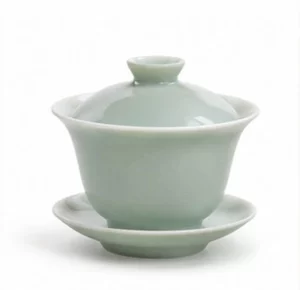
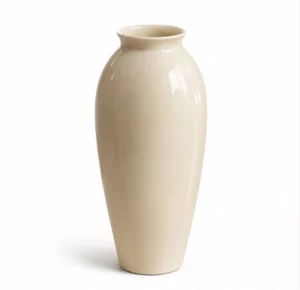
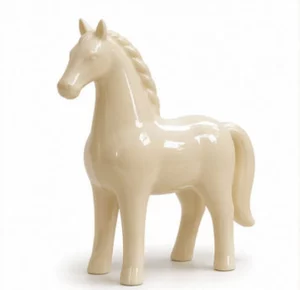
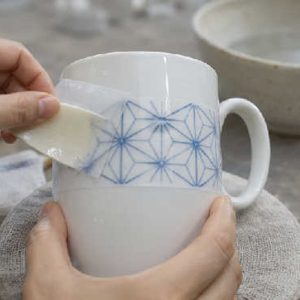
Blue and white, the style most people picture when they hear “Chinese porcelain”, is cobalt painted on the raw body and then covered with clear glaze before firing. The colour sits under the glaze, which is why a 600-year-old blue and white bowl still looks fresh.
The same principle keeps decoration safe today. On every surface that touches food we decorate underglaze or in-glaze only, so a fork, a scourer or a commercial dishwasher has glaze to wear before it reaches the pattern. Decals and gold lines go on surfaces that food does not touch, and gold is never microwave safe.
One Jingdezhen factory’s timeline
Our own history follows the town’s recent one: from a small seller of porcelain to a plant that fires it at industrial scale.
| Year | What happened |
|---|---|
| 2011 | Beihanmei Ceramics founded in Jingdezhen’s Zhushan district: three people and a 40 m² warehouse, selling porcelain online |
| 2013 | Our first own mold goes into production, the BM-350 mug |
| 2015 | Decision to build our own kilns and bring firing in-house |
| 2017 | First export customer, in Canada; first time at Ambiente in Frankfurt |
| 2018 | Tunnel kiln 1 lit; IKEA IWAY audit passed |
| 2021 | Jiangxi Tuofeng Ceramics Group formed; industrial land acquired in the High-tech Zone |
| 2024 | Full production in the new plant; Workshop 6 opened |
| 2025 | National High-tech Enterprise; National Green Factory |
| 2026 | amfori BSCI grade B; China Customs AEO Advanced status; selected for Hainan Airport VIP lounges |
A Jingdezhen factory in numbers
“Made in Jingdezhen” covers a one-person studio and a plant of 136,000 m². This is what the second kind looks like, using ours.
| Item | Figure |
|---|---|
| Land and buildings | 94.7 mu (about 63,100 m²) of our own industrial land in the Jingdezhen High-tech Zone; site 136,000 m²; 168,000 m² of buildings |
| Main workshop | One 60,000 m² building on three floors, forming and firing on the same floor, 42 m average between processes |
| Forming | 14 roller lines, 3 slip-casting lines, 6 high-pressure casting machines, 2 isostatic presses |
| Firing | 4 natural-gas tunnel kilns (390 m in total), 6 shuttle kilns, 3 roller decorating kilns, 4 electric sample kilns |
| Decoration | 12 glazing robots, 6 automatic decal machines, 4 laser markers, 2 gold-lining lines |
| Warehouse | 6,800 pallet positions, 32 AGVs, linked to production |
| Capacity | 22 million pieces a year; 17.8 million delivered in 2025 |
| Exports | 43 countries, 620 containers in 2025 |
| People | 268, including 186 in production, 32 in quality, 42 in design and R&D, 8 in export and documents |
Two figures say most about a factory’s consistency. Our front-line team leaders have been with us for nine years on average, and every piece is traced from its clay batch to its kiln run, team and test data.
Recognition, and what it is based on
Titles are easy to list and hard to check. These are the ones we hold, with what each is awarded for.
| Recognition | Year | Awarded for |
|---|---|---|
| National High-tech Enterprise | 2025 | Research spending, patents and technical staff |
| National Green Factory | 2025 | Energy, emissions and resource use, assessed by the Ministry of Industry and Information Technology |
| Jiangxi specialised and innovative SME | 2025 | Specialist products and innovation |
| Jiangxi Industrial Design Centre | 2024 | In-house design capability |
| Jiangxi Enterprise Technology Centre | 2023 | In-house technical development |
| Jiangxi 5G+ Industrial Internet demonstration factory | 2025 | Networked production and traceability |
| China Customs AEO Advanced Certified Enterprise | 2026 | Customs compliance and supply-chain security |
Each title has a certificate number and an issuing body, and our certifications page lists them.
Design awards
Our own ranges have won design awards that buyers can check: the Fendai dinner set took gold at the 2024 Jiangxi Industrial Design Competition, the Wujinxia range a China National Light Industry Council award in 2025, the Zhuanzhuanma ornament a bronze at the Canton Fair Design Awards in 2026, and the Qingai celadon tea ware a silver for daily-use ceramic design from the China Ceramic Industry Association in 2026.
Designs, trademarks and standards
A Jingdezhen name sells, so it is copied. Protecting designs and names is part of running a factory here.
- Patents: 670 in total, of which 512 are design patents, 118 utility models and 40 inventions, including our high-white body formula and a low lead-and-cadmium underglaze process.
- Trademarks: 360, covering 31 countries, including registrations in the EU, the US, Japan, South Korea and Australia.
- Copyrights: 500 registered works, covering patterns, shape drawings and packaging designs.
- Standards: we have taken part in drafting 15 standards: 3 national, 5 industry and 7 association standards.
For buyers, the practical point is ownership. Molds, decal plates and box artwork made for your range belong to you; shapes and patterns from our own collections stay ours, which is how a collection can be protected when it is sold in your market.
Where to meet us outside Jingdezhen
If a factory visit is not possible yet, meet the team at a trade fair first.
| Fair | When | Where to find us |
|---|---|---|
| Canton Fair, Guangzhou | Six sessions from spring 2023 to autumn 2026 | Hall 12.2, booths A13–15 |
| Ambiente, Frankfurt | 2025 and 2026 | Hall 4.1 |
| Maison&Objet, Paris | January 2026 | Hall 5A |
| The Inspired Home Show, Chicago | 2026 | North American retail lines |
| INDEX, Dubai | 2025 | Middle East hotel lines |
| Jingdezhen International Ceramic Fair | Every year from 2019 to 2026 | Main hall |
How to check a piece is really made in Jingdezhen
“Jingdezhen porcelain” sells, so the name is used on goods made elsewhere and on goods a trader bought from a third factory. Four checks settle it:
- The factory address. Ask for it in writing and look it up on a map. Ours is No. 1 Changcheng Chuangyu Road, Jingdezhen High-tech Zone.
- The export registration. A factory that exports under its own name has its own customs registration. Ours is 3302960091, with China Customs AEO Advanced status.
- A live video walk. Ask to see the kiln and the packing line on a video call, at a time you choose.
- A visit. Jingdezhen is reachable: Luojia Airport is 12 km from our plant and Jingdezhen North Station is 9 km. We pick up from both.
Our supplier sourcing guide covers the rest of the checks, from test reports to inspection.
Four checks, from desk to factory floor
| Check | What to ask for | What it proves |
|---|---|---|
| Address | Business licence and production address | The company is registered and producing in Jingdezhen |
| Customs code | The exporter’s customs registration | Goods are exported under the factory’s own name, through Jingdezhen Customs |
| Live video | A walk from the kilns to the warehouse without cuts | The production you are buying from exists and is running |
| Visit | A tour of the plant | Everything above, and how the work is done |
Our customs registration is with Jingdezhen Customs, code 3302960091, and our production address is No. 1 Changcheng Chuangyu Road, Jingdezhen High-tech Zone.
The geographical indication
“Jingdezhen porcelain” is a protected geographical indication in China. The name on its own is not a guarantee, so check the producer behind it, using the four checks above.
“Made in Jingdezhen” on your packaging
If you want the town’s name on your box, ask the supplier to confirm the production address in writing for your order. The origin mark itself follows the destination market’s rules, and the certificate of origin names the exporter and the place of manufacture.
Visit the porcelain capital
We host groups of up to 30 people, Monday to Friday from 09:00 to 16:00, booked 7 working days ahead. The 90-minute route covers the showroom, forming, kilns, lab and warehouse, with two English-speaking guides. See our factory tour page for the details, or meet us at the Canton Fair, Hall 12.2, booths A13–15.
If you would rather start with the product, tell us what you need and we will send two stock samples from Jingdezhen in 3 days.