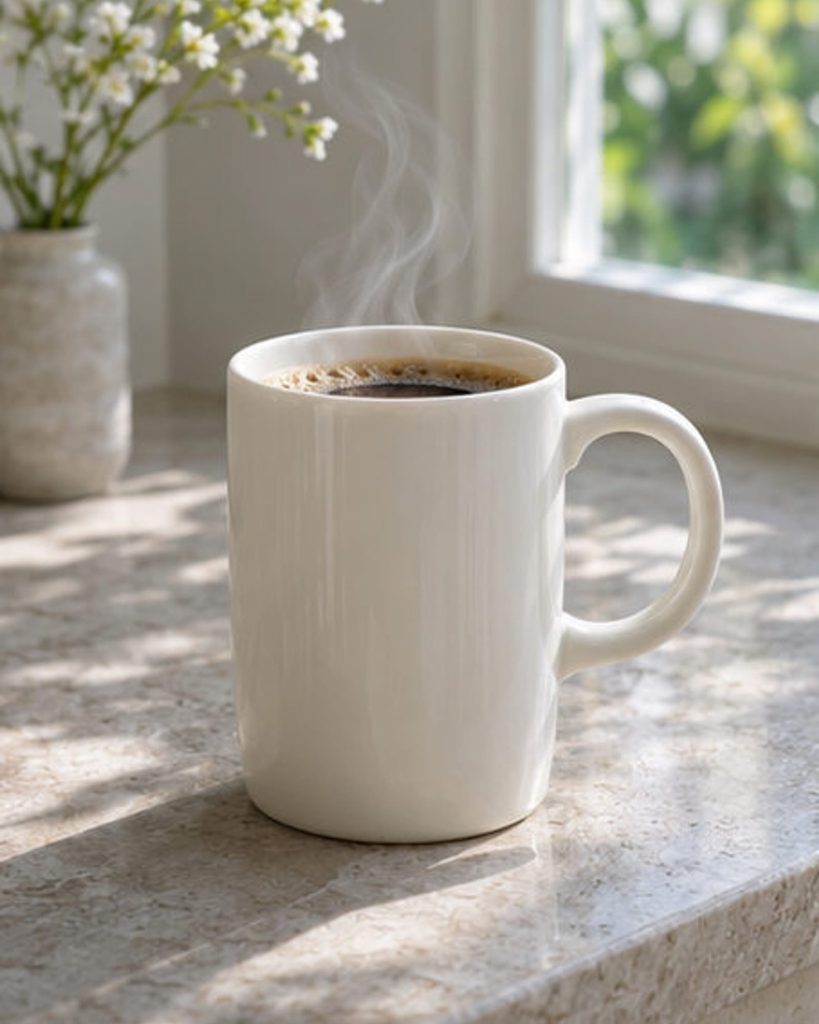
The standard coffee mug holds 11 US fluid ounces, about 325 ml. The common large mug holds 15 oz, about 444 ml. Most mugs sold in shops fall between 8 and 16 oz, which is 240 to 475 ml.
Those are the labels. Below is what the sizes measure in the hand, on the scale and in a shipping container. We make 8.2 million mugs a year in Jingdezhen across seven sizes, from 250 to 500 ml, so the numbers here come from our own production, not from a catalogue.
Our seven mug sizes, measured
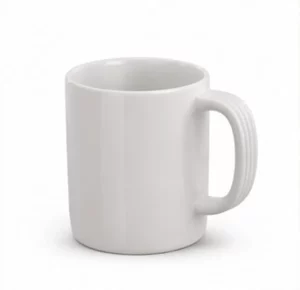
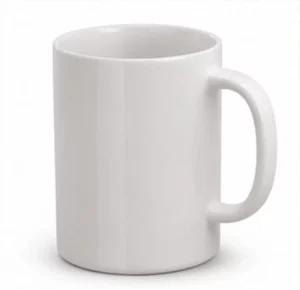
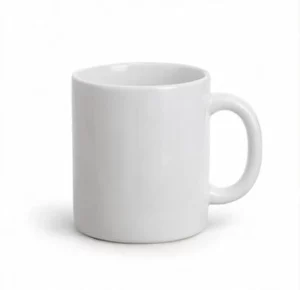
Every mug in our BM family is named after its capacity in millilitres: a BM-350 holds 350 ml. This is the full range, with the ounce equivalents a US or UK buyer will search for.
| Model | Capacity | US fl oz | Diameter × height | Weight | Per carton | Per 40HQ |
|---|---|---|---|---|---|---|
| BM-250 | 250 ml | 8.5 oz | 7.6 × 8.6 cm (3.0 × 3.4 in) | 260 g | 60 | 63,420 |
| BM-280 | 280 ml | 9.5 oz | 7.9 × 9.1 cm (3.1 × 3.6 in) | 272 g | 60 | 58,500 |
| BM-320 | 320 ml | 10.8 oz | 8.0 × 9.3 cm (3.1 × 3.7 in) | 300 g | 48 | 44,592 |
| BM-350 | 350 ml | 11.8 oz | 8.2 × 9.6 cm (3.2 × 3.8 in) | 320 g | 48 | 41,616 |
| BM-400 | 400 ml | 13.5 oz | 8.6 × 10.4 cm (3.4 × 4.1 in) | 355 g | 48 | 37,872 |
| BM-450 | 450 ml | 15.2 oz | 9.0 × 11.0 cm (3.5 × 4.3 in) | 380 g | 36 | 29,088 |
| BM-500 | 500 ml | 16.9 oz | 9.4 × 11.6 cm (3.7 × 4.6 in) | 405 g | 36 | 25,776 |
Container loads assume a 40-foot high-cube container with 60 m³ usable and 92% fill. Each model has its own page with carton size and CBM in our wholesale ceramic mugs range.
Proportion: how the same volume can look different
Capacity is a volume, and a volume can be tall and narrow or short and wide. Our BM-250 is 7.6 cm across and 8.6 cm tall, a compact, squat mug; the BM-500 is 9.4 cm across and 11.6 cm tall. Across the range, height grows faster than diameter, so the larger mugs read as taller rather than fatter. That keeps them comfortable to hold: a mug much wider than about 9 cm is hard to wrap a hand around.
If a brief gives a capacity but not dimensions, ask for both. Two 400 ml mugs from two factories can be a centimetre apart in height and look like different sizes on a shelf.
Weight per millilitre
Larger mugs carry less porcelain for each millilitre they hold:
| Model | Capacity | Weight | Grams per ml |
|---|---|---|---|
| BM-250 | 250 ml | 260 g | 1.04 |
| BM-350 | 350 ml | 320 g | 0.91 |
| BM-500 | 500 ml | 405 g | 0.81 |
A small mug is mostly wall and base; a large one is mostly space. That is why small mugs feel solid and large ones can feel light for their size, and why a small mug is the better choice when a buyer wants weight in the hand.
Matching “11 oz” and “15 oz” to real millilitres
If a brief says “11 oz mug”, the closest of our shapes are the BM-320 and BM-350. A “15 oz mug” is the BM-450. A “12 oz” café mug is the BM-350, and a “16 oz” mug is the BM-500.
| Size on the brief | In ml | Our nearest model |
|---|---|---|
| 8 oz | 237 ml | BM-250 |
| 10 oz | 296 ml | BM-280 or BM-320 |
| 11 oz | 325 ml | BM-320 or BM-350 |
| 12 oz | 355 ml | BM-350 |
| 15 oz | 444 ml | BM-450 |
| 16 oz | 473 ml | BM-500 |
Watch which ounce is meant. A US fluid ounce is 29.6 ml and a UK fluid ounce is 28.4 ml, so an “11 oz” mug is 325 ml in the US and 313 ml in the UK. On a quote that goes to both markets, write the size in millilitres and the ounces will follow.
Brim capacity is not the coffee you get
A mug’s rated size can mean two different things: how much it holds filled to the very top, or how much it holds at a sensible drinking level a centimetre or so below the rim. The difference is a fair share of the cup, and nobody pours to the brim.
When you compare samples from two suppliers, ask which one their number means, then check it yourself: weigh the empty mug, fill it to the rim with water and weigh it again. One gram of water is one millilitre. If one supplier’s “350 ml” holds noticeably less than another’s, you are comparing two different sizes under one label.
How size changes weight, shipping and cost
Size is the decision that moves your landed cost most, before glaze or logo.
From our smallest to our largest mug, capacity doubles but weight rises only 56%, from 260 g to 405 g. The container load moves much further. A 40HQ holds 63,420 BM-250 mugs but only 25,776 BM-500 mugs, two and a half times fewer. If you sell by the piece, the freight on each 500 ml mug is about two and a half times the freight on a 250 ml one.
Three things follow from that:
- Do not order larger than your customers use. A 450 ml mug that mostly serves 200 ml of tea pays for air in every container.
- Check the carton count, not just the mug. Our 250 and 280 ml mugs pack 60 to a carton; the 450 and 500 ml pack 36. Warehouse handling is often priced per carton, not per piece.
- Mix sizes in one container. A shipment of 350 ml mugs with a smaller run of 450 ml fills the space better than two half-loads.
Our guide to sourcing ceramic dinnerware from China shows how freight, duty and breakage add up to a landed cost per piece.
Freight per mug, worked through
Freight per piece is the container price divided by the pieces in the container. Whatever your forwarder charges, the ratios between sizes stay the same. Against the BM-250 at 1.00:
| Model | Pieces per 40HQ | Freight per mug (BM-250 = 1.00) |
|---|---|---|
| BM-250 | 63,420 | 1.00 |
| BM-350 | 41,616 | 1.52 |
| BM-400 | 37,872 | 1.67 |
| BM-500 | 25,776 | 2.46 |
Use your forwarder’s real price, and the ratios stay the same: the BM-500 costs about 2.5 times as much to ship as the BM-250. On a range of several sizes, those cents are the difference between two price points on a shelf.
Which size for which use
| Use | Size we recommend | Why |
|---|---|---|
| Espresso-based drinks, tea for one | 250–280 ml (8–9.5 oz) | Right for a flat white or one cup of tea, and the lightest to carry and ship |
| Everyday coffee at home or in the office | 320–350 ml (11–12 oz) | The size most people mean by “a mug” |
| Large coffee, soup, hot chocolate | 400–450 ml (13.5–15 oz) | Room for milk and a full serve |
| Promotional and gift mugs | 350 ml | Familiar size, large enough wall for a logo, light enough to post |
| Café and hotel service | 280–350 ml | Matches common serving sizes and keeps freight per piece down |
Check height before you pick a large mug for a café or a hotel room. A 500 ml mug at 11.6 cm tall may not fit under a capsule machine spout. A short sample run on your own machines settles it. For cups and saucers, see our guide to coffee cup sizes.
The handle matters as much as the volume. Our BM-350 has a ribbed handle of our own design, protected by design patent ZL 2024 3 0528417.6. It was our first own mold, in 2013, and has sold over a million pieces since.
Size by use, as a starting point
| Use | Common choice | Our closest models |
|---|---|---|
| Espresso-based drinks at home, children | Small | BM-250 |
| Office and everyday coffee or tea | Standard 11–12 oz | BM-320, BM-350 |
| Large latte, tea with milk | 14–15 oz | BM-400, BM-450 |
| Soup, large hot drinks | 16 oz and above | BM-500 |
| Corporate gifts | Standard, for the widest appeal | BM-350 |
These are common choices, not rules. For gifts, a standard size is safer than a large one, because it suits most cupboards and most dishwashers.
What the size does not tell you
Two mugs of the same size can behave very differently. Before you approve one, ask for these:
- Body. Porcelain absorbs 0.5% of its weight in water or less, so it does not take in coffee stains or crack its glaze over the years. Our guide to porcelain vs ceramic explains why we use it for mugs.
- Microwave and thermal shock. 41 of our SKUs are tested through 20 microwave cycles at 700 W for 5 minutes, and our mugs survive a 180 °C to 20 °C water quench without cracking under ASTM C554 (SGS-CSTC-2026-QZ-05233).
- Food contact. Our tested lines are covered by SGS reports to FDA CPG 7117.06/07 and ASTM C738 (SGS-CSTC-2026-QZ-04187) and by LFGB (LFGB-20260305-118, TÜV Rheinland). Ask which reports cover the size and decoration you order. US-01, a US warehouse club buying mugs and 24-piece sets from us since 2021, gets an SGS report in every container.
- Logo. On the lip and inside the mug we decorate underglaze or in-glaze only, so the dishwasher cannot wear it off.
Three things to check that the label cannot
Handle and finger room
Fill the mug to its working level and hold it by the handle for a minute. The handle has to carry the full weight without pinching, and leave room for at least two fingers on a large mug. Our BM-350 has a ribbed handle designed for grip, and the design is protected by Chinese design patent ZL 2024 3 0528417.6.
Stability
A tall mug with a narrow base tips more easily, especially on a desk or a café tray. Compare the base diameter with the height before you choose a large size for a busy setting.
Decoration and care
A plain glaze mug and the same mug with a decal or gold rim are different products for the dishwasher and the microwave. Our guides on dishwasher-safe dinnerware and microwave-safe porcelain explain how to label each version.
Ordering branded mugs in our sizes
The BM family is where our company started. The BM-350 was our first own mold, in 2013, and it has sold more than a million pieces. Mugs remain our largest product line: we make up to 8.2 million cups and mugs a year, on eight roller-forming lines and two of our tunnel kilns.
Minimums and lead times for mugs
| What you order | Minimum | Lead time |
|---|---|---|
| Mixed stock mugs | 48 pcs | 7–10 days |
| One stock model | 500 pcs | 7–10 days from stock |
| Existing model, made to order | 500 pcs | 25–30 days |
| Your glaze colour | 1,000 pcs | 30–35 days |
| One-colour decal logo | 1,000 pcs | 35–40 days |
| Multi-colour or gold decal | 1,500 pcs | 35–40 days |
| New shape or new handle | 3,000 pcs | 45–55 days |
Lead times are working days from the deposit and signed artwork, with 7–10 days added between July and October.
Who buys mugs from us
A US warehouse club takes our mugs with 24-piece dinner sets, about 1.8 million pieces a year, with an SGS report in every container. Mugs are also the core of most e-commerce brand orders, at 500–5,000 pieces a month, and of corporate gift orders from 1,000 sets.
How our mugs are made
Mugs are our largest product line: 8.2 million pieces a year of capacity for mugs and cups, and 6.6 million delivered in 2025. Knowing how they are made explains why some sizes cost more and why some changes are easy.
Forming
Mug bodies are formed on 8 roller lines, which press the clay against a rotating plaster mold. Roller forming gives an even wall, which is why we can hold wall thickness to ±0.4 mm and piece weight to ±3% across a run. The handle is formed separately and joined to the body before drying, and the joint is checked in process.
Glazing and firing
Glaze goes on by robot, 0.25–0.35 mm thick, and mugs fire in tunnel kilns 1 and 2 at 1,290–1,320 °C with the temperature logged at nine points. A whiter body and an even glaze are what keep a logo or a brand colour looking the same on every mug in an order.
Why some changes are easy and others are not
A new glaze colour or your decal on one of our seven sizes uses the existing molds, so it starts at 1,000 pieces. A new handle shape or a new body needs a new mold, from 3,000 pieces. If a design can live with one of our seven bodies, the minimum and the lead time both drop.
Packing mugs, size by size
Carton size changes with mug size, and so does the number of mugs per carton.
| Model | Capacity | Per carton | Carton size | CBM per carton |
|---|---|---|---|---|
| BM-250 | 250 ml | 60 | 48 × 34 × 32 cm | 0.0522 |
| BM-280 | 280 ml | 60 | 49 × 35 × 33 cm | 0.0566 |
| BM-320 | 320 ml | 48 | 50 × 36 × 33 cm | 0.0594 |
| BM-350 | 350 ml | 48 | 52 × 36 × 34 cm | 0.0636 |
| BM-400 | 400 ml | 48 | 54 × 37 × 35 cm | 0.0699 |
| BM-450 | 450 ml | 36 | 50 × 39 × 35 cm | 0.0683 |
| BM-500 | 500 ml | 36 | 52 × 40 × 37 cm | 0.0770 |
Each mug sits in a molded pulp or EVA insert inside a five-ply carton, and every new carton is drop-tested from 1.2 m to ISTA 1A and 3A. For retail, a mug can go into a printed colour box, on FSC-certified board if needed, or a gift box with a magnetic lid and an EVA insert, both carrying only your brand.
Single mugs in a parcel
E-commerce brands ship mugs one at a time, so the retail box has to protect the mug without the export carton around it. Test the boxed mug on its own, not only inside the carton, and keep the box light enough to keep postage down. E-commerce orders with us commonly run at 500–5,000 mugs and cups a month.
A three-size mug range, planned
Many brands sell a mug in more than one size. Here is how a three-size range works on our existing molds.
| Size | Model | Use |
|---|---|---|
| Small | BM-250 | Smaller drinks and gift sets |
| Standard | BM-350 | The everyday mug, the “11 oz” of the range |
| Large | BM-450 | Tea and large coffees, the “15 oz” end |
Minimums across sizes
All three are existing models, from 500 pieces each in our glaze. With your logo as a one-colour decal, the 1,000-piece minimum can be spread across the three sizes and across colours, so a first order does not need 1,000 of each.
Freight across sizes
The three sizes ship at 63,420, 41,616 and 29,088 per 40HQ. If you price the range with one freight figure per mug, the large size will be undercharged and the small one overcharged. Our container loading guide shows how to work out freight per piece by model.
One look across sizes
Approve the logo on each size, because a mark that suits a 350 ml mug can look small on a 450 ml one and crowded on a 250 ml one. We hold glaze colour to ΔE 1.5 within a batch and 2.0 between batches, so all three sizes match on the shelf.
Ordering a mug size that is not on the list
If none of the seven sizes fits, there are three routes:
- Use an existing shape as it is. From 500 pcs, ready in 25–30 days.
- Change the colour or add your logo. Glaze colour from 1,000 pcs; a one-colour logo decal from 1,000 pcs, multi-colour or gold from 1,500, in 35–40 days.
- Make a new size. A new mold starts at 3,000 pcs. We 3D-print your shape in 3 days so you can hold it and check the volume before the mold is cut. Our guide to 3D printing ceramics covers how that works.
For branded mugs, see custom ceramic mugs, and for gifts, our ceramic corporate gift ideas. If you know the size and the quantity, send us your brief and we will send two stock samples in 3 days so you can fill them and see for yourself.