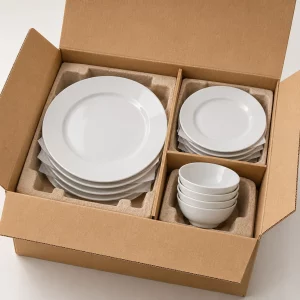
A 30 cm dinner plate costs about two and a half times as much to ship per piece as a 27 cm plate. The plates are 3 cm apart in diameter, but the larger one packs 12 to a carton instead of 24, so a 40-foot container holds 5,940 of them against 15,072. No supplier quote shows that difference, and it can be larger than the gap between two unit prices.
That is the problem with comparing dinnerware suppliers on unit price. The price is one line of a cost that has ten. Here is each line, what drives it, and what to ask a supplier so you can put two quotes side by side.
The ten lines that make up landed cost
Landed cost is everything you pay to get a sellable piece onto your shelf, divided by the number of pieces that arrive sellable. Most of it is decided before the order ships, by choices about size, packing, testing and terms.
| Cost line | What drives it | What to ask the supplier |
|---|---|---|
| Unit price | Material, decoration, MOQ tier | The tier you are in and what moves you to the next one |
| Packing | Carton grade, inserts, gift box | Carton spec, drop-test standard, pieces per carton |
| Freight per piece | Pieces per container | Carton size, CBM per carton, units per 40HQ |
| Inland and port charges | Incoterm (EXW, FOB, CIF, DDP) | Which costs the quote includes, and from which port |
| Duty and customs brokerage | HS code, origin, destination | The HS code for each item |
| Testing | Market, number of SKUs and decorations | Which SKUs current reports cover, and what a new test needs |
| Inspection | AQL level, who inspects | Whether your inspector is welcome and when |
| Breakage | Packing, route, handling | Measured transit breakage rate |
| Claims and rework | Contract terms | Claims window, response time, liability cap |
| Delay | Lead time, peak season, port holds | Lead time from which date, and what happens if it slips |
The unit price line moves with what you change on the product. A colour change starts at 1,000 pcs, a new shape at 3,000, and our guide to dinnerware MOQs shows what each tier adds.
Our dinnerware ships under HS 6911.10 (porcelain tableware) or 6912.00 (other ceramic tableware). Give the code to your customs broker before you compare quotes. The duty is the same whichever Chinese factory you buy from, but a wrong code on the paperwork is a delay.
Tooling: where a refund changes the sum
Setup fees are usually quoted separately, and their effect on cost per piece depends on whether they come back. At our factory, a new-mold fee is refunded once the order for that shape reaches 3,000 pieces, an underglaze or laser logo plate fee from 2,000 pieces, and an exclusive glaze fee from 5,000 pieces. Decal printing plates are not refunded, but they are yours and serve every reorder.
A mold fee that is refunded at your order quantity is not a cost at all, only cash paid early. A plate fee that is not refunded is a real cost, but it is spent once: the plates are yours and serve every reorder. Put both into the sheet as separate lines, so the unit price you compare is the price of the product, not the product plus its tools.
Freight per piece follows the carton, not the price
A container costs roughly the same to ship whatever is inside it, so freight per piece follows how many pieces fit. Here are real loads for a few of our models, with freight per piece shown against the BM-350 mug:
| Model | Units per 40HQ | Freight per piece (BM-350 = 1.00) |
|---|---|---|
| BM-350 mug, 350 ml | 41,616 | 1.00 |
| BM-500 mug, 500 ml | 25,776 | 1.61 |
| PL-21 plate, 21 cm | 25,320 | 1.64 |
| PL-27 plate, 27 cm | 15,072 | 2.76 |
| PL-30 plate, 30 cm | 5,940 | 7.01 |
| TP-800 teapot, 800 ml | 9,468 | 4.40 |
| DS-16 dinner set, 16 pieces | 2,044 sets | 20.36 per set |
Loads assume 60 m³ usable in a 40HQ at 92% fill. The container loading guide has the figures for every model, and explains when a container of trays or bottles fills by weight before it fills by volume.
Two things follow. A small change in size can move freight per piece more than a large change in unit price, so check the load before you fix dimensions. And a supplier that cannot give you pieces per carton, CBM and units per 40HQ for every SKU has not worked out your freight. Its delivered price is an estimate.
Full container or shared container
A minimum order rarely fills a 40HQ. Below a full container, goods ship as a less-than-container load (LCL), sharing a container with other shippers. LCL is charged by volume, usually costs more per cubic metre than a full container, and the cartons are handled more often at both ends.
For example, 1,000 BM-350 mugs fill 21 cartons, about 1.3 m³. A full 40HQ of the same mug is 41,616 pieces. Between those two points, ask your forwarder for both prices: sometimes a 20-foot container, half full, costs about the same as LCL and spares the cartons the extra handling.
Breakage costs more than the broken pieces
A broken piece costs its own price plus the freight, duty and handling already spent on it. In a set it costs more, because one broken mug can make a whole gift box unsellable.
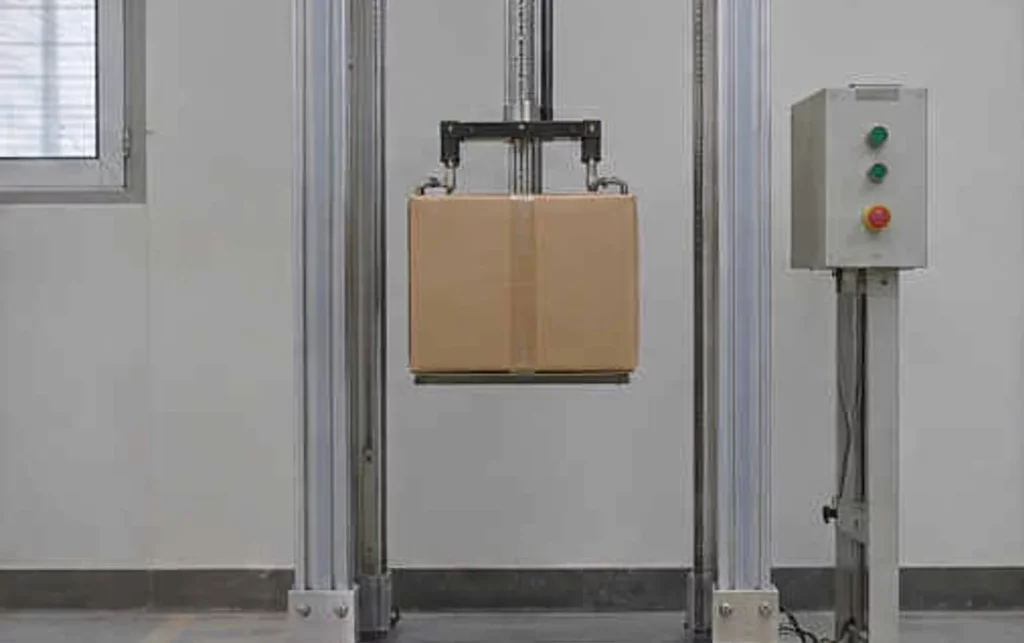
Our transit breakage in 2025 was 0.21%, with five-ply cartons drop-tested from 1.2 m to ISTA 1A and 3A. On 5,000 mugs, that means planning for about 10 broken pieces. At the other end, a gift buyer who came to us after a trial order elsewhere had seen breakage of nearly 17% on 3,000 sets: about 510 sets, each with freight and duty already paid.
When you compare quotes, divide by sellable units, not ordered units:
Landed cost per sellable unit = total landed cost ÷ (units ordered × (1 − breakage rate))
A worked example on 10,000 pieces
Take an order of 10,000 mugs and compare three breakage rates against the same order arriving whole:
| Breakage | Sellable pieces | Cost per sellable piece, against no breakage |
|---|---|---|
| 0.21% | 9,979 | +0.2% |
| 1% | 9,900 | +1.0% |
| 3% | 9,700 | +3.1% |
Going from 0.21% to 3% breakage adds about 3% to the cost of every sellable piece, before counting the time spent on claims, replacement shipments and customers who received a broken piece. A supplier quoting a few percent less with weaker packing has not saved you anything.
Compliance costs arrive at the border
Testing is cheap next to goods held at customs. A food-contact report for the right market, covering the right SKUs, costs far less than demurrage, inspection fees and a missed sales window.
The same buyer’s trial order arrived without food-contact test reports, so the local distributor’s goods were held at customs, with demurrage and inspection fees on top of the breakage. Their tally: USD 3,300 saved on the unit price, about USD 12,800 lost. That is a saving of USD 1.10 a set against losses of roughly USD 4.27 a set, before the penalty their own customer charged for late delivery.
Before you order, ask which test report covers each SKU and decoration, for which market, and when it was issued. Our guide to food-contact testing by country explains what to check on the report itself.
Time has a price too
A cheaper order that arrives four weeks late can cost more than a dearer one that arrives on time, especially for seasonal goods. Three dates decide it.
- When the clock starts. Our lead times count from deposit and signed artwork: 25–30 days for an existing model, 35–40 for your decal, 45–55 for a new mold.
- Peak season. July to October adds 7–10 days at our factory, because every holiday programme is in production at once.
- Transit. About 16–20 days to the US West Coast, 30–34 to the East Coast, 28–33 to Northern Europe, and 18–22 door to door by rail to Europe.
Our on-time rate in 2025 was 96.8% of orders. Ask any supplier for the same figure, and for how it is measured.
What peak season does to the calendar
Between July and October our lead times rise by 7–10 days, because the kilns are full with Christmas and holiday orders. A buyer who plans as if it were March can lose two weeks without anything going wrong. Put the season into the cost sheet as a date, not as a line: write the shelf date first and work back, with production, inspection, loading and transit each given its own row.
A missed date in the holiday season
An order meant for a November promotion that lands in December is often sold at a markdown, or held until the next year with storage costs. Neither shows up in the unit price, and both are larger than the difference between two quotes.
A missed date for a hotel opening
A hotel that opens without its full set of plates borrows, rents or buys stock at short notice, usually at retail prices. For hotel and project orders, our lead time is 30–40 days; plan the order back from the opening date with transit and customs added.
The Incoterm decides which lines are in the quote
The Incoterm decides which of the lines above sit inside the price you are quoted and which you pay separately.
| Term | The supplier covers | You handle |
|---|---|---|
| EXW | Goods ready at the factory | Everything from the factory gate |
| FOB Ningbo, Shanghai or Yantian | Goods loaded on the ship | Ocean freight, insurance, import, delivery |
| CIF | Freight and insurance to your port | Import clearance, duty, delivery |
| DDP (US, Canada, EU) | Delivery to your door, duty paid | Unloading |
FOB is the usual choice for importers who already have a forwarder. DDP suits buyers without one, or smaller orders where coordinating several parties costs more than it saves. Our shipping and trade terms list the ports and documents, and the guide to shipping ceramics from China covers the mistakes that cause holds and claims.
Payment terms are a cost too
When you pay changes what an order costs you, because money paid early is money not working elsewhere. On our standard terms, 30% is paid at order and 70% against a copy of the bill of lading, so the deposit is out of your account for the production time plus loading. On a first order with a new mold, that can be two months or more.
Forward stock in Los Angeles or Toronto, for North American programmes, shortens the time between payment and sale.
A landed-cost sheet you can copy
This is the sheet we would fill in for a buyer, line by line. Each row says where the number comes from.
| Line | Where the number comes from |
|---|---|
| Unit price | The quote, per piece, for the exact version |
| Setup fees | The quote, as separate lines, with refund conditions |
| Packaging | The quote; colour box and gift box priced per piece |
| Inland transport to port | Included in FOB; separate under EXW |
| Sea freight | Your forwarder’s container price ÷ pieces per container |
| Insurance | 110% of invoice value under CIF, or your own policy |
| Duty | Your customs broker, from the HS code and origin certificate |
| Import clearance and delivery | Your broker and forwarder |
| Testing | The supplier’s existing reports, or the cost of new tests for new versions |
| Breakage allowance | Divide by sellable pieces, using the supplier’s breakage rate |
Ask each supplier for the same inputs
To fill the sheet, every supplier needs to give you the same five numbers per SKU: pieces per carton, carton size, CBM per carton, pieces per 40HQ and unit weight. Our product pages carry these for every model. A supplier who cannot give them has not packed the product yet, and its freight is a guess.
How to compare two quotes in one sheet
Put both suppliers in one sheet, with a row for each line in the first table and a column per supplier. Fill in what each quote includes, ask for what is missing, and finish with landed cost per sellable unit. If one supplier leaves a row blank, that cost has not gone away. It has moved to you.
We are rarely the lowest unit price, and we don’t try to be. We try to be the lowest number at the bottom of that sheet. If you want to run it on one of our models, send us the model, quantity and destination and we will fill in our column. For the full order sequence, from first inquiry to loaded container, start with our guide to sourcing ceramic dinnerware from China.