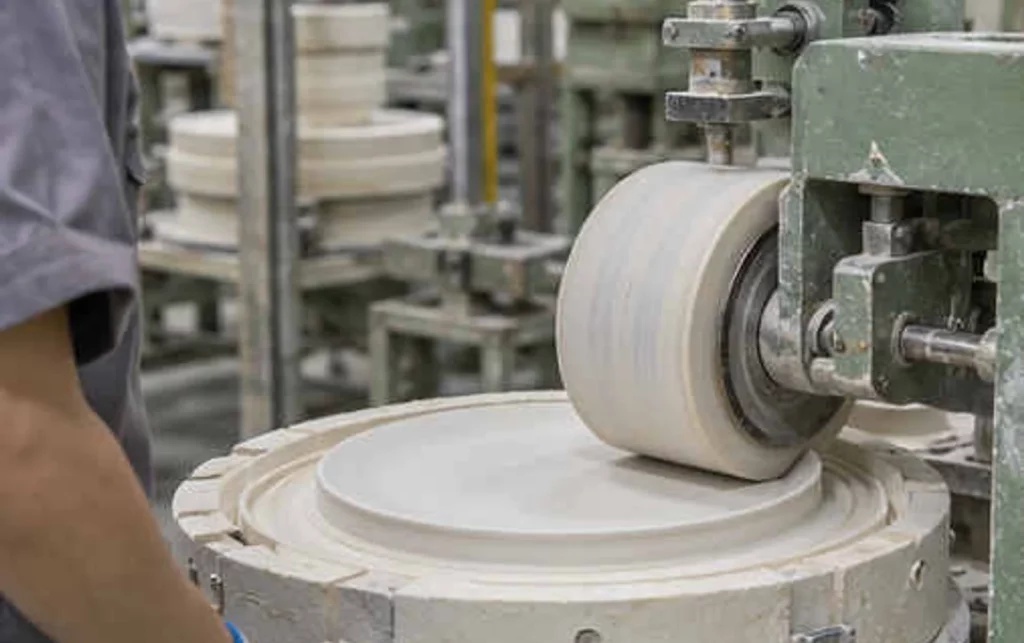
A new ceramic mold at our factory takes 12–15 days for the model and 15–20 days for the production molds. The order that follows starts at 3,000 pieces per model, and once you have paid for the tooling, the molds are yours. That is most of what a buyer needs to know before tooling a new plate, mug or bottle.
The rest is clearing up what buyers are often told, by suppliers who either do not make their own molds or would rather you did not ask. Here are five claims we hear, and what actually happens on our lines.
Myth 1: “A new mold takes months”
It takes weeks: 12–15 days for the model and 15–20 days for the production molds, inside a total of 45–55 working days from deposit and signed artwork to finished goods for a new shape. Months usually means the supplier sends the mold work out, or that nobody has agreed what the shape is.
Here is the sequence for a new shape at our factory:
| Step | Time | What you approve |
|---|---|---|
| 3D-printed prototype | 3 days | Size, proportion, handle, stacking |
| Model (master) for the mold | 12–15 days | The form, with firing shrinkage built in |
| Production molds | 15–20 days | Nothing new; molds are trialed in-house |
| Glazed sample, fired in our electric sample kilns | Part of sampling | Colour, weight, finish |
| Production | 45–55 working days in total for a new-mold order | The approved sample is the standard |
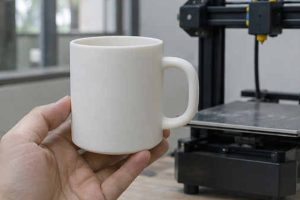
The step that slips is the first one. A shape that is changed after the model is made means a second model. That is why we print a prototype in 3 days, charged at cost, before anyone makes a master. Our 3D printing ceramics guide covers what a printed prototype can and cannot tell you.
The new-shape timeline, stage by stage
| Stage | Time | What you approve |
|---|---|---|
| 3D printed prototype (optional) | 3 days, charged at cost | Proportions, grip, how it sits on a table |
| Master model | 12–15 days | The shape that every mold will be cast from |
| Production molds | 15–20 days | Nothing new; this is our work |
| Glazed sample, fired in an electric sample kiln | Within the mold stage | Glaze, weight, finish |
| Bulk production of a new shape | 45–55 days in total from deposit and signed drawing | The signed sample is the standard |
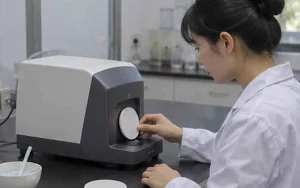
The sample kilns are small electric kilns that fire 60–120 pieces at 1,280 °C, so a sample can be made without waiting for space in a tunnel kiln. That keeps the sample stage inside the mold stage instead of adding to it.
What slows a new shape down
Almost always, a change after the master model is approved. A new handle angle or a different rim height means a new model and new molds, and the clock goes back to the model stage. If you are not sure about proportions, use a printed prototype first. It takes three days and is charged at cost, against two to three weeks for a remade model.
Myth 2: “The factory keeps the mold”
Not here. A mold made for your shape belongs to you, and so do the decal plates and box artwork made for your range. We keep them on file, so a reorder reuses the same molds and runs on the standard lead time instead of the new-mold one.
Put ownership in writing either way, with three lines in the purchase contract:
- the molds, models and decal plates made for the order belong to the buyer;
- the factory will not make that shape for anyone else;
- the factory keeps them on file for reorders, and what happens to them if you move production.
The second line matters more than the first. A mold you own but cannot stop being used for someone else’s order is a mold you have paid for twice. On one of our existing models the situation is different: the mold is ours, there is no mold charge, and the shape is not exclusive to you.
What a mold costs, and what moves the price
A new mold set is charged as a one-off fee, and the fee is refunded once the order for that shape reaches 3,000 pieces. The fee depends on how many parts the mold needs: a plate needs fewer than a teapot with a lid, a spout and a handle.
- Lower end: simple round shapes that form in one piece, such as a plate or an open bowl.
- Middle: shapes with a separately cast part, such as a mug handle attached after forming.
- Upper end: shapes with spouts, lids, undercuts or several joined parts, such as a teapot or a sculpted bottle.
Ask any supplier to quote the mold separately from the product, with the quantity at which the fee is refunded. A mold cost hidden in the unit price disappears from view but not from the invoice.
Molds kept on file between orders
Owning the mold matters most at the reorder. We keep every customer mold, the master model and the signed sample on file, so a reorder runs from the same tools as the first order. That is how a range ordered every quarter keeps the same size and weight year after year.
Myth 3: “One mold makes the whole order”
A production run uses many working molds, all cast from one master. Plaster molds absorb water from the clay and wear with use, so a factory making thousands of pieces a day needs a set of identical molds in rotation, not a single tool.
What keeps the 3,000th plate the same as the first is control of those molds and of the forming line:
| Check | Our limit | When |
|---|---|---|
| Plaster mold dimensions and surface | ±0.3 mm | Incoming inspection, every mold |
| Wall thickness | ±0.4 mm | In-process, recorded every 2 hours |
| Rim diameter | ±1.5 mm | Final inspection |
| Rim ovality | ≤1.5% | Final inspection |
| Plate warp | ≤1.2 mm | Final inspection |
Ask any supplier how it checks a mold before it goes on the line. If the answer is that the first pieces look fine, the check is happening after the defects are made.
How we check molds on the line
Plaster molds are checked when they arrive at the forming line, against the master, to a tolerance of ±0.3 mm. During production, forming dimensions, wall thickness and seams are recorded every two hours, and wall thickness is held to ±0.4 mm. When a mold starts to drift, the pieces show it before the eye does: weight creeps up or down. Our tolerance on single-piece weight is ±3%, and a piece outside it is sorted out and the mold is checked.
Why weight is the early warning
Weight is quick to measure on every piece and sensitive to small changes in the mold. A worn mold leaves a slightly thicker wall, which shows as a heavier piece long before the shape looks different. Ask a supplier for weight records across the run, not just for the sample.
Myth 4: “Any shape can go on any line”
The shape decides the forming route, and the route decides the mold. A plate, a mug and a bottle are not made the same way, and a supplier quoting you a new bottle needs the right line for it.
| Product | Forming route | Our equipment |
|---|---|---|
| Mugs | Roller forming | 8 roller lines |
| Coffee cups and saucers | Roller forming | 4 roller lines |
| Plates and dinner sets | Roller forming or isostatic pressing | 6 roller lines and 2 isostatic presses (280–320 bar) |
| Gaiwans and teapots | High-pressure casting | 6 high-pressure casting machines |
| Vases and ornaments | Slip casting | 3 slip-casting lines, 6 shuttle kilns |
| Liquor bottles and custom pieces | High-pressure casting | A separate special-shape mold line |
A few things follow from this. Very flat, thin plates are where isostatic pressing earns its place. Closed and hollow forms such as bottles are cast, not pressed. And a form with deep undercuts or a lattice may not come out of any mold at all; for those we print the ceramic piece directly. Tell us what the piece is, and we will tell you which route it takes before we model it.
Shrinkage is built into the model
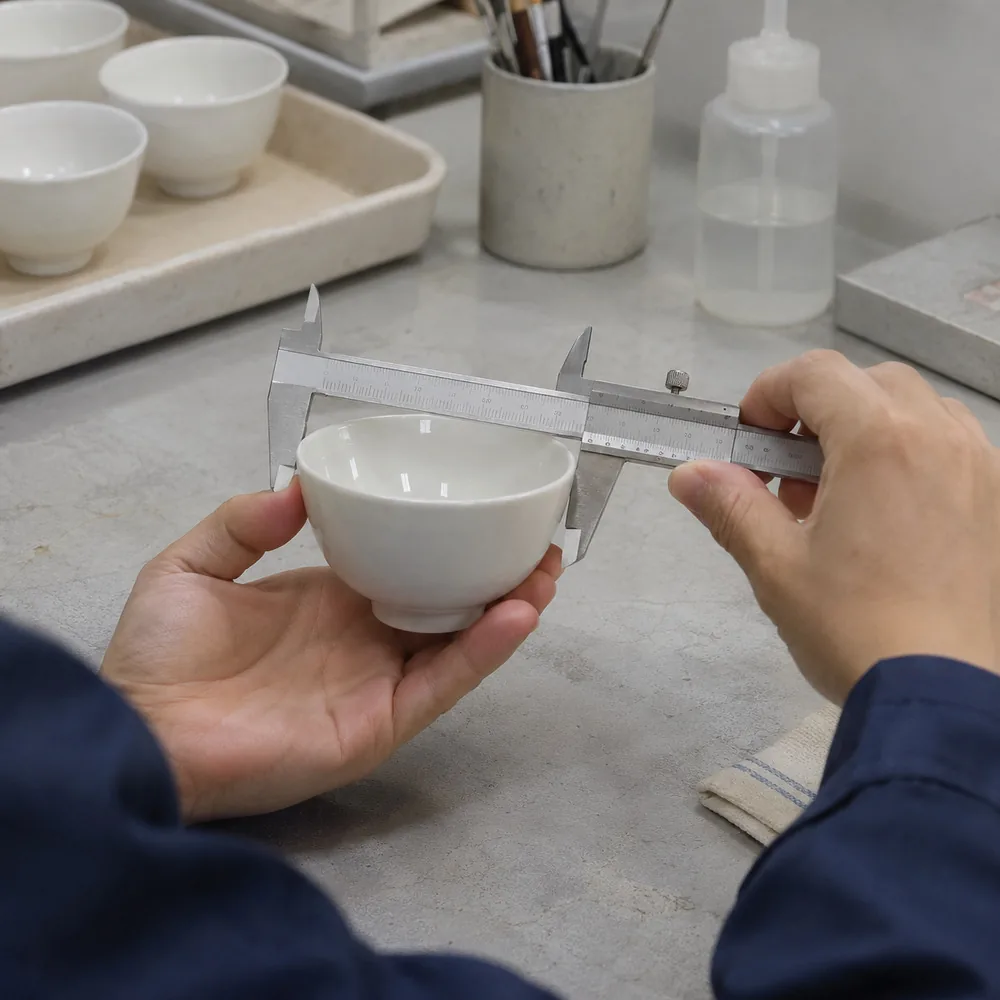
Porcelain shrinks as it dries and again as it fires, so a mold is always larger than the finished piece. The model maker scales the shape up to allow for it, and the allowance differs with the body and the shape. That is one reason a shape tooled for one factory’s clay rarely comes out the same size in another factory’s clay, even from the same mold drawings.
If you are moving an existing product to us, send a finished piece as well as the drawing. We tool to the piece you want on the shelf, not to the drawing alone.
Myth 5: “A new look needs a new mold”
Most new looks do not. We hold 3,800 molds across 12 shape families, and a new glaze or your decal on one of them starts at 1,000 pieces, with 7–10 days for the decoration setup and no mold work. A new mold only pays for itself at around 3,000 pieces per model.
So before you tool a shape, check three things:
- Is the shape the point? If customers will recognise the range by its glaze, pattern or logo, start from an existing mold.
- Can you mix? Many ranges combine our stock plates and bowls with one or two new shapes, so only the new pieces need molds.
- Will you reorder? A mold is worth most when it runs again. A one-off gift of 2,000 pieces is usually better on an existing shape with your decoration.
Our guide to dinnerware MOQs lays out every tier from 48 pieces to 5,000 per SKU, and underglaze vs overglaze covers which decoration methods hold up on food-contact surfaces.
Changes that do not need a mold
| What you want | What we change | Minimum |
|---|---|---|
| A new colour | Glaze | 1,000 pcs |
| Your own exclusive colour | Glaze recipe reserved for you; development fee | Refunded from 5,000 pcs |
| A logo or pattern | Decal, one printing plate per colour | 1,000 pcs one colour; 1,500 pcs multi-colour or gold |
| A permanent mark | Laser marking or underglaze logo plate | Fee refunded from 2,000 pcs |
| A gold or coloured rim | Gold line or in-glaze line | Ask with the quantity |
| A different set mix | Combine existing plates, bowls and mugs | 500 pcs per model |
A new mold makes sense when the shape itself is the product: a handle that is part of your brand, a size the market needs and nobody stocks, or a form that customers recognise without a logo.
Your mold, your design, your rights
A shape you pay to tool should be yours to use, and yours to protect.
What belongs to you
The mold, the master model and the decal plates made for your order belong to you, and we use them only for your orders. Artwork, box designs and revisions made for you belong to you as well. Put that in the purchase contract with the three lines above, so it is clear at the reorder and if you ever move production.
Protecting the shape
A distinctive shape can be registered as a design. We register our own: the BM-350 mug with its ribbed handle, the GW-160 Sancai gaiwan and our vase and figurine shapes are covered by Chinese design patents. If a shape you tool with us is important to your range, ask us for the final drawings and photos you need for your own registration.
What to send us to quote a new mold
Send a drawing, a photo, a sample or a 3D file, with what the piece is for, the quantity you plan to order and the market it will be sold in. We will tell you whether an existing mold gets you there, and if not, which forming route the shape takes and what the first order looks like.
You can send it through our prototyping page or the custom dinnerware page. If the mold is one step in a larger project, our guide to sourcing ceramic dinnerware from China puts it in order with samples, testing and inspection.