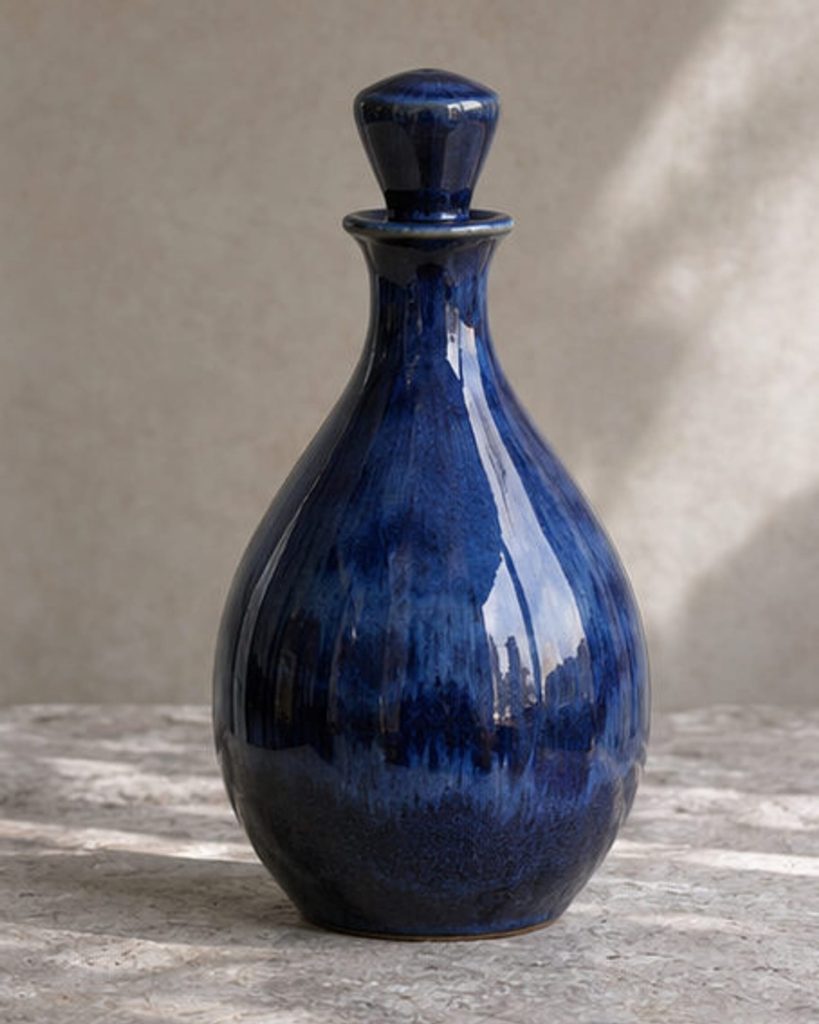
Bottle sizes we make
Our TB range covers three sizes; custom shapes start from your drawing.
| Model | Capacity and size | Weight | Per carton | Carton (cm) | Per 40HQ |
|---|
| TB-350 | 350 ml, Ø7.0 × 22 cm | 480 g | 30 | 46 × 31 × 28 | 41,490 |
| TB-500 | 500 ml, Ø7.6 × 26 cm | 620 g | 24 | 48 × 32 × 30 | 28,728 |
| TB-750 | 750 ml, Ø8.4 × 30 cm | 780 g | 18 | 48 × 34 × 32 | 19,026 |
Ceramic liquor bottles for spirits brands
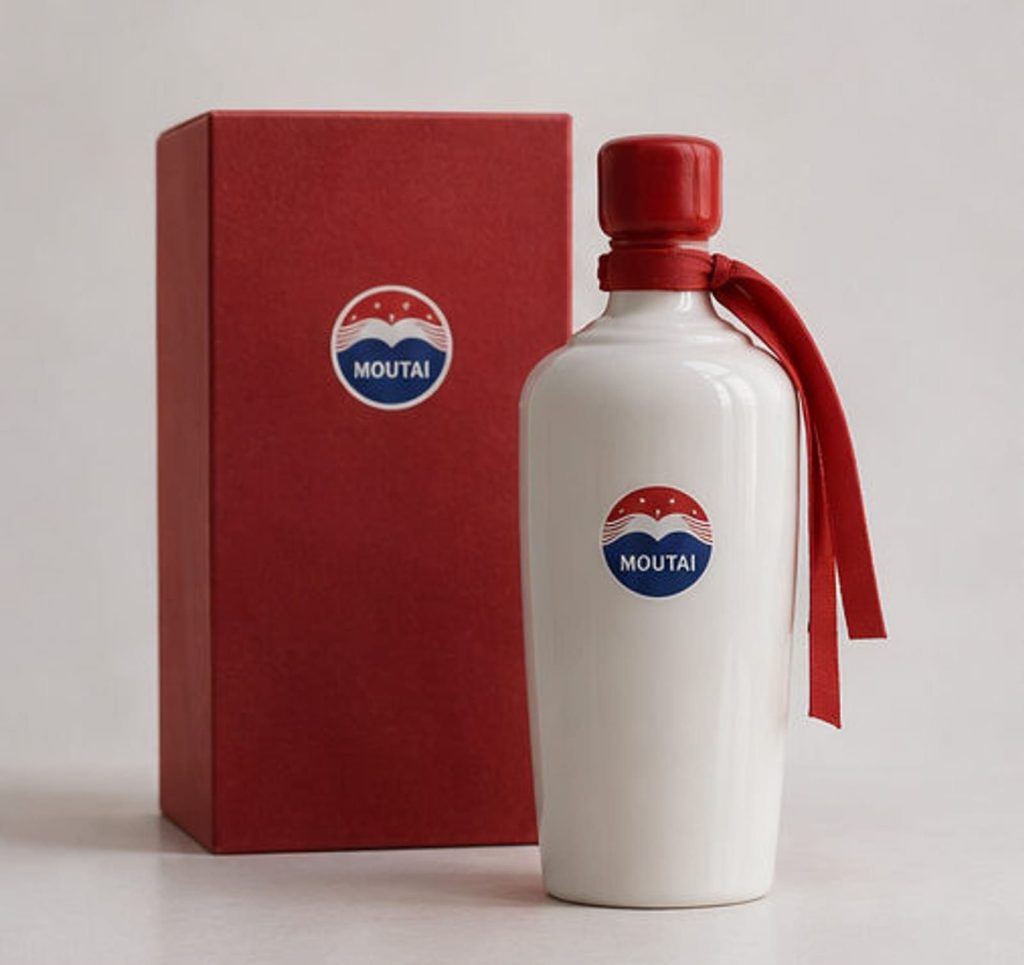
A ceramic bottle is a piece of packaging that has to behave like porcelain and like a container at once: a neck that takes the closure, a body that holds its glaze colour across thousands of pieces, and a carton that gets it to a bottling line unbroken. Our bottles are made on high-pressure casting and our special-shape mold line, with 600,000 pieces of capacity a year; Moutai is among the brands we have made for.
Glaze matched to your Pantone starts at 1,000 pieces on our 350, 500 and 750 ml shapes; a bottle in your own shape starts at 3,000 pieces, with the model in 12 to 15 days and the molds in 15 to 20. We suggest starting with a 3D-printed prototype so the closure and label area can be checked before any mold is cut.
Read next: Ceramic bottles · Ceramic prototyping · 3D printing ceramics
Decoration, closures and labels on a bottle
Spirits bottles are decorated more heavily than tableware because they sit on a shelf, not on a table. Coloured glazes, gold and fired decals are all used; because a bottle never holds food at the rim, gold and overglaze colour can go where they would not on a cup. The neck is the critical dimension: it has to take your stopper or cap, so we fix it on the prototype and check it on every batch. Paper labels and wraps go on after firing.
How bottles are made
A bottle is a closed, hollow form with a narrow neck, so roller lines cannot make it. We cast bottles on 6 high-pressure casting machines with a dedicated mold line for special shapes, and fire tall or irregular pieces in tunnel kiln 4#, which runs at 1,260–1,300 °C for large pieces and second glaze firings. Capacity is 600,000 bottles and custom pieces a year, and we delivered 520,000 in 2025.
Decorating a bottle
| Method | Where it sits | Notes |
|---|
| Underglaze | Under the glaze, fired at 1,260–1,320 °C | The most durable option |
| Colour glazes | The whole body | Exclusive colours developed in 20 days, held to ΔE 1.5 within a batch |
| Decal | On the glaze, fired at 780–850 °C | Detailed labels and multi-colour artwork |
| Gold line | On the glaze, fired at 780–850 °C | Necks, shoulders and lettering |
| Laser marking | Into the glaze or base | Batch codes and numbering; on C-04 a 15 W laser marked every base |
Packing bottles
Bottles ship in 5-ply cartons with molded pulp or EVA inserts; gift bottles can go into rigid boxes with fabric lining.
Read next: Shipping and trade terms
Who orders bottles
Spirits brands order bottles for gift editions and limited releases, often with a box. Gift companies order bottles inside gift sets. Both usually need decoration, sealing and packing approved together, so plan the bottle, the closure and the box at the same time.
Read next: Customer cases
Testing bottles
Bottles are tested for lead and cadmium release on our ICP-MS and held to half the legal limit. For bottles with closures we can run weight-loss and inversion tests; on C-04, 12 bottles lost 0.18% over 30 days at 20 °C, and none seeped when held upside down for 72 hours. Cartons are drop-tested at 1.2 m to ISTA 1A.
Bottle orders: the figures in brief
Minimums, tooling, routes and terms that apply to a ceramic bottle order.
| Topic | What applies here | Full details |
|---|
| Minimums and lead times | New colour or glaze: 1,000 pcs, 30–35 days; Custom decal, several colours or gold: 1,500 pcs, 35–40 days; New mold: 3,000 pcs, 45–55 days. | Shipping and trade terms |
| Production steps | 2 Forming: Roller forming, slip casting or isostatic pressing; wall thickness ±0.4 mm; 4 Glazing: Dip, spray or pour; glaze 0.25–0.35 mm thick, robot repeatability ±0.02 mm; 6 Firing: 1,260–1,320 °C, ±8 °C across the kiln, 9 thermocouples logged. | Factory |
| How an order runs | Samples: Samples and test data; Inspection: Inspection report; Shipping: Full document set and tracking. | Shipping and trade terms |
| Transit times | Northern Europe: 28–33 days; Middle East: 20–24 days; China–Europe rail: 36 hours to the Xi'an hub, 18–22 days door to door. | Shipping and trade terms |
| Tooling and samples | New mold: 12–15 days for the model, 15–20 days for the molds; Exclusive glaze colour: 20 days. | Samples and quotes |
| Trade terms | Incoterms: EXW, FOB Ningbo, FOB Shanghai, FOB Yantian, CIF, CFR; DDP to the US, Canada and the EU; Inspection: AQL 2.5 by default, 1.5 on request; major 2.5, minor 4.0. | Shipping and trade terms |
| Lab tests | ICP-MS (Agilent 7900): Lead and cadmium release to FDA and LFGB methods; Whiteness and absorption: Whiteness meter, vacuum water-absorption rig. | Quality control |